
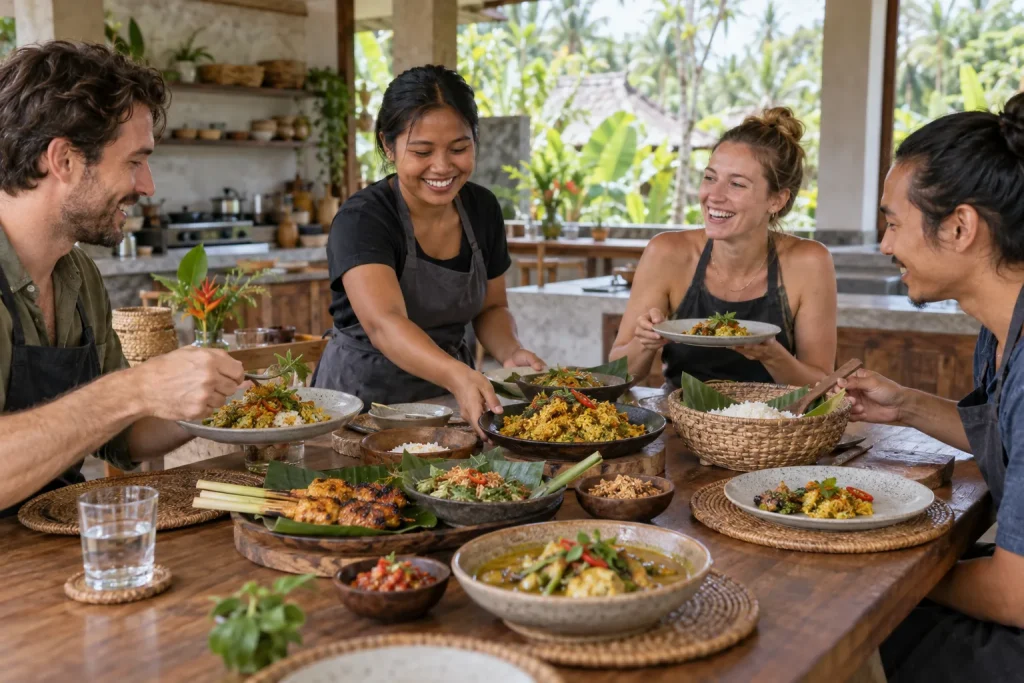
Shared table cooking in Ubud can mean different things. This guide is about one specific private class: its service page describes a curated cooking-and-dining experience inspired by Megibung, and says it is not a ceremonial reenactment. The wider Cooking Class Ubud offer helps you compare formats; the live megibung cooking class ubud page carries the current details. When examining shared table cooking in ubud in the context of everyday kitchen work and guest planning in Gianyar and Ubud, separating specific ingredient names, preparation timing, and household customs prevents common misunderstandings before you shop or cook.
One group, one meal to prepare
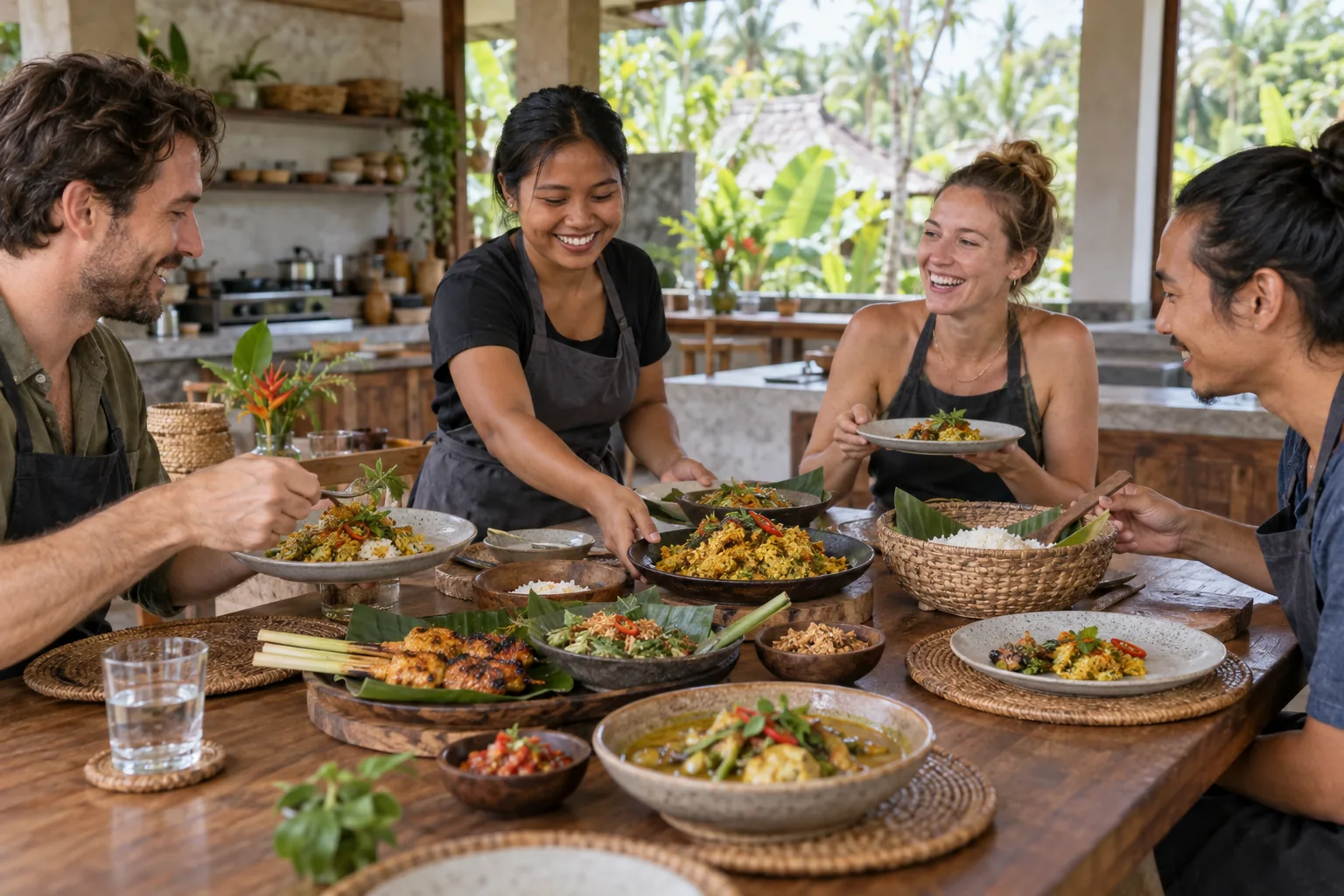
The class is arranged for a private booking group. Guests work on selected parts of a curated meal, bring those parts together, and eat at a shared table. That gives the session one common direction. It does not mean a traveler joins a public community gathering or enters an official cultural event.
Megibung is the inspiration, not a promise of reenactment
The shared-table idea is useful when the group wants to cook and eat as one party. If each person wants to choose a separate set of dishes, compare that preference with the other formats listed on the homepage before booking.
Check the menu and practical details before the date
Megibung has a cultural context in Karangasem, including community practices that are more specific than simply placing food on a table. The current Ubud class presents itself as inspired by the tradition, not as an official ceremony or a complete representation of every local practice. Keeping those ideas separate helps set respectful, accurate expectations.
Decide whether the format matches your group
The class-versus-ceremony guide below sets out that boundary in practical terms. The service owner remains the source for what this particular booking includes.
Explore the practical guides
The menu is curated rather than built by choosing dishes from a full list. Ask what the group is expected to prepare on your date, which ingredients are involved, and whether a requested substitution can be confirmed. Do this before relying on a photograph or an example from another visit.
Timing is arranged with the host. Ubud pickup and return are listed on the service page; transport from outside Ubud is quoted by location. Send the date, guest count, dietary needs and pickup area together so the reply can cover the whole plan. The dietary and timing guides below cover those questions separately.
Choose this kind of class when your group values a shared cooking sequence and one meal to sit down to afterward. It may be a weaker fit when menu choice is the main priority or when the group wants separate dishes and separate eating plans. The class comparison and audience-fit guides below can help with that choice.
Check the service page before you reserve because menus, transport details and availability can change.
Use these guides to settle the questions that matter to your group, then confirm the date-specific plan on the service page.
Choose the question that matters most to your group:
How Shared Table Cooking in Ubud: A Megibung-Inspired Class Connects Market Observation, Kitchen Technique, and Practical Planning in Ubud
For travellers and home cooks researching shared table cooking in ubud, the biggest gap in general travel guides is that they treat Balinese food and daily life as a single uniform checklist rather than a living household system. In a traditional Balinese compound around Ubud, decisions about ingredients, prep sequence, and table pairing depend on whether a meal is prepared for a quiet family lunch, a morning market run, or a shared gathering. When you join an Ubud Cooking Class at Wayan’s Paon, every question around shared table cooking in ubud is answered through direct hands-on observation rather than abstract theory.
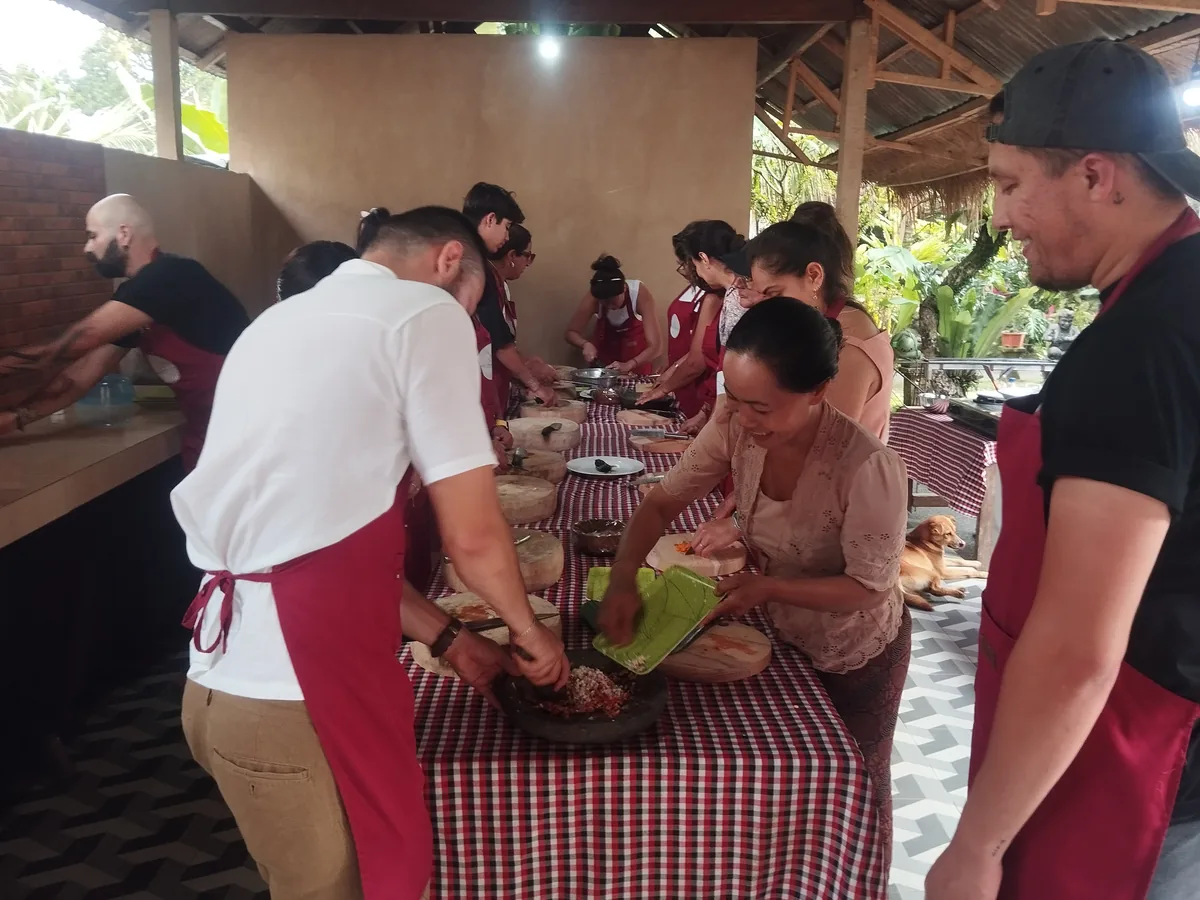
A second practical principle when evaluating shared table cooking in ubud is recognizing the boundary between what happens at the morning produce stalls, what happens at the stone mortar (ulekan), and how the final dishes are balanced on the plate. In our private sessions such as Megibung Cooking Class, your group works only with your own booking party and selects up to five dishes from the 53-dish menu (plus the foundational Base Genep spice paste), allowing you to test how each choice affects flavour, texture, and timing.
Comparative Reference Matrix: 10 Core Dimensions of Shared Table Cooking In Ubud
Before diving into each specialized subtopic in this family of guides, the table below summarizes how the ten focused questions around shared table cooking in ubud differ in scope, practical kitchen impact, and what you should verify before buying ingredients or confirming a menu in Ubud:
| Focus Topic / Keyword Owner | Specific Question Addressed | Key Practical Distinction in Ubud |
|---|---|---|
| 1. megibung class in ubud | Booking a Megibung Class in Ubud: What to Confirm | A Ubud Cooking Class search may show several kinds of cooking experience, so start by checking the details of the specific Megibung-inspired… |
| 2. megibung fixed menu format | The Megibung Fixed Menu Format: One Menu, One Table | The megibung cooking class ubud page describes one curated meal for a private group. That makes the cooking classes ubud experience a differ… |
| 3. private megibung cooking class | A Private Megibung Cooking Class in Ubud for Your Group | The current offer is listed as a private booking, so the cooking group is the people on your reservation rather than unrelated guests joinin… |
| 4. megibung class and ceremony | Megibung Class and Ceremony: Understanding the Difference | A Megibung-inspired cooking session can introduce a shared meal, but it should not be mistaken for a community ceremony. The megibung cookin… |
| 5. megibung vs choose your menu | Megibung vs Choose Your Menu Cooking Class in Ubud | The choice between megibung cooking class ubud and another cooking classes ubud class starts with how you want to choose the food. The Megib… |
| 6. megibung class dietary requests | Megibung Class Dietary Requests: What to Confirm | The megibung cooking class ubud page asks guests to share dietary needs in advance so the host can confirm whether a substitution fits the c… |
| 7. megibung cooking class experience | Megibung Cooking Class Experience: From Prep to Meal | The live megibung cooking class ubud page describes a hands-on session built around cooking and dining together. If you are comparing cookin… |
| 8. communal cooking class in ubud | Communal Cooking Class in Ubud: Is It Right for Your Group? | A Ubud Cooking Class class can be private to your booking and still center on communal cooking and dining. The Megibung-inspired offer is ar… |
| 9. megibung class menu questions | Megibung Class Menu Questions to Ask Before Booking | The megibung cooking class ubud page describes a curated menu but does not publish a complete dish list for every date. Use the Cooking Clas… |
| 10. megibung cooking class timing | Megibung Cooking Class Timing: Plan the Rest of Your Ubud Day | The public megibung cooking class ubud details say that timing is arranged with the host. That is useful to know before you plan the rest of… |
Deep-Dive Guide to the 10 Specialized Subtopics Within Shared Table Cooking In Ubud
Each of the ten companion articles in this topic family isolates one specific decision or ingredient question related to shared table cooking in ubud so that you never confuse a broad category label with a concrete culinary rule. Below is how each specialized guide fits into the wider picture:
1. Booking a Megibung Class in Ubud: What to Confirm
When narrowing your focus from shared table cooking in ubud to the specific question of megibung class in ubud, the primary distinction is context and practical application. A Ubud Cooking Class search may show several kinds of cooking experience, so start by checking the details of the specific Megibung-inspired offer. The live megibung cooking class ubud page describes a private group, a curated shared meal and timing arranged with the host. By keeping this specific scope distinct from neighbouring topics, you avoid applying a general rule where a precise ingredient check or timing adjustment is required.
In practice at the market or in the paon, Availability and the price depend on the booking details shown by the host, so send your intended date and the number of guests before planning around a particular slot. The page lists private group price bands, but confirm the current total and what it covers rather than relying on an old screenshot or a previous quote. Whether you are comparing options before booking your private session or taking notes to cook at home after your trip, treating megibung class in ubud as its own step ensures your preparation remains accurate and stress-free.
2. The Megibung Fixed Menu Format: One Menu, One Table
When narrowing your focus from shared table cooking in ubud to the specific question of megibung fixed menu format, the primary distinction is context and practical application. The megibung cooking class ubud page describes one curated meal for a private group. That makes the cooking classes ubud experience a different choice from a class where guests select separate dishes; the main question is whether one shared plan suits the way your group wants to cook. By keeping this specific scope distinct from neighbouring topics, you avoid applying a general rule where a precise ingredient check or timing adjustment is required.
In practice at the market or in the paon, A fixed or curated menu gives the session a shared direction. Guests are not choosing unrelated dishes from a large catalogue and then cooking separate lessons side by side. The group prepares components of one planned meal, arranges the food together and shares it afterward. Whether you are comparing options before booking your private session or taking notes to cook at home after your trip, treating megibung fixed menu format as its own step ensures your preparation remains accurate and stress-free.
3. A Private Megibung Cooking Class in Ubud for Your Group
When narrowing your focus from shared table cooking in ubud to the specific question of private megibung cooking class, the primary distinction is context and practical application. The current offer is listed as a private booking, so the cooking group is the people on your reservation rather than unrelated guests joining the same table. Compare it with other Cooking Class Ubud formats and use the live megibung cooking class ubud page to check the current booking terms. By keeping this specific scope distinct from neighbouring topics, you avoid applying a general rule where a precise ingredient check or timing adjustment is required.
In practice at the market or in the paon, The private format is useful when friends or family want to take the class as their own group. The page describes cooking and dining together around a curated meal; it does not describe a public drop-in session. Confirm the final guest count with the host so the price and setup match the party you are bringing. Whether you are comparing options before booking your private session or taking notes to cook at home after your trip, treating private megibung cooking class as its own step ensures your preparation remains accurate and stress-free.
4. Megibung Class and Ceremony: Understanding the Difference
When narrowing your focus from shared table cooking in ubud to the specific question of megibung class and ceremony, the primary distinction is context and practical application. A Megibung-inspired cooking session can introduce a shared meal, but it should not be mistaken for a community ceremony. The megibung cooking class ubud page makes that distinction clear. For a visitor-friendly overview of the class itself, begin with the Ubud Cooking Class experience list and shared table cooking in ubud. By keeping this specific scope distinct from neighbouring topics, you avoid applying a general rule where a precise ingredient check or timing adjustment is required.
In practice at the market or in the paon, Megibung is associated with Karangasem and has a cultural life beyond the act of eating together. Official Karangasem cultural and tourism accounts describe community contexts, shared food and practices that are particular to the tradition. Those accounts also show why it would be careless to reduce Megibung to a decorative meal or a generic Bali custom. Whether you are comparing options before booking your private session or taking notes to cook at home after your trip, treating megibung class and ceremony as its own step ensures your preparation remains accurate and stress-free.
5. Megibung vs Choose Your Menu Cooking Class in Ubud
When narrowing your focus from shared table cooking in ubud to the specific question of megibung vs choose your menu, the primary distinction is context and practical application. The choice between megibung cooking class ubud and another cooking classes ubud class starts with how you want to choose the food. The Megibung-inspired offer follows one curated menu for the group; a choose-your-menu format may suit people who want to select particular dishes, if that option is available on their date. By keeping this specific scope distinct from neighbouring topics, you avoid applying a general rule where a precise ingredient check or timing adjustment is required.
In practice at the market or in the paon, A curated menu links the cooking tasks to one meal. Guests work on components, arrange them together and eat at the same table. This suits a group that likes one plan and wants to see how the separate parts become a meal. Whether you are comparing options before booking your private session or taking notes to cook at home after your trip, treating megibung vs choose your menu as its own step ensures your preparation remains accurate and stress-free.
6. Megibung Class Dietary Requests: What to Confirm
When narrowing your focus from shared table cooking in ubud to the specific question of megibung class dietary requests, the primary distinction is context and practical application. The megibung cooking class ubud page asks guests to share dietary needs in advance so the host can confirm whether a substitution fits the curated menu. Before booking, compare that shared-menu format with the wider Cooking Class Ubud options and send the details clearly. By keeping this specific scope distinct from neighbouring topics, you avoid applying a general rule where a precise ingredient check or timing adjustment is required.
In practice at the market or in the paon, Tell the host what you avoid and why it matters. A preference, an intolerance and a serious allergy may require different handling. Name ingredients you must avoid, say whether cross-contact is a concern, and explain whether the restriction applies to one guest or the whole group. Whether you are comparing options before booking your private session or taking notes to cook at home after your trip, treating megibung class dietary requests as its own step ensures your preparation remains accurate and stress-free.
7. Megibung Cooking Class Experience: From Prep to Meal
When narrowing your focus from shared table cooking in ubud to the specific question of megibung cooking class experience, the primary distinction is context and practical application. The live megibung cooking class ubud page describes a hands-on session built around cooking and dining together. If you are comparing cooking classes ubud options, this one follows the meal from preparation to the shared table rather than focusing only on a finished dish. By keeping this specific scope distinct from neighbouring topics, you avoid applying a general rule where a precise ingredient check or timing adjustment is required.
In practice at the market or in the paon, The host curates the meal, so the exact ingredient list and tasks should be confirmed for your date. Ask what the group will cook and which parts guests will handle. That keeps expectations tied to the actual menu instead of to a photograph or a different Megibung-inspired experience. Whether you are comparing options before booking your private session or taking notes to cook at home after your trip, treating megibung cooking class experience as its own step ensures your preparation remains accurate and stress-free.
8. Communal Cooking Class in Ubud: Is It Right for Your Group?
When narrowing your focus from shared table cooking in ubud to the specific question of communal cooking class in ubud, the primary distinction is context and practical application. A Ubud Cooking Class class can be private to your booking and still center on communal cooking and dining. The Megibung-inspired offer is arranged for one group, with a curated meal; check the live megibung cooking class ubud page before deciding whether that rhythm fits your party. By keeping this specific scope distinct from neighbouring topics, you avoid applying a general rule where a precise ingredient check or timing adjustment is required.
In practice at the market or in the paon, This format is a natural candidate when the group wants to prepare parts of one meal and sit down to share it. People do not need to choose separate recipes to take part. The private booking keeps the experience focused on the people you reserved with, while the meal itself is shared across the group. Whether you are comparing options before booking your private session or taking notes to cook at home after your trip, treating communal cooking class in ubud as its own step ensures your preparation remains accurate and stress-free.
9. Megibung Class Menu Questions to Ask Before Booking
When narrowing your focus from shared table cooking in ubud to the specific question of megibung class menu questions, the primary distinction is context and practical application. The megibung cooking class ubud page describes a curated menu but does not publish a complete dish list for every date. Use the Cooking Class Ubud page to compare experiences, then ask the host the practical menu questions below before relying on an example or image. When examining megibung class menu questions in the context of everyday kitchen work and guest planning in Gianyar and Ubud, separating specific ingredient names, preparation timing, and household customs prevents common misunderstandings before you shop or cook. By keeping this specific scope distinct from neighbouring topics, you avoid applying a general rule where a precise ingredient check or timing adjustment is required.
In practice at the market or in the paon, Start with the names of the dishes planned for your booking and the main ingredients in each one. If a spice level, ingredient or preparation method matters to you, say so directly. The aim is to understand the meal the host has confirmed, not to infer it from a general description of Megibung. Whether you are comparing options before booking your private session or taking notes to cook at home after your trip, treating megibung class menu questions as its own step ensures your preparation remains accurate and stress-free.
10. Megibung Cooking Class Timing: Plan the Rest of Your Ubud Day
When narrowing your focus from shared table cooking in ubud to the specific question of megibung cooking class timing, the primary distinction is context and practical application. The public megibung cooking class ubud details say that timing is arranged with the host. That is useful to know before you plan the rest of your day around a Ubud Cooking Class experience built around both cooking and a shared meal. By keeping this specific scope distinct from neighbouring topics, you avoid applying a general rule where a precise ingredient check or timing adjustment is required.
In practice at the market or in the paon, The service page does not promise one standard duration for every booking. Ask for the start time and expected finish for your group and date. Leave room for the cooking sequence and the meal, rather than treating the class as a short demonstration with a fixed end time. Whether you are comparing options before booking your private session or taking notes to cook at home after your trip, treating megibung cooking class timing as its own step ensures your preparation remains accurate and stress-free.
How to Apply These Notes When Planning Your Private Cooking Day at Wayan’s Paon
Bringing all ten facets of shared table cooking in ubud together reveals a consistent lesson about Balinese culinary culture: clarity comes from asking specific questions before the cooking begins. In a private household setting in Ubud, your host does not rely on factory-made pastes or rigid group schedules. Instead, fresh roots (galangal, turmeric, ginger, and aromatic kencur), shallots, garlic, lemongrass, salam leaves, and kaffir lime are proportioned for the exact five dishes your group chooses to cook.
If you have dietary requirements—such as vegetarian or vegan preparation without fermented shrimp paste (terasi), gluten-free substitutions using pure rice flour and palm sugar (Gula Aren), dairy-free coconut milk infusions, or nut-free spice pastes omitting candlenut (kemiri)—discussing them when you select your menu allows the kitchen to prepare dedicated mortars, cutting boards, and filtered drinking-water washing stations in advance.
Finally, use this pillar overview on shared table cooking in ubud alongside the ten focused cluster guides linked above whenever you want to verify a local Balinese term, compare morning market timing against afternoon kitchen sessions, or adapt a traditional Ubud technique for your own stove at home.