
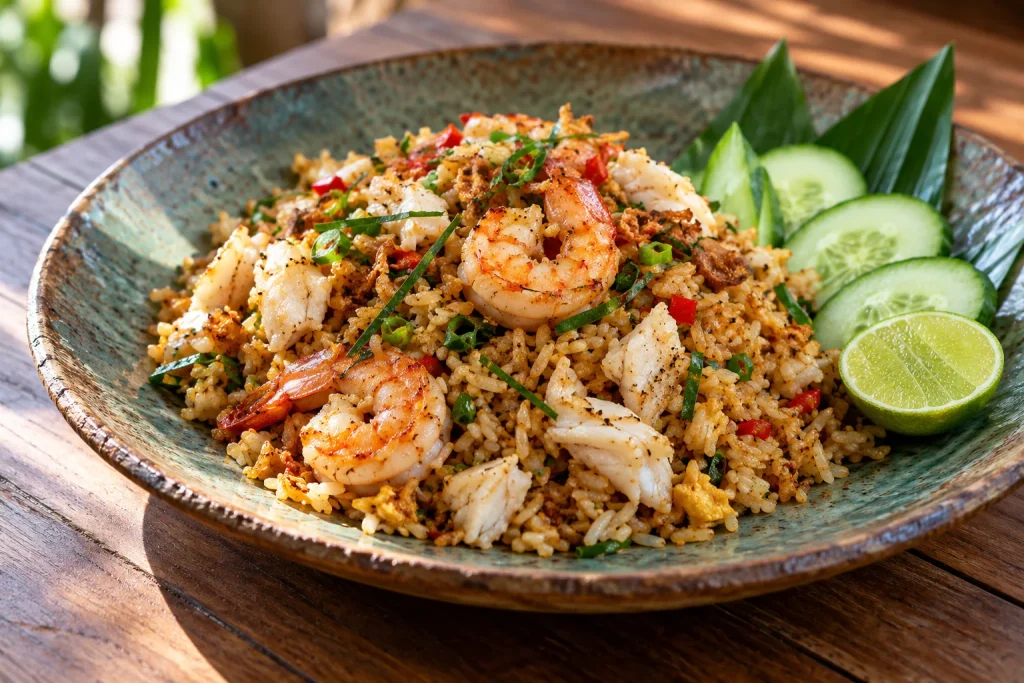
A seafood nasi goreng Bali recipe changes the order of work more than the spice paste. Prawns and fish release moisture and cook quickly, so they need room in the pan and should not be left under a long stir-fry. Keep the rice and aromatics ready before the seafood touches the heat.
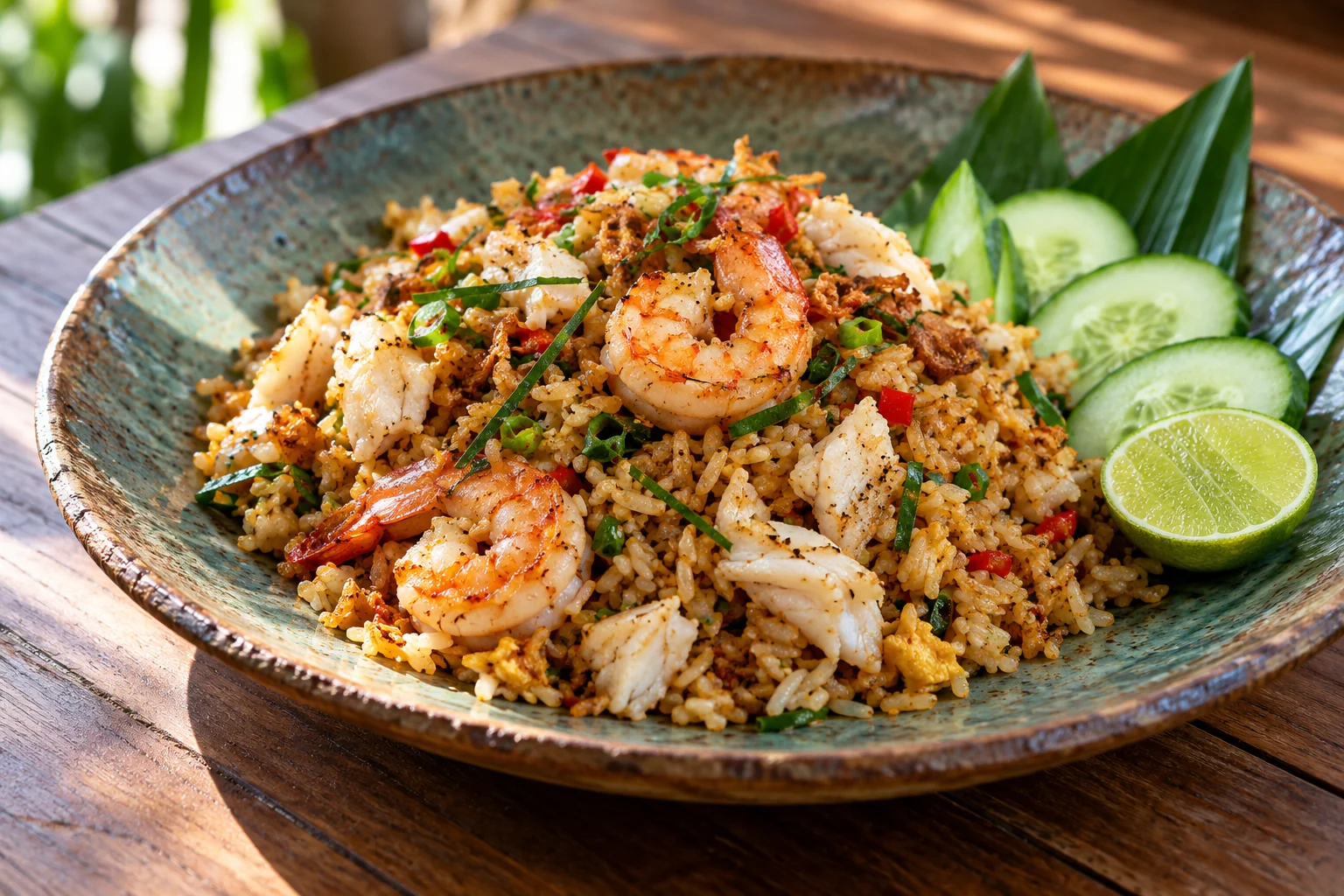
Dry the seafood and keep the batch small
Use a modest quantity of cleaned prawns, firm fish or a combination. Pat the seafood dry and cut fish into even pieces. Too much seafood in a small pan lowers the heat and lets liquid collect. If you are cooking a larger quantity, cook it in separate rounds or use a wider wok.
Cook the paste, then the seafood
Prepare the spice paste and loosen the cooked rice first. Keep raw seafood away from garnish and cooked ingredients. If seafood allergy matters at the table, use separate utensils and cooking surfaces rather than relying on the absence of visible pieces.
Choose a fresh, simple finish
Fry the paste, lemongrass and lime leaf until fragrant. Add prawns and turn them until nearly cooked, then lift them out while the rice fries. Firm fish can be cooked separately and returned at the end because it breaks more easily. Add the rice to the hot pan and toss until the grains are hot and no longer clumped.
Return the seafood for a brief final toss, just long enough to warm it through. Avoid adding watery sauce at this stage. If the dish tastes flat, adjust salt or lime at the table instead of pouring more liquid into the wok.
Cucumber, lime and a small sambal bowl let the seafood remain the centre of the plate. Keep chilli on the side when the diners prefer different heat levels. This is a flexible home variation; regional fried-rice recipes differ and this page does not imply that a particular cooking class serves seafood fried rice.
See current hands-on food experience information for Cooking Class Ubud.
How Seafood Nasi Goreng Bali Recipe Fits Into the Wider Nasi Goreng Bali Framework
When travellers and home cooks look closely at seafood nasi goreng bali recipe, the most helpful starting point is seeing where this specific topic sits inside our broader pillar guide on nasi goreng bali. While the parent overview maps out the full family of concepts, seafood nasi goreng bali: what changes in the pan? focuses specifically on the practical criteria, kitchen boundaries, and real-world observations that apply only to this narrower question.
Keeping seafood nasi goreng bali recipe distinct from general assumptions matters because small details—such as how an ingredient is named at a Gianyar morning market, how heat or moisture affects texture, or how timing is coordinated for a private group—change the outcome on the plate. Rather than relying on generic rules of thumb, evaluating the concrete factors behind seafood nasi goreng bali recipe gives you a reliable checklist you can use both in Bali and in your own kitchen at home.
Practical Kitchen Verification and Guest Planning for Seafood Nasi Goreng Bali Recipe in Ubud
In a traditional household compound in Ubud, questions surrounding seafood nasi goreng bali recipe are resolved through direct sensory checks and clear communication before cooking begins. During a private Cooking Class Ubud session with Wayan’s family, guests work exclusively with their own booking party, which means you can inspect every ingredient on the prep table, ask how local cooks judge ripeness, texture, or seasoning balance, and adjust the workflow to match your pace.
Choosing the right class format also helps you experience seafood nasi goreng bali recipe in the way that best matches your travel day. For instance, booking Private Paon Table allows your group to pair up to five confirmed Balinese dishes (alongside freshly pounded Base Genep spice paste) while discussing any dietary adaptations, spice-level preferences, or ingredient questions directly with Wayan before the wok or steamer is heated.
Decision & Observation Checklist for Seafood Nasi Goreng Bali Recipe
To help you apply the lessons of seafood nasi goreng bali recipe without guesswork, the reference table below breaks down the four practical checkpoints to verify at the market, at the prep table, during cooking, and when adapting the method at home:
| Stage of Preparation | What to Check for Seafood Nasi Goreng Bali Recipe | Why It Matters in a Balinese Paon |
|---|---|---|
| 1. Identification & Selection | Confirm the exact local name, variety, or session scope associated with seafood nasi goreng bali recipe rather than assuming a generic substitute works identically. | Prevents mixing up look-alike ingredients or mismatched schedule expectations before prep starts. |
| 2. Prep & Mortar Sequence | Separate components that require fine knife slicing (rajang), stone-mortar bruising (ulekan), or advance soaking/steaming. | Controls moisture release and aromatic oil extraction so textures stay crisp or tender as intended. |
| 3. Heat, Timing & Balance | Monitor visual and aromatic cues—colour change, steam aroma, and reduction thickness—while adjusting chili heat separately for your group. | Ensures every guest enjoys the full complexity of Balinese roots and herbs without overwhelming heat. |
| 4. Home Kitchen Adaptation | Record the functional role of each element in seafood nasi goreng bali recipe (acidity, starch structure, aromatic oil, or wrapping) before choosing a local equivalent at home. | Allows you to reproduce authentic Ubud flavours in Europe, North America, Australia, or East Asia. |
Comparing Seafood Nasi Goreng Bali Recipe with Related Questions in the Same Culinary Series
A frequent point of confusion when researching seafood nasi goreng bali recipe is where its boundary meets adjacent questions in the same topic family. If your next question shifts toward can you make nasi goreng bali without shrimp paste?, our companion guide on nasi goreng bali without shrimp paste addresses that specific angle directly so you can compare both side by side without conflating their rules.
Similarly, readers who want to connect seafood nasi goreng bali recipe with broader preparation choices often benefit from reviewing nasi goreng bali for two, which explores how complementary ingredients, equipment, or scheduling choices interact across a full five-dish Balinese menu.
Frequently Asked Questions About Seafood Nasi Goreng Bali Recipe
How do we confirm details about seafood nasi goreng bali recipe before our private cooking class in Ubud?
When you send your booking inquiry to Wayan’s Paon via WhatsApp or the booking page, simply mention your interest in seafood nasi goreng bali recipe along with your preferred date, session time (morning market class at 08:00, morning kitchen-only class at 10:00, or afternoon/dinner class at 17:00), group size, and Ubud pickup location. Wayan personally reviews every request so that ingredient availability, menu balance, and dietary preferences are confirmed clearly before you arrive.
Can seafood nasi goreng bali recipe be adapted for vegetarian, vegan, gluten-free, or allergy-conscious guests?
Yes. Because every session at Wayan’s Paon is 100% private for your group and all spice pastes are ground fresh from whole roots and herbs using filtered potable water, we easily adapt recipes related to seafood nasi goreng bali recipe to omit shrimp paste (terasi), candlenuts, peanuts, gluten, or animal products while keeping the authentic Balinese flavour profile intact.
What is the most important takeaway to write in your kitchen notes for seafood nasi goreng bali recipe?
Focus on function rather than memorising a rigid formula: note how seafood nasi goreng bali recipe contributes to aroma, texture, or timing in the dish, observe the visual cues Wayan demonstrates during prep, and keep the ingredient’s specific role separate from look-alike varieties when you shop at home.