

Fresh banana leaves for cooking are useful when you want a broad, flexible wrap, but frozen leaves can save a trip to the market and work well for many home recipes. The right choice depends less on a rule about authenticity and more on whether the leaf can fold around your filling without cracking. When examining fresh banana leaves for cooking in the context of everyday kitchen work and guest planning in Gianyar and Ubud, separating specific ingredient names, preparation timing, and household customs prevents common misunderstandings before you shop or cook.
What to look for in a fresh leaf
Choose a leaf with an even green colour and a surface that feels pliable rather than papery. Small marks do not automatically make it unusable; trim away bruised, dirty or torn sections and keep the sound middle. Very large leaves are convenient for broad parcels or lining a tray, while narrow pieces suit small portions. If the leaf feels stiff, do not force the first fold. A short warming step can make it easier to handle.
When frozen leaves make sense
Frozen banana leaves are convenient when fresh leaves are difficult to find or when you want to keep a small supply on hand. Let them thaw while still wrapped so the surface does not dry out. Separate the leaves only after they have softened. A leaf that has been frozen may look darker or feel damp; that alone does not mean it has gone bad. Check for off smells, heavy damage or a slimy surface, and discard anything that seems spoiled.
Match the leaf to the job
Do not try to fold a frozen or partly frozen leaf. Once thawed, wipe or rinse it, dry it gently and warm it briefly if it still resists bending. The goal is flexibility, not cooking the leaf. A small test fold at the edge tells you more than pressing hard across the centre.
For a large fish portion or several vegetables, fresh leaves can be easier to position because you can choose their shape at the market. For a weeknight parcel, a thawed section from the freezer is often enough. If you are making several bundles, prepare a few extra pieces; one may split or have a weak seam. Keep the filling amount modest so the wrap does not have to stretch.
For the wider method behind a leaf wrap, read banana leaf cooking. The main guide to recipes using banana leaves connects the ingredient choice with recipes and serving ideas. To practise the preparation with a local cook, the Cooking Class Ubud page shows the current Ubud class experience.
How Fresh or Frozen? Choosing Banana Leaves for Cooking Connects Market Observation, Kitchen Technique, and Practical Planning in Ubud
For travellers and home cooks researching fresh banana leaves for cooking, the biggest gap in general travel guides is that they treat Balinese food and daily life as a single uniform checklist rather than a living household system. In a traditional Balinese compound around Ubud, decisions about ingredients, prep sequence, and table pairing depend on whether a meal is prepared for a quiet family lunch, a morning market run, or a shared gathering. When you join an Ubud Cooking Class at Wayan’s Paon, every question around fresh banana leaves for cooking is answered through direct hands-on observation rather than abstract theory.
A second practical principle when evaluating fresh banana leaves for cooking is recognizing the boundary between what happens at the morning produce stalls, what happens at the stone mortar (ulekan), and how the final dishes are balanced on the plate. In our private sessions such as Market to Paon, your group works only with your own booking party and selects up to five dishes from the 53-dish menu (plus the foundational Base Genep spice paste), allowing you to test how each choice affects flavour, texture, and timing.
Comparative Reference Matrix: 10 Core Dimensions of Fresh Banana Leaves For Cooking
Before diving into each specialized subtopic in this family of guides, the table below summarizes how the ten focused questions around fresh banana leaves for cooking differ in scope, practical kitchen impact, and what you should verify before buying ingredients or confirming a menu in Ubud:
| Focus Topic / Keyword Owner | Specific Question Addressed | Key Practical Distinction in Ubud |
|---|---|---|
| 1. food cooked in banana leaves | What Gets Cooked in Banana Leaves around Bali? | Food cooked in banana leaves can mean several different things on a Balinese table. A leaf may hold seasoned fish, wrap a portion of chicken… |
| 2. serve food on banana leaves | When Banana Leaves Belong on the Plate, Not around the Food | Serve food on banana leaves when you want a natural-looking liner or a broad surface for a shared meal. The leaf can sit beneath rice, snack… |
| 3. store fresh banana leaves | How to Keep Fresh Banana Leaves Ready for Another Day | Store fresh banana leaves flat and protected from drying if you bought more than one recipe needs. A leaf that stays flexible is easier to u… |
| 4. recipes using banana leaves | Recipes Using Banana Leaves: A Balinese Home-Cook Guide | Recipes using banana leaves are easier to approach when you think about what the leaf is doing. It might wrap a filling for steaming, shield… |
| 5. warm banana leaves before cooking | A Quick Warm-Up Makes a Banana Leaf Easier to Fold | Warm banana leaves before cooking when the piece feels stiff or snaps at the first bend. Fresh leaves are not always equally flexible, and c… |
| 6. fold a banana leaf parcel | Fold a Banana-Leaf Parcel without Fighting the Leaf | Fold a banana leaf parcel after the filling and leaf are ready, not while you are still measuring ingredients. A little space at the edges m… |
| 7. grilling vegetables in banana leaves | Grilling Vegetables in Banana Leaves: What Works? | Grilling vegetables in banana leaves gives tender pieces some protection from direct contact with the grate. The wrap holds aromatics close … |
| 8. preparing banana leaves for cooking | How to Prepare Banana Leaves before They Reach the Pan | Preparing banana leaves for cooking takes only a few minutes once you know what to check. Start with a clean work surface and a leaf large e… |
| 9. pepes vs tum | Pepes or Tum? How Two Balinese Leaf Parcels Differ | Pepes vs tum is not a contest with one winner. Both names are associated with food wrapped in banana leaf, but the filling, parcel shape and… |
| 10. banana leaf wrap splitting | A Tear in the Leaf? Keep the Parcel from Opening | Banana leaf wrap splitting is frustrating, but a small tear does not always mean you need to start over. Most splits happen because a stiff … |
Deep-Dive Guide to the 10 Specialized Subtopics Within Fresh Banana Leaves For Cooking
Each of the ten companion articles in this topic family isolates one specific decision or ingredient question related to fresh banana leaves for cooking so that you never confuse a broad category label with a concrete culinary rule. Below is how each specialized guide fits into the wider picture:
1. What Gets Cooked in Banana Leaves around Bali?
When narrowing your focus from fresh banana leaves for cooking to the specific question of food cooked in banana leaves, the primary distinction is context and practical application. Food cooked in banana leaves can mean several different things on a Balinese table. A leaf may hold seasoned fish, wrap a portion of chicken, line a serving platter or sit beneath a sweet. The phrase describes a family of uses rather than one recipe, and the result depends on what is inside and how it is cooked. By keeping this specific scope distinct from neighbouring topics, you avoid applying a general rule where a precise ingredient check or timing adjustment is required.
In practice at the market or in the paon, Fish is often paired with aromatics and enclosed in a leaf so the filling cooks in its own moisture. A wrapped fish parcel has a softer surface than a fillet exposed directly to the grill. The leaf helps keep the filling together and carries a gentle vegetal aroma, but it is not the seasoning itself. Chicken can also be mixed with spices and wrapped before steaming. The exact shape and seasoning depend on the recipe and the cook. Whether you are comparing options before booking your private session or taking notes to cook at home after your trip, treating food cooked in banana leaves as its own step ensures your preparation remains accurate and stress-free.
2. When Banana Leaves Belong on the Plate, Not around the Food
When narrowing your focus from fresh banana leaves for cooking to the specific question of serve food on banana leaves, the primary distinction is context and practical application. Serve food on banana leaves when you want a natural-looking liner or a broad surface for a shared meal. The leaf can sit beneath rice, snacks or sweets without wrapping the food at all. That is different from cooking inside a parcel, where the folds hold ingredients while heat reaches them. By keeping this specific scope distinct from neighbouring topics, you avoid applying a general rule where a precise ingredient check or timing adjustment is required.
In practice at the market or in the paon, Choose a broad piece without large tears. Rinse and wipe it, then dry the surface before placing food on it. If it curls, warm it gently or set it under a clean plate for a moment so it lies flatter. A leaf-lined tray is easier to carry if the leaf extends only a little beyond the edges; long loose corners can catch on the table or fold under the food. Whether you are comparing options before booking your private session or taking notes to cook at home after your trip, treating serve food on banana leaves as its own step ensures your preparation remains accurate and stress-free.
3. How to Keep Fresh Banana Leaves Ready for Another Day
When narrowing your focus from fresh banana leaves for cooking to the specific question of store fresh banana leaves, the primary distinction is context and practical application. Store fresh banana leaves flat and protected from drying if you bought more than one recipe needs. A leaf that stays flexible is easier to use later; one left uncovered on a warm counter can dry at the edges and split when you try to fold it. By keeping this specific scope distinct from neighbouring topics, you avoid applying a general rule where a precise ingredient check or timing adjustment is required.
In practice at the market or in the paon, Separate usable pieces from leaves with large tears or damaged patches. Trim away dirty or bruised edges and keep the sound sections together. If the leaves are larger than your refrigerator shelf, cut them into manageable pieces before storing. Avoid sharp creases that could become weak points when you fold the leaf later. Whether you are comparing options before booking your private session or taking notes to cook at home after your trip, treating store fresh banana leaves as its own step ensures your preparation remains accurate and stress-free.
4. Recipes Using Banana Leaves: A Balinese Home-Cook Guide
When narrowing your focus from fresh banana leaves for cooking to the specific question of recipes using banana leaves, the primary distinction is context and practical application. Recipes using banana leaves are easier to approach when you think about what the leaf is doing. It might wrap a filling for steaming, shield food on a grill, line a tray or present a dish at the table. Those uses overlap, but they are not interchangeable: a parcel needs a secure fold, while a serving liner simply needs to be clean and stable. By keeping this specific scope distinct from neighbouring topics, you avoid applying a general rule where a precise ingredient check or timing adjustment is required.
In practice at the market or in the paon, Balinese cooks use leaves in different ways across fish, chicken, rice, vegetables and sweets. A familiar example is a seasoned filling enclosed in a parcel so its aromatics stay close. Other preparations place food on a leaf or use it as a practical wrapper. Recipes vary by cook and setting, so the guide is a starting point rather than a claim that there is one correct parcel for every dish. Whether you are comparing options before booking your private session or taking notes to cook at home after your trip, treating recipes using banana leaves as its own step ensures your preparation remains accurate and stress-free.
5. A Quick Warm-Up Makes a Banana Leaf Easier to Fold
When narrowing your focus from fresh banana leaves for cooking to the specific question of warm banana leaves before cooking, the primary distinction is context and practical application. Warm banana leaves before cooking when the piece feels stiff or snaps at the first bend. Fresh leaves are not always equally flexible, and chilled or frozen leaves may need time to soften. A gentle warm-up helps the leaf follow the parcel shape; it should not cook, brown or become limp. By keeping this specific scope distinct from neighbouring topics, you avoid applying a general rule where a precise ingredient check or timing adjustment is required.
In practice at the market or in the paon, Lay the leaf flat and bend one corner slowly. If it gives without a sharp crease, you may not need to warm it. If a pale crack appears, stop and soften the leaf before folding the whole piece. This small test saves a larger tear near the filling, where patching becomes harder. Whether you are comparing options before booking your private session or taking notes to cook at home after your trip, treating warm banana leaves before cooking as its own step ensures your preparation remains accurate and stress-free.
6. Fold a Banana-Leaf Parcel without Fighting the Leaf
When narrowing your focus from fresh banana leaves for cooking to the specific question of fold a banana leaf parcel, the primary distinction is context and practical application. Fold a banana leaf parcel after the filling and leaf are ready, not while you are still measuring ingredients. A little space at the edges makes the difference between a neat bundle and a seam that springs open. Start with a flat, clean piece of leaf and a modest amount of filling. By keeping this specific scope distinct from neighbouring topics, you avoid applying a general rule where a precise ingredient check or timing adjustment is required.
In practice at the market or in the paon, Cut a rectangle or square large enough to overlap above the filling and close at both ends. Trim away the stiff central rib if it prevents a corner from bending. If the piece feels rigid, warm it briefly until the edge flexes. A small test bend is safer than pulling hard across the centre. Whether you are comparing options before booking your private session or taking notes to cook at home after your trip, treating fold a banana leaf parcel as its own step ensures your preparation remains accurate and stress-free.
7. Grilling Vegetables in Banana Leaves: What Works?
When narrowing your focus from fresh banana leaves for cooking to the specific question of grilling vegetables in banana leaves, the primary distinction is context and practical application. Grilling vegetables in banana leaves gives tender pieces some protection from direct contact with the grate. The wrap holds aromatics close and can help keep smaller pieces from falling through. It changes the result: a closed parcel steams in its own moisture, while an open or unwrapped vegetable gets more direct browning. By keeping this specific scope distinct from neighbouring topics, you avoid applying a general rule where a precise ingredient check or timing adjustment is required.
In practice at the market or in the paon, Cut vegetables into pieces of roughly equal thickness so one part does not turn soft while another stays firm. Dense roots take longer than tender greens or thin slices, so cook unlike ingredients separately or stagger when they go into the parcel. A little oil can help seasoning coat the surface, but avoid adding so much liquid that the bundle becomes a pot of vegetables rather than a grill parcel. Whether you are comparing options before booking your private session or taking notes to cook at home after your trip, treating grilling vegetables in banana leaves as its own step ensures your preparation remains accurate and stress-free.
8. How to Prepare Banana Leaves before They Reach the Pan
When narrowing your focus from fresh banana leaves for cooking to the specific question of preparing banana leaves for cooking, the primary distinction is context and practical application. Preparing banana leaves for cooking takes only a few minutes once you know what to check. Start with a clean work surface and a leaf large enough for the dish. The aim is to remove dirt, trim away damaged edges and make the surface easy to fold; you do not need to turn the leaf into a complicated project. For how the leaf changes the finished dish, see the banana leaf cooking guide. By keeping this specific scope distinct from neighbouring topics, you avoid applying a general rule where a precise ingredient check or timing adjustment is required.
In practice at the market or in the paon, Unfold the leaf on the counter and look along the rib and edges. Cut away any dirty, bruised or badly torn areas. If the central rib is too stiff for a small parcel, slice along it and use the two sides separately. For a tray liner, leave more of the leaf intact. A clean pair of kitchen scissors or a knife makes straighter pieces than tearing by hand. Whether you are comparing options before booking your private session or taking notes to cook at home after your trip, treating preparing banana leaves for cooking as its own step ensures your preparation remains accurate and stress-free.
9. Pepes or Tum? How Two Balinese Leaf Parcels Differ
When narrowing your focus from fresh banana leaves for cooking to the specific question of pepes vs tum, the primary distinction is context and practical application. Pepes vs tum is not a contest with one winner. Both names are associated with food wrapped in banana leaf, but the filling, parcel shape and cooking method can differ. Recipes vary by household, so use the comparison as a way to ask better questions rather than a rigid definition that every cook must follow. When examining pepes vs tum in the context of everyday kitchen work and guest planning in Gianyar and Ubud, separating specific ingredient names, preparation timing, and household customs prevents common misunderstandings before you shop or cook. By keeping this specific scope distinct from neighbouring topics, you avoid applying a general rule where a precise ingredient check or timing adjustment is required.
In practice at the market or in the paon, Pepes ikan is a useful example of a seasoned fish filling enclosed in a leaf. The parcel keeps the aromatics close to the fish and protects it as it cooks. The existing pesan be pasih / pepes ikan bali page introduces the dish on the menu. Tum Ayam is commonly described as chicken mixed with aromatics, wrapped and steamed; the scheduled tum ayam wrapping technique guide focuses on the fold and steaming method. Whether you are comparing options before booking your private session or taking notes to cook at home after your trip, treating pepes vs tum as its own step ensures your preparation remains accurate and stress-free.
10. A Tear in the Leaf? Keep the Parcel from Opening
When narrowing your focus from fresh banana leaves for cooking to the specific question of banana leaf wrap splitting, the primary distinction is context and practical application. Banana leaf wrap splitting is frustrating, but a small tear does not always mean you need to start over. Most splits happen because a stiff leaf is bent too sharply, a rib blocks the fold, or the filling pushes against a seam with no spare room. Pause before the tear reaches the centre and decide whether a patch will hold. The banana leaf cooking guide shows how wrapping fits into a finished dish. By keeping this specific scope distinct from neighbouring topics, you avoid applying a general rule where a precise ingredient check or timing adjustment is required.
In practice at the market or in the paon, If the leaf is still stiff, warm it gently until the edge bends. Do not pull on a crack while the leaf is cold. Trim away a ragged edge if it is outside the section that needs to wrap around the filling. A tiny split can often be covered with a second piece of leaf placed underneath, with the smoother side facing the filling. Whether you are comparing options before booking your private session or taking notes to cook at home after your trip, treating banana leaf wrap splitting as its own step ensures your preparation remains accurate and stress-free.
How to Apply These Notes When Planning Your Private Cooking Day at Wayan’s Paon
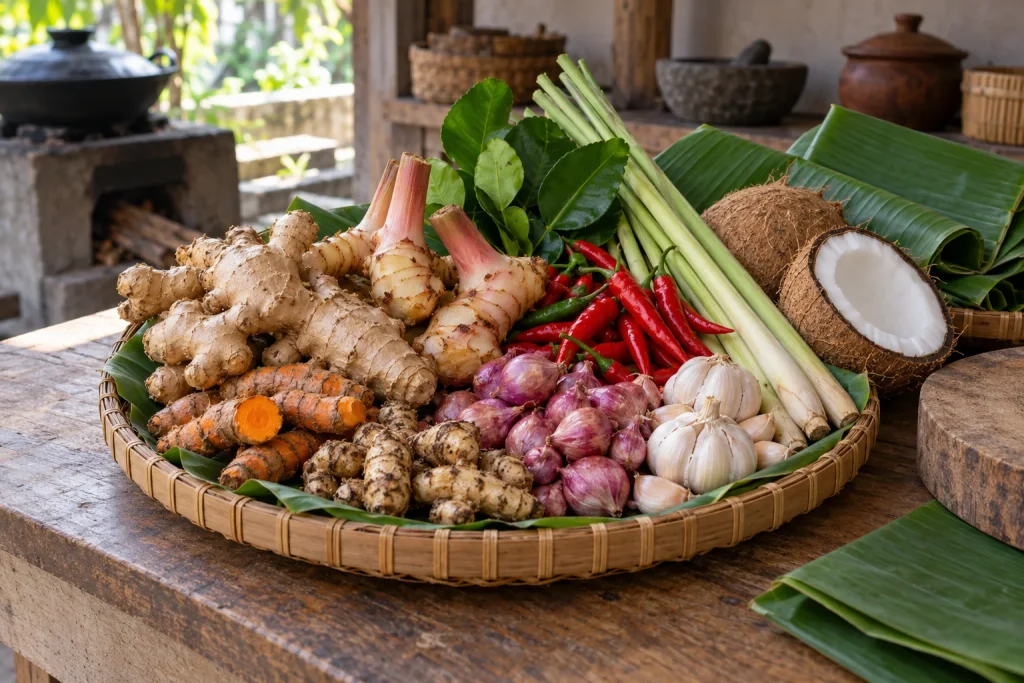
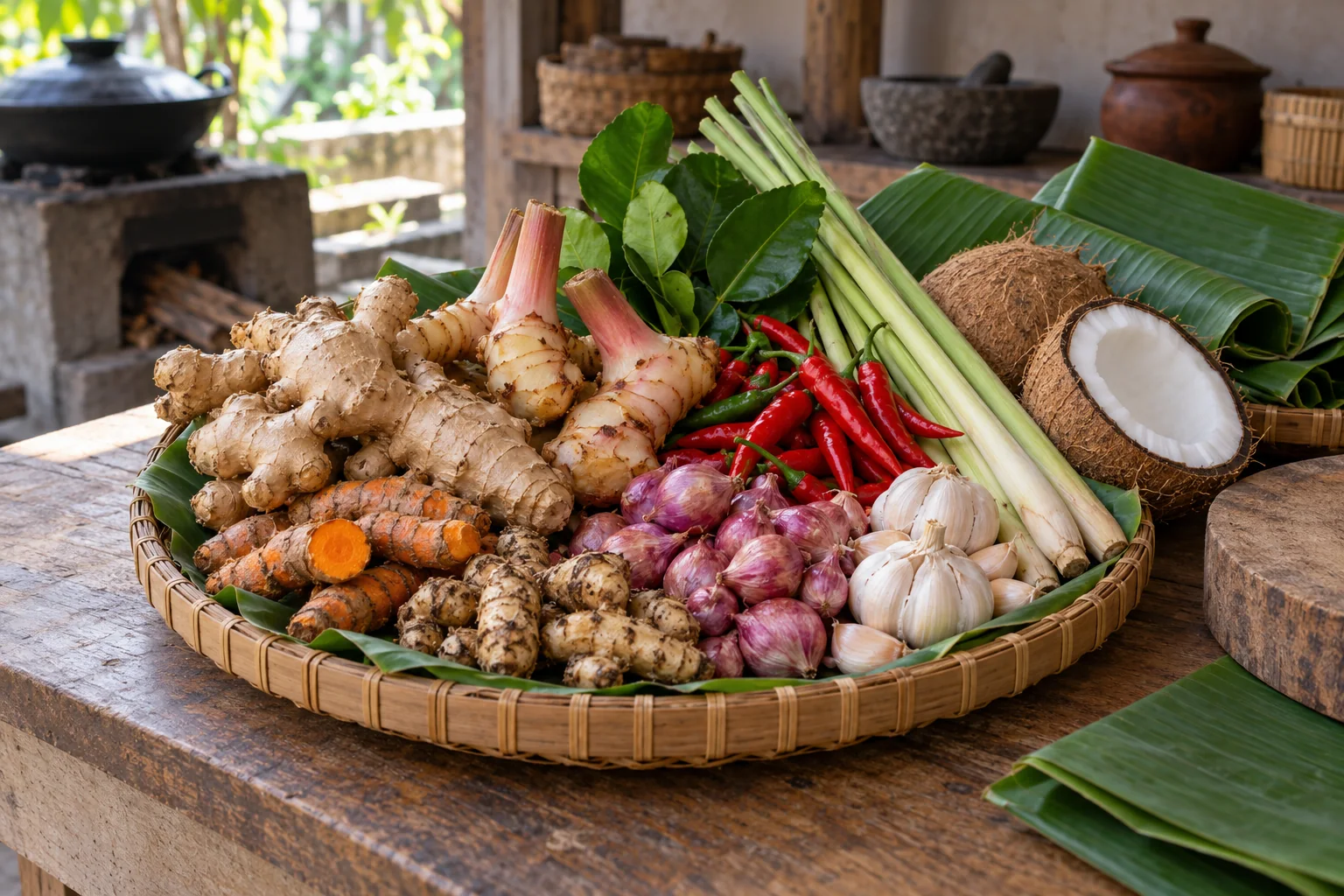
Bringing all ten facets of fresh banana leaves for cooking together reveals a consistent lesson about Balinese culinary culture: clarity comes from asking specific questions before the cooking begins. In a private household setting in Ubud, your host does not rely on factory-made pastes or rigid group schedules. Instead, fresh roots (galangal, turmeric, ginger, and aromatic kencur), shallots, garlic, lemongrass, salam leaves, and kaffir lime are proportioned for the exact five dishes your group chooses to cook.
If you have dietary requirements—such as vegetarian or vegan preparation without fermented shrimp paste (terasi), gluten-free substitutions using pure rice flour and palm sugar (Gula Aren), dairy-free coconut milk infusions, or nut-free spice pastes omitting candlenut (kemiri)—discussing them when you select your menu allows the kitchen to prepare dedicated mortars, cutting boards, and filtered drinking-water washing stations in advance.
Finally, use this pillar overview on fresh banana leaves for cooking alongside the ten focused cluster guides linked above whenever you want to verify a local Balinese term, compare morning market timing against afternoon kitchen sessions, or adapt a traditional Ubud technique for your own stove at home.