
Four servings becoming six is a multiplication problem. Four servings becoming a reliable dinner is also a cooking problem. When scaling Balinese recipes, separate the ingredient calculation from the decisions about equipment, preparation and the finished dish. A neat column of numbers cannot answer all four. When examining scaling balinese recipes in the context of everyday kitchen work and guest planning in Gianyar and Ubud, separating specific ingredient names, preparation timing, and household customs prevents common misunderstandings before you shop or cook.
Put the same unit on both sides
Start by reading the original yield. Does the recipe make four complete meals, four side portions, twelve cakes or a jar of spice paste? Those descriptions are not interchangeable. If the yield is unclear, keep the first attempt at the original size and record what it actually produces. You will have a better basis for the next meal than an imagined serving size.
Keep the calculation beside the original
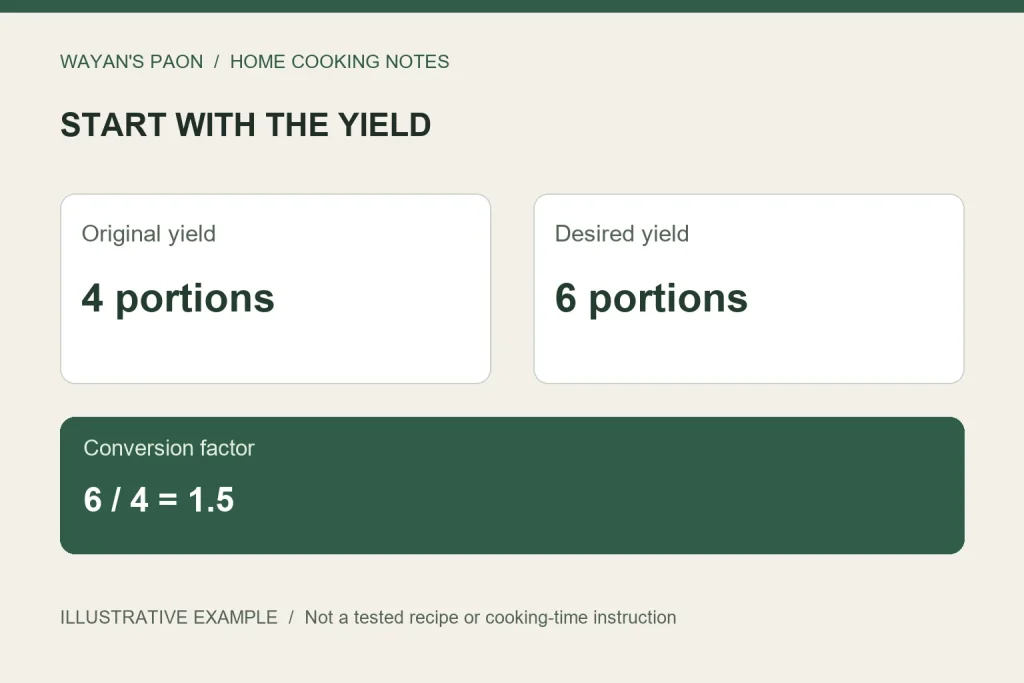
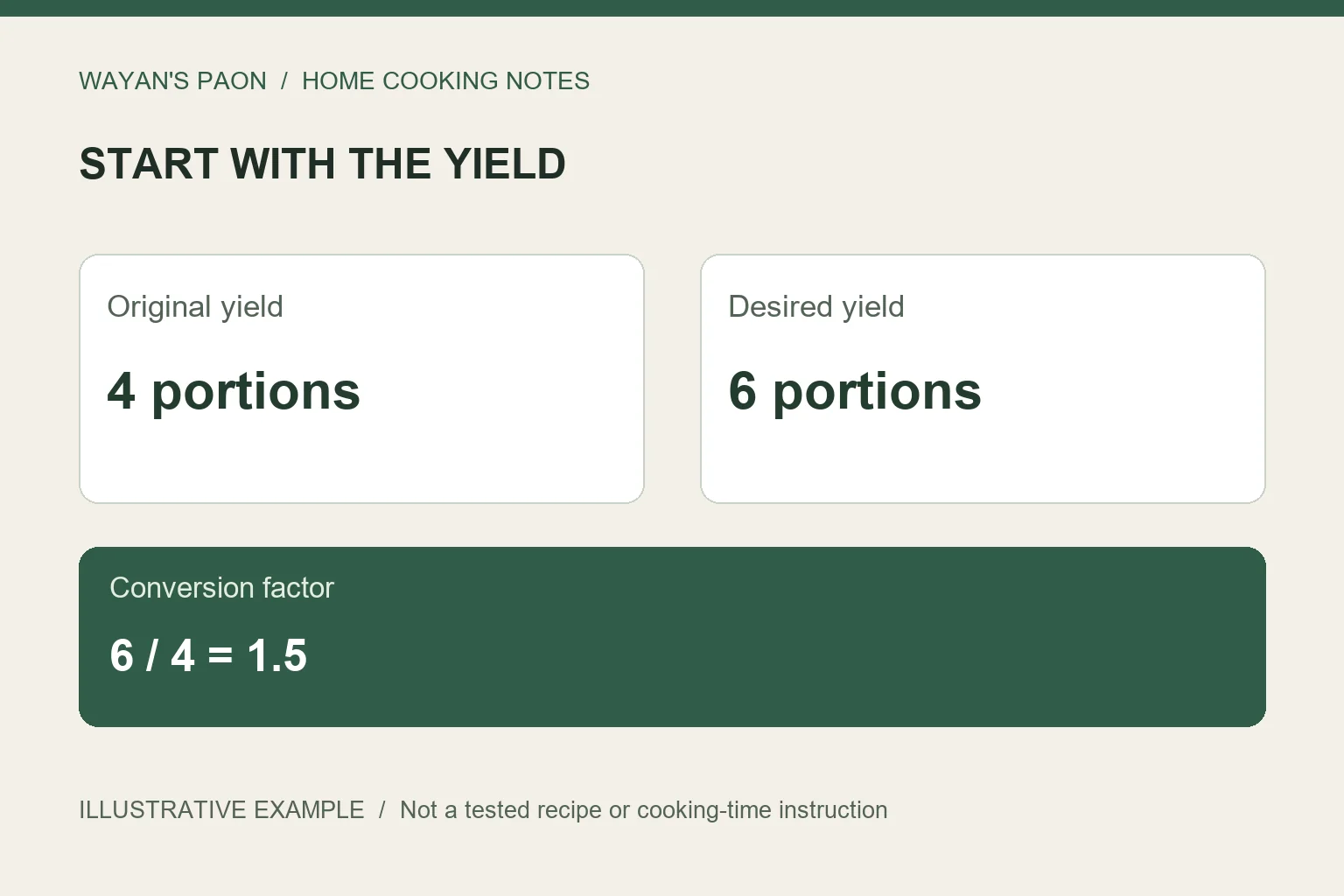
The conversion factor is the desired yield divided by the original yield. Six portions from a four-portion recipe gives a factor of 1.5. Multiply each stated ingredient amount by that number. This is an arithmetic starting point; it does not establish a new tested recipe, a cooking time or a suitable pan.
A meal has several recipes, not one universal multiplier
Counted items need a second look. Half a coconut, a thumb of ginger and three chillies are descriptions as well as quantities. Before dividing them, establish what part of the ingredient the recipe uses. Coconut flesh is different from a whole coconut weighed with its shell. Peeled ginger is different from the piece before trimming.
Record the result before repeating it
Make two columns rather than crossing out the original quantities. Put the recipe's amount in the first and the calculated amount in the second. A third column can record what you actually used. That last column matters when a scale cannot resolve a tiny quantity or the original recipe tells you to adjust an ingredient while cooking.
Find the calculation you need
Work through the guides below in the order that matches your problem. Start with the conversion factor for a change in yield. Use the ingredient-weight guides when the units are unclear. Read the equipment and cooking-round guides before putting a larger batch into the same vessel.
Planning six guests does not automatically mean multiplying every recipe by six. A dish originally written for four needs a different factor from one written for two. A sauce shared by several dishes needs its own calculation, otherwise it can quietly be counted twice on the shopping list.
Keep each dish's identity while doing the arithmetic. The existing guide to balinese recipes for two covers the smaller meal itself. This guide deals with the worksheet behind any stated yield. Likewise, the balinese curry paste recipe remains the place for that recipe's actual ingredients and method; a numerical example here is not a replacement formula.
After cooking, note the finished count or weight, how many cooking rounds you used and which measurements were uncertain. Keep comments such as “too much for this pan” separate from ingredient corrections. Otherwise, an equipment problem may become an unnecessary change to the recipe.
If you want to learn a dish before adapting it at home, explore Cooking Class Ubud and ask about the current menu. During a demonstration, useful questions concern the stated yield, the prepared ingredient weights and the signs the cook uses to judge each stage. Write those observations next to the recipe before changing its size.
How Scaling a Balinese Recipe Starts with Its Yield Connects Market Observation, Kitchen Technique, and Practical Planning in Ubud
For travellers and home cooks researching scaling balinese recipes, the biggest gap in general travel guides is that they treat Balinese food and daily life as a single uniform checklist rather than a living household system. In a traditional Balinese compound around Ubud, decisions about ingredients, prep sequence, and table pairing depend on whether a meal is prepared for a quiet family lunch, a morning market run, or a shared gathering. When you join an Ubud Cooking Class at Wayan’s Paon, every question around scaling balinese recipes is answered through direct hands-on observation rather than abstract theory.
A second practical principle when evaluating scaling balinese recipes is recognizing the boundary between what happens at the morning produce stalls, what happens at the stone mortar (ulekan), and how the final dishes are balanced on the plate. In our private sessions such as Private Paon Table, your group works only with your own booking party and selects up to five dishes from the 53-dish menu (plus the foundational Base Genep spice paste), allowing you to test how each choice affects flavour, texture, and timing.
Comparative Reference Matrix: 10 Core Dimensions of Scaling Balinese Recipes
Before diving into each specialized subtopic in this family of guides, the table below summarizes how the ten focused questions around scaling balinese recipes differ in scope, practical kitchen impact, and what you should verify before buying ingredients or confirming a menu in Ubud:
| Focus Topic / Keyword Owner | Specific Question Addressed | Key Practical Distinction in Ubud |
|---|---|---|
| 1. balinese recipe conversion factor | Work Out a Recipe Conversion Factor before Changing the Ingredients | A Balinese recipe conversion factor is simply the ratio between the amount you want and the amount the recipe originally makes. The difficul… |
| 2. halve a balinese recipe | Halving a Balinese Recipe without Losing Half the Instructions | To halve a Balinese recipe, multiply its stated ingredient quantities by 0.5 and keep the original method beside the new amounts. Do this on… |
| 3. grams and cups in balinese recipes | Grams and Cups Answer Different Questions in a Balinese Recipe | Grams and cups in Balinese recipes describe different measurements. Grams measure mass; cups measure volume. A cup of one ingredient cannot … |
| 4. prepared ingredient weight in balinese recipes | Weigh the Ingredient in the State the Recipe Asks For | Prepared ingredient weight in Balinese recipes needs a description beside the number. Whole coconut, coconut flesh and grated coconut are no… |
| 5. small spice measurements in balinese recipes | Tiny Spice Quantities Need More Than a Rounded Number | Small spice measurements in Balinese recipes can become awkward when a recipe is reduced. The arithmetic may produce a quantity your scale c… |
| 6. dividing balinese spice paste between dishes | Divide a Shared Spice Paste before Counting It Twice | Dividing Balinese spice paste between dishes starts with the recipes that will use it. A single bowl on the counter does not mean every dish… |
| 7. balinese cake recipe yield | A Cake Count Is Only Useful If the Pieces Stay Comparable | A Balinese cake recipe yield may be written as a number of pieces rather than a weight or a number of diners. That makes sense only while th… |
| 8. balinese cooking batch size | A Bigger Batch May Need More Cooking Rounds | Balinese cooking batch size is a practical equipment question as well as an ingredient question. A worksheet can correctly double the quanti… |
| 9. balinese recipe shopping quantities | Turn Several Balinese Recipes into One Shopping List | Balinese recipe shopping quantities are easier to check when every dish has already been scaled on its own sheet. Combine those completed sh… |
| 10. balinese recipe scaling notes | Write Recipe Notes That Explain What You Changed | Balinese recipe scaling notes should preserve three things: what the original said, what you calculated and what you actually did. Combining… |
Deep-Dive Guide to the 10 Specialized Subtopics Within Scaling Balinese Recipes
Each of the ten companion articles in this topic family isolates one specific decision or ingredient question related to scaling balinese recipes so that you never confuse a broad category label with a concrete culinary rule. Below is how each specialized guide fits into the wider picture:
1. Work Out a Recipe Conversion Factor before Changing the Ingredients
When narrowing your focus from scaling balinese recipes to the specific question of balinese recipe conversion factor, the primary distinction is context and practical application. A Balinese recipe conversion factor is simply the ratio between the amount you want and the amount the recipe originally makes. The difficult part is often deciding what those two amounts describe. Count cakes against cakes, portions against the same kind of portions, or finished paste weight against finished paste weight. By keeping this specific scope distinct from neighbouring topics, you avoid applying a general rule where a precise ingredient check or timing adjustment is required.
In practice at the market or in the paon, Suppose a recipe states four portions and you want six comparable portions. Six divided by four is 1.5. An ingredient listed as 200 g becomes 300 g; one listed as 80 ml becomes 120 ml. These are calculation examples, not ingredient quantities for a particular Balinese dish. Whether you are comparing options before booking your private session or taking notes to cook at home after your trip, treating balinese recipe conversion factor as its own step ensures your preparation remains accurate and stress-free.
2. Halving a Balinese Recipe without Losing Half the Instructions
When narrowing your focus from scaling balinese recipes to the specific question of halve a balinese recipe, the primary distinction is context and practical application. To halve a Balinese recipe, multiply its stated ingredient quantities by 0.5 and keep the original method beside the new amounts. Do this on paper before preparing anything. Working from memory makes it easy to halve the main ingredient but leave a smaller seasoning line unchanged. By keeping this specific scope distinct from neighbouring topics, you avoid applying a general rule where a precise ingredient check or timing adjustment is required.
In practice at the market or in the paon, For an illustrative recipe, 240 g becomes 120 g, 100 ml becomes 50 ml and two tablespoons become one tablespoon of the same size. Keep the unit attached to every number. A bare “50” is not useful when one line is in grams and the next is in millilitres. Whether you are comparing options before booking your private session or taking notes to cook at home after your trip, treating halve a balinese recipe as its own step ensures your preparation remains accurate and stress-free.
3. Grams and Cups Answer Different Questions in a Balinese Recipe
When narrowing your focus from scaling balinese recipes to the specific question of grams and cups in balinese recipes, the primary distinction is context and practical application. Grams and cups in Balinese recipes describe different measurements. Grams measure mass; cups measure volume. A cup of one ingredient cannot be assigned the same gram value as a cup of another just because both fit the same container. By keeping this specific scope distinct from neighbouring topics, you avoid applying a general rule where a precise ingredient check or timing adjustment is required.
In practice at the market or in the paon, When a recipe supplies grams, scaling that amount does not require a cup conversion. For example, multiplying an illustrative 120 g ingredient by 1.5 gives 180 g. Converting it into cups and then multiplying introduces another measurement that the original calculation did not need. Whether you are comparing options before booking your private session or taking notes to cook at home after your trip, treating grams and cups in balinese recipes as its own step ensures your preparation remains accurate and stress-free.
4. Weigh the Ingredient in the State the Recipe Asks For
When narrowing your focus from scaling balinese recipes to the specific question of prepared ingredient weight in balinese recipes, the primary distinction is context and practical application. Prepared ingredient weight in Balinese recipes needs a description beside the number. Whole coconut, coconut flesh and grated coconut are not the same item on a shopping list. Neither are an untrimmed bunch of greens and the leaves left after sorting. By keeping this specific scope distinct from neighbouring topics, you avoid applying a general rule where a precise ingredient check or timing adjustment is required.
In practice at the market or in the paon, Compare “200 g peeled ingredient” with “200 g ingredient, then peel.” The first describes a prepared amount; the second starts from an amount before that preparation. If the wording is ambiguous, ask the recipe author or record how you interpreted it. Do not quietly switch between the two when scaling. Whether you are comparing options before booking your private session or taking notes to cook at home after your trip, treating prepared ingredient weight in balinese recipes as its own step ensures your preparation remains accurate and stress-free.
5. Tiny Spice Quantities Need More Than a Rounded Number
When narrowing your focus from scaling balinese recipes to the specific question of small spice measurements in balinese recipes, the primary distinction is context and practical application. Small spice measurements in Balinese recipes can become awkward when a recipe is reduced. The arithmetic may produce a quantity your scale cannot resolve or a fraction of a spoon you do not own. That is a measurement problem, not permission to round every line in the same direction. By keeping this specific scope distinct from neighbouring topics, you avoid applying a general rule where a precise ingredient check or timing adjustment is required.
In practice at the market or in the paon, In a numerical example, half of 3 g is 1.5 g. If your scale only displays whole grams, it cannot show that target exactly. Check the scale's stated resolution and minimum usable load. A display reading zero does not prove the ingredient has no weight. Whether you are comparing options before booking your private session or taking notes to cook at home after your trip, treating small spice measurements in balinese recipes as its own step ensures your preparation remains accurate and stress-free.
6. Divide a Shared Spice Paste before Counting It Twice
When narrowing your focus from scaling balinese recipes to the specific question of dividing balinese spice paste between dishes, the primary distinction is context and practical application. Dividing Balinese spice paste between dishes starts with the recipes that will use it. A single bowl on the counter does not mean every dish needs the same paste or the same quantity. Confirm that the recipes actually call for an identical preparation before combining their requirements. By keeping this specific scope distinct from neighbouring topics, you avoid applying a general rule where a precise ingredient check or timing adjustment is required.
In practice at the market or in the paon, Imagine two recipes that explicitly use the same finished paste. One needs 60 g and the other needs 90 g. Their combined requirement is 150 g. This is a bookkeeping example, not a recommendation for a particular curry or vegetable dish. Whether you are comparing options before booking your private session or taking notes to cook at home after your trip, treating dividing balinese spice paste between dishes as its own step ensures your preparation remains accurate and stress-free.
7. A Cake Count Is Only Useful If the Pieces Stay Comparable
When narrowing your focus from scaling balinese recipes to the specific question of balinese cake recipe yield, the primary distinction is context and practical application. A Balinese cake recipe yield may be written as a number of pieces rather than a weight or a number of diners. That makes sense only while the piece size remains reasonably comparable. Changing the mould, the portioning spoon or the shape changes the assumption behind the count. By keeping this specific scope distinct from neighbouring topics, you avoid applying a general rule where a precise ingredient check or timing adjustment is required.
In practice at the market or in the paon, Suppose a recipe states twelve cakes and you want eighteen of the same size. The factor is eighteen divided by twelve, or 1.5. This gives a starting ingredient calculation. It does not tell you that eighteen larger cakes will emerge from the same amount of mixture. Whether you are comparing options before booking your private session or taking notes to cook at home after your trip, treating balinese cake recipe yield as its own step ensures your preparation remains accurate and stress-free.
8. A Bigger Batch May Need More Cooking Rounds
When narrowing your focus from scaling balinese recipes to the specific question of balinese cooking batch size, the primary distinction is context and practical application. Balinese cooking batch size is a practical equipment question as well as an ingredient question. A worksheet can correctly double the quantities while leaving you with a pan, steamer or mould intended for the original amount. Plan the cooking rounds before starting the first one. By keeping this specific scope distinct from neighbouring topics, you avoid applying a general rule where a precise ingredient check or timing adjustment is required.
In practice at the market or in the paon, Suppose a method has a stated working batch of 250 g and your calculated total is 750 g. Three comparable rounds may be the starting plan if the recipe and equipment guidance support that arrangement. The example illustrates division; it is not a universal loading recommendation for a wok or steamer. Whether you are comparing options before booking your private session or taking notes to cook at home after your trip, treating balinese cooking batch size as its own step ensures your preparation remains accurate and stress-free.
9. Turn Several Balinese Recipes into One Shopping List
When narrowing your focus from scaling balinese recipes to the specific question of balinese recipe shopping quantities, the primary distinction is context and practical application. Balinese recipe shopping quantities are easier to check when every dish has already been scaled on its own sheet. Combine those completed sheets into the shopping list afterward. Starting with one large list makes it harder to see which dish a quantity belongs to. When examining balinese recipe shopping quantities in the context of everyday kitchen work and guest planning in Gianyar and Ubud, separating specific ingredient names, preparation timing, and household customs prevents common misunderstandings before you shop or cook. By keeping this specific scope distinct from neighbouring topics, you avoid applying a general rule where a precise ingredient check or timing adjustment is required.
In practice at the market or in the paon, In a simple numerical example, one recipe needs 100 g of a prepared ingredient and another needs 150 g in the same prepared state. Their combined usable requirement is 250 g. If a third recipe lists an unpeeled amount, keep that line separate until you have a valid basis for comparing it. Whether you are comparing options before booking your private session or taking notes to cook at home after your trip, treating balinese recipe shopping quantities as its own step ensures your preparation remains accurate and stress-free.
10. Write Recipe Notes That Explain What You Changed
When narrowing your focus from scaling balinese recipes to the specific question of balinese recipe scaling notes, the primary distinction is context and practical application. Balinese recipe scaling notes should preserve three things: what the original said, what you calculated and what you actually did. Combining all three into a single rewritten recipe can hide the very change you need to understand next time. By keeping this specific scope distinct from neighbouring topics, you avoid applying a general rule where a precise ingredient check or timing adjustment is required.
In practice at the market or in the paon, Record the recipe title, author or source, original yield and the date of your attempt. You do not need to copy someone else's entire recipe into a public post. For a personal worksheet, a clear reference lets you return to the original instructions when a shortened note becomes ambiguous. Whether you are comparing options before booking your private session or taking notes to cook at home after your trip, treating balinese recipe scaling notes as its own step ensures your preparation remains accurate and stress-free.
How to Apply These Notes When Planning Your Private Cooking Day at Wayan’s Paon
Bringing all ten facets of scaling balinese recipes together reveals a consistent lesson about Balinese culinary culture: clarity comes from asking specific questions before the cooking begins. In a private household setting in Ubud, your host does not rely on factory-made pastes or rigid group schedules. Instead, fresh roots (galangal, turmeric, ginger, and aromatic kencur), shallots, garlic, lemongrass, salam leaves, and kaffir lime are proportioned for the exact five dishes your group chooses to cook.
If you have dietary requirements—such as vegetarian or vegan preparation without fermented shrimp paste (terasi), gluten-free substitutions using pure rice flour and palm sugar (Gula Aren), dairy-free coconut milk infusions, or nut-free spice pastes omitting candlenut (kemiri)—discussing them when you select your menu allows the kitchen to prepare dedicated mortars, cutting boards, and filtered drinking-water washing stations in advance.
Finally, use this pillar overview on scaling balinese recipes alongside the ten focused cluster guides linked above whenever you want to verify a local Balinese term, compare morning market timing against afternoon kitchen sessions, or adapt a traditional Ubud technique for your own stove at home.