
A banana for the fruit bowl and a banana for a cooked sweet may look like two sizes of the same ingredient. In Bali, it is more useful to ask which variety you are looking at and what the cook intends to do with it. Balinese banana varieties include fruit used fresh, fruit used in cooking and varieties that can serve both purposes. When examining balinese banana varieties in the context of everyday kitchen work and guest planning in Gianyar and Ubud, separating specific ingredient names, preparation timing, and household customs prevents common misunderstandings before you shop or cook.
Start with the name, then the intended use
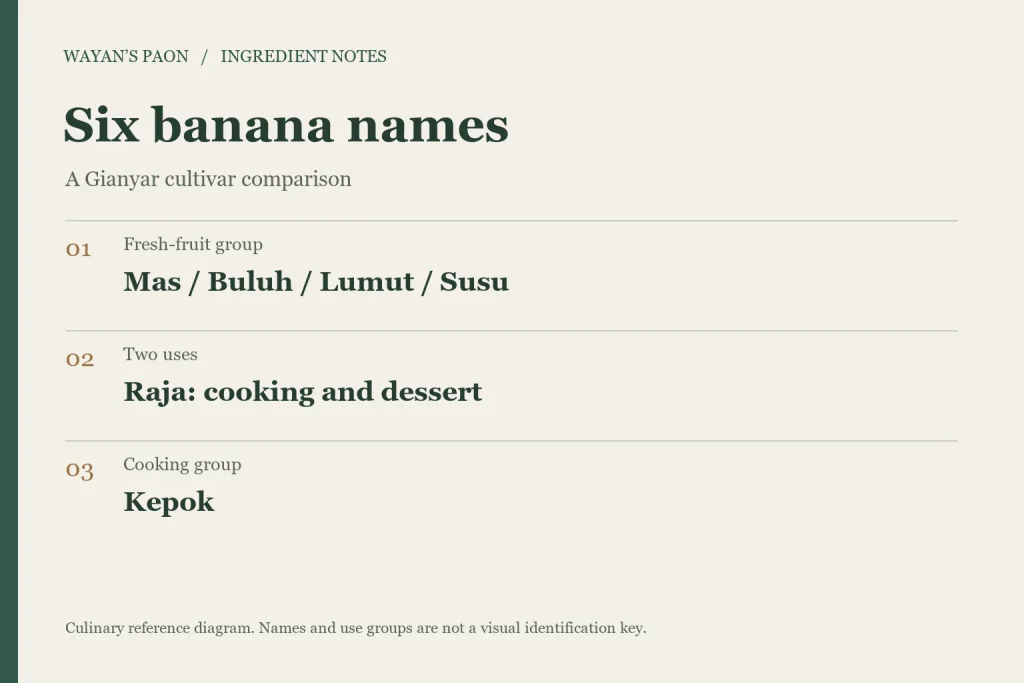
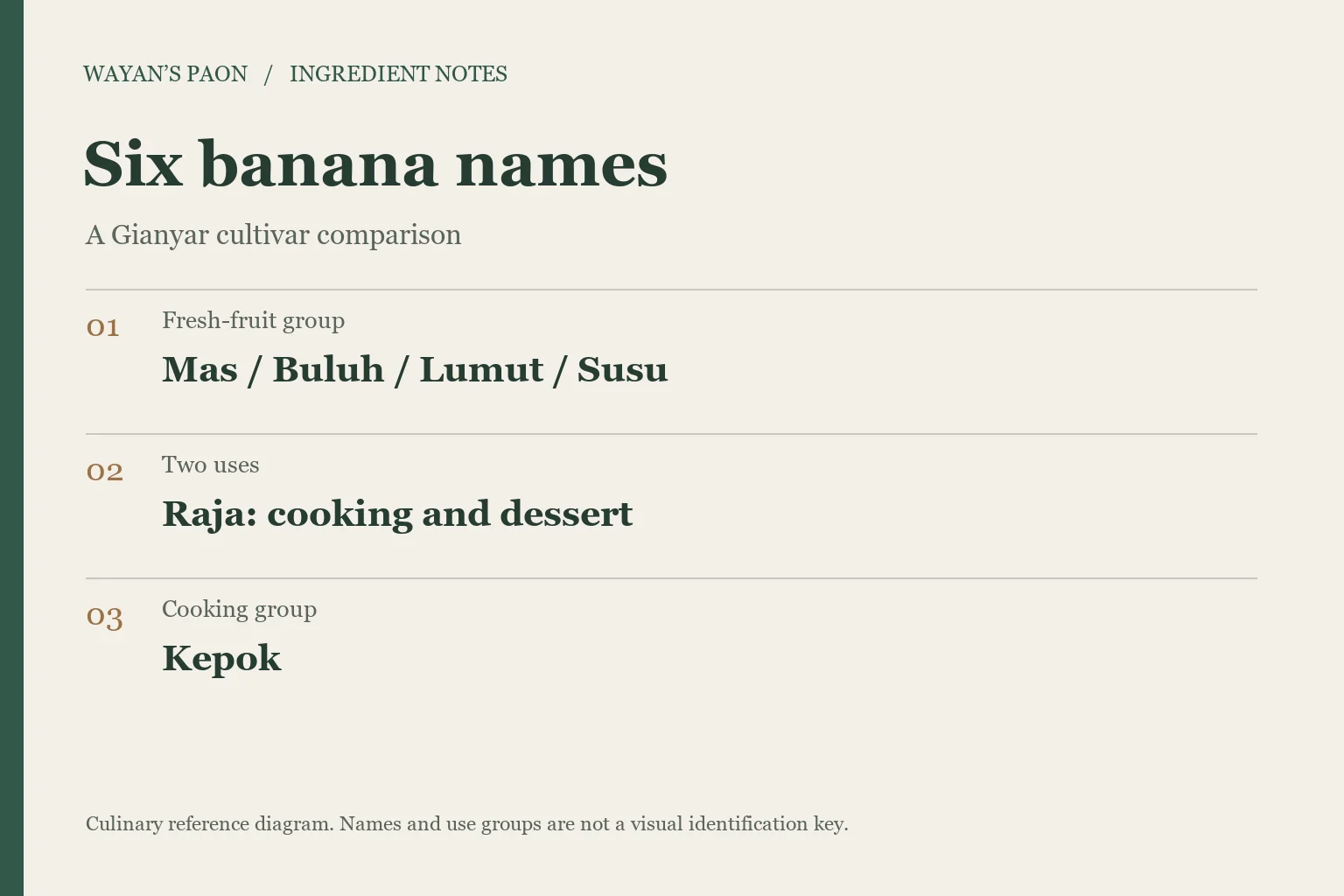
A 2023 study by researchers from Udayana and Warmadewa universities compared six cultivars from a collection in Gianyar: Mas, Buluh, Lumut, Susu, Raja and Kepok. Its table groups the first four as dessert fruit, Raja as dual-purpose and Kepok as a cooking banana. That is a useful starting map rather than a complete catalogue of every banana sold on the island.
Learn one variety at a time
The name alone does not finish the shopping decision. Ask whether the fruit in front of you is ready for the dish you want to make. A cultivar name describes the kind of banana; it does not describe the condition of every fruit carrying that name today.
Keep a dish's identity separate from its ingredient
Start with a small quantity and keep the name attached to it. If you are comparing two varieties, keep them separate until you have recorded which is which. A photograph of the whole fruit, its label and its cut surface is more useful than a photograph of an anonymous mixed fruit bowl.
Buy for the plan you actually have
For a cooked dish, use a recipe that specifies the banana or explains a suitable alternative. Keep the preparation and amount unchanged on the first attempt. A successful substitution in one dish does not establish that the same fruit will behave identically in every batter, wrapper or cooking method.
Six cultivars in the Gianyar comparison
The individual guides below describe six documented names and the questions each raises. Other guides explain dessert versus cooking use, local naming, recipe substitution and the difference between fruit and the other parts of the banana plant.
Explore the names and cooking questions
The guide to pisang rai bali belongs to the finished dish. It is the place to understand that preparation rather than trying to construct a recipe from a fruit description. Likewise, banana leaf cooking concerns the wrapping material, and jukut pusuh biu bali concerns a dish made with banana blossom. Buying a particular banana fruit does not automatically supply the other parts of that plant.
If you want fruit to eat as it is, say so. If you have a named recipe, show its ingredient requirement. If you are buying ahead, explain when you intend to use the fruit and let the seller describe the current batch. Avoid treating a single peel colour or a familiar English label as a universal test.
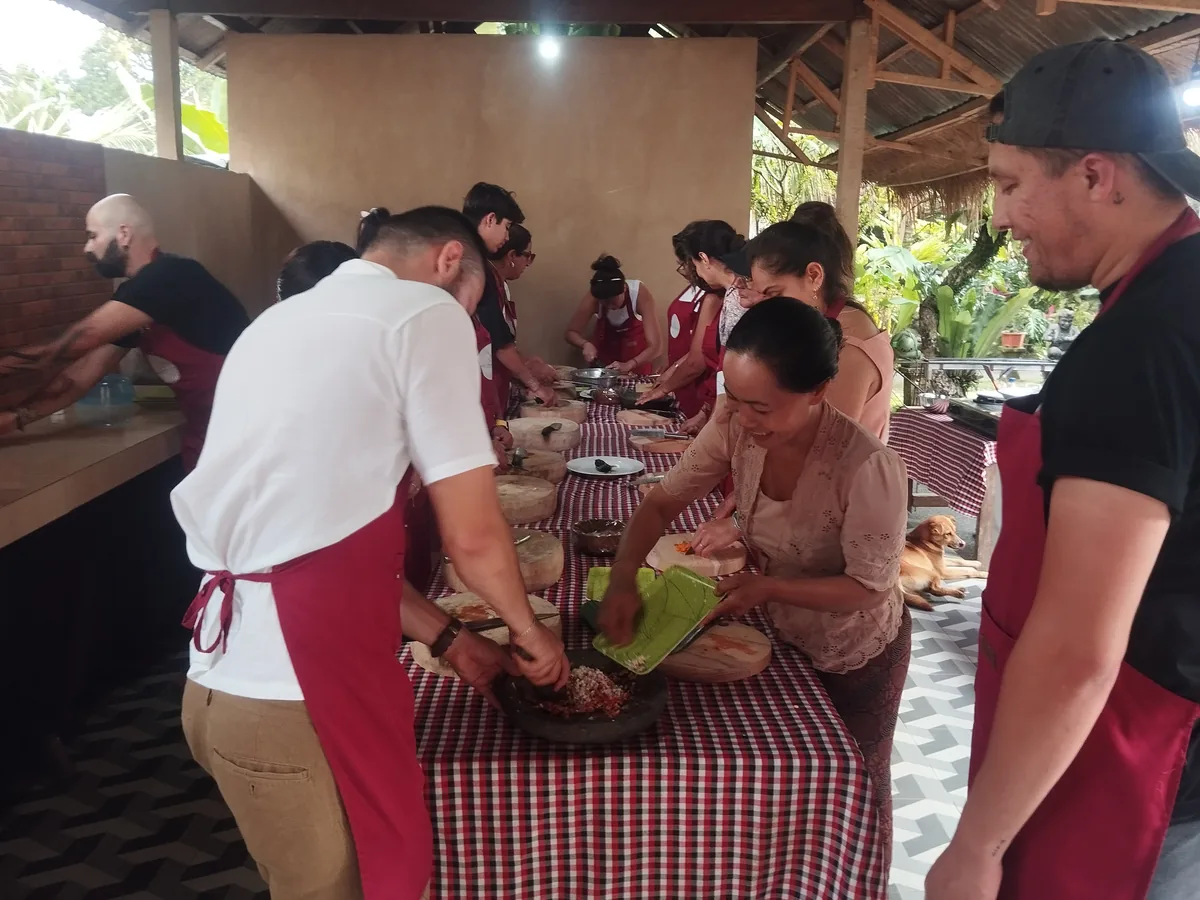
Learning ingredient choices can also be part of planning a Cooking Class Ubud visit. Ask which current dishes involve banana and which fruit the cook uses for them. The answer should come from the chosen menu and the actual ingredients, rather than an assumption that every variety in this guide is offered in a class.
Here, dessert identifies fresh-fruit use. The comparison describes six sampled cultivars, rather than every banana grown or sold in Bali.
How Balinese Banana Varieties from the Fruit Bowl to the Cooking Pot Connects Market Observation, Kitchen Technique, and Practical Planning in Ubud
For travellers and home cooks researching balinese banana varieties, the biggest gap in general travel guides is that they treat Balinese food and daily life as a single uniform checklist rather than a living household system. In a traditional Balinese compound around Ubud, decisions about ingredients, prep sequence, and table pairing depend on whether a meal is prepared for a quiet family lunch, a morning market run, or a shared gathering. When you join an Ubud Cooking Class at Wayan’s Paon, every question around balinese banana varieties is answered through direct hands-on observation rather than abstract theory.
A second practical principle when evaluating balinese banana varieties is recognizing the boundary between what happens at the morning produce stalls, what happens at the stone mortar (ulekan), and how the final dishes are balanced on the plate. In our private sessions such as Market to Paon, your group works only with your own booking party and selects up to five dishes from the 53-dish menu (plus the foundational Base Genep spice paste), allowing you to test how each choice affects flavour, texture, and timing.
Comparative Reference Matrix: 10 Core Dimensions of Balinese Banana Varieties
Before diving into each specialized subtopic in this family of guides, the table below summarizes how the ten focused questions around balinese banana varieties differ in scope, practical kitchen impact, and what you should verify before buying ingredients or confirming a menu in Ubud:
| Focus Topic / Keyword Owner | Specific Question Addressed | Key Practical Distinction in Ubud |
|---|---|---|
| 1. pisang mas in bali | Pisang Mas Is a Small Banana with a Place in the Fruit Bowl | Pisang Mas in Bali is a useful name to learn when you are looking for fruit to eat fresh. In the six-cultivar Gianyar study, Mas was the sma… |
| 2. pisang buluh | Pisang Buluh and the Ambon Kuning Name | Pisang Buluh appears alongside the name Ambon Kuning in the Gianyar cultivar study. Knowing that documented name pairing can help when a rec… |
| 3. pisang lumut | Pisang Lumut Is Also Documented as Ambon Hijau | Pisang Lumut is documented with the names Ambon Hijau and Ambon Lumut in the six-cultivar Gianyar study. The name connection is useful when … |
| 4. pisang susu in bali | Meet Pisang Susu before You Choose a Banana for Dessert | Pisang Susu in Bali is one of the names documented in local banana research. The Gianyar six-cultivar study includes it as dessert fruit. Fo… |
| 5. pisang raja in bali | Pisang Raja Can Belong in the Fruit Bowl or the Kitchen | Pisang Raja in Bali is a useful example of why “dessert banana” and “cooking banana” are not always exclusive labels. The Gianyar study clas… |
| 6. pisang kepok in bali | Pisang Kepok Starts with a Cooking Question | Pisang Kepok in Bali is listed as a cooking banana in the Gianyar six-cultivar study. That makes the intended preparation a useful starting … |
| 7. biu and pisang | Biu or Pisang? Keep Both Names in Your Market Notes | Biu and pisang are useful words to recognise when you are discussing bananas in Bali. Biu is a Balinese word used for banana; pisang is the … |
| 8. dessert bananas vs cooking bananas in Bali | Dessert Bananas and Cooking Bananas Describe Uses, Not Recipes | Dessert bananas vs cooking bananas in Bali is a useful comparison when an English recipe says only banana. The labels describe intended uses… |
| 9. banana substitutions in balinese recipes | Changing the Banana Changes a Recipe Ingredient | Banana substitutions in Balinese recipes deserve the same attention as a change to any named ingredient. Start by reading what the original … |
| 10. banana fruit blossom and leaf in Bali | Banana Fruit, Blossom and Leaf Have Different Jobs in a Balinese Kitchen | Banana fruit, blossom and leaf in Bali can appear in very different food conversations. Keeping the plant part explicit prevents an easy mis… |
Deep-Dive Guide to the 10 Specialized Subtopics Within Balinese Banana Varieties
Each of the ten companion articles in this topic family isolates one specific decision or ingredient question related to balinese banana varieties so that you never confuse a broad category label with a concrete culinary rule. Below is how each specialized guide fits into the wider picture:
1. Pisang Mas Is a Small Banana with a Place in the Fruit Bowl
When narrowing your focus from balinese banana varieties to the specific question of pisang mas in bali, the primary distinction is context and practical application. Pisang Mas in Bali is a useful name to learn when you are looking for fruit to eat fresh. In the six-cultivar Gianyar study, Mas was the smallest fruit examined and was classified as a dessert banana. That description gives you a reason to ask about it; it does not identify every small yellow banana on a market stall. By keeping this specific scope distinct from neighbouring topics, you avoid applying a general rule where a precise ingredient check or timing adjustment is required.
In practice at the market or in the paon, Mas was the smallest cultivar in the comparison. Its relatively small fruit makes size a useful comparison with Buluh and Lumut, but size alone cannot confirm identity. The study also records Mas Sasih and Muli as names associated with Mas. Keep those names beside Mas in a reference note, rather than treating them as three additional varieties. Whether you are comparing options before booking your private session or taking notes to cook at home after your trip, treating pisang mas in bali as its own step ensures your preparation remains accurate and stress-free.
2. Pisang Buluh and the Ambon Kuning Name
When narrowing your focus from balinese banana varieties to the specific question of pisang buluh, the primary distinction is context and practical application. Pisang Buluh appears alongside the name Ambon Kuning in the Gianyar cultivar study. Knowing that documented name pairing can help when a recipe, a seller and a fruit label seem to use different words. Treat it as a starting question, especially when you are buying in a different place. By keeping this specific scope distinct from neighbouring topics, you avoid applying a general rule where a precise ingredient check or timing adjustment is required.
In practice at the market or in the paon, The researchers recorded Buluh as Ambon Kuning and Lumut as Ambon Hijau or Ambon Lumut. Both were in the dessert group. Their fruit was larger than Mas in that sample. This is a more useful comparison than grouping every banana under an English label such as small, large or green. Whether you are comparing options before booking your private session or taking notes to cook at home after your trip, treating pisang buluh as its own step ensures your preparation remains accurate and stress-free.
3. Pisang Lumut Is Also Documented as Ambon Hijau
When narrowing your focus from balinese banana varieties to the specific question of pisang lumut, the primary distinction is context and practical application. Pisang Lumut is documented with the names Ambon Hijau and Ambon Lumut in the six-cultivar Gianyar study. The name connection is useful when reading ingredient notes. It also shows why identifying a banana only as “the green one” loses information. By keeping this specific scope distinct from neighbouring topics, you avoid applying a general rule where a precise ingredient check or timing adjustment is required.
In practice at the market or in the paon, Lumut and Buluh were both recorded as dessert cultivars, with larger fruit than Mas in the sample. Their documented names distinguish Ambon Hijau from Ambon Kuning. Preserve the full name when comparing a written ingredient list with a market label; shortening both to Ambon removes the distinction the reference makes. Whether you are comparing options before booking your private session or taking notes to cook at home after your trip, treating pisang lumut as its own step ensures your preparation remains accurate and stress-free.
4. Meet Pisang Susu before You Choose a Banana for Dessert
When narrowing your focus from balinese banana varieties to the specific question of pisang susu in bali, the primary distinction is context and practical application. Pisang Susu in Bali is one of the names documented in local banana research. The Gianyar six-cultivar study includes it as dessert fruit. For a visitor, the useful next step is to connect that name with the fruit being sold, rather than translating the name into an assumed flavour or an ingredient list. By keeping this specific scope distinct from neighbouring topics, you avoid applying a general rule where a precise ingredient check or timing adjustment is required.
In practice at the market or in the paon, The study records Susu Madu alongside Susu. It places Susu in the dessert group with Mas, Buluh and Lumut. A useful comparison therefore begins with those fresh-fruit varieties, while Raja and Kepok introduce different culinary use categories. The word dessert here means fruit intended for fresh eating; it does not describe a finished sweet with added ingredients. Whether you are comparing options before booking your private session or taking notes to cook at home after your trip, treating pisang susu in bali as its own step ensures your preparation remains accurate and stress-free.
5. Pisang Raja Can Belong in the Fruit Bowl or the Kitchen
When narrowing your focus from balinese banana varieties to the specific question of pisang raja in bali, the primary distinction is context and practical application. Pisang Raja in Bali is a useful example of why “dessert banana” and “cooking banana” are not always exclusive labels. The Gianyar study classifies Raja as suitable for both uses. That does not mean every recipe treats it in the same way or uses it at the same stage. By keeping this specific scope distinct from neighbouring topics, you avoid applying a general rule where a precise ingredient check or timing adjustment is required.
In practice at the market or in the paon, Raja is listed for both cooking and dessert use, whereas Kepok is listed for cooking. The reference also records the name Raja Bali. Keeping the dual-purpose category visible matters: a two-column list that forces every variety into either fresh or cooked use would misrepresent this comparison. Whether you are comparing options before booking your private session or taking notes to cook at home after your trip, treating pisang raja in bali as its own step ensures your preparation remains accurate and stress-free.
6. Pisang Kepok Starts with a Cooking Question
When narrowing your focus from balinese banana varieties to the specific question of pisang kepok in bali, the primary distinction is context and practical application. Pisang Kepok in Bali is listed as a cooking banana in the Gianyar six-cultivar study. That makes the intended preparation a useful starting point when you ask about it. “For cooking” remains a category, however, rather than a complete instruction for what to do with the fruit. By keeping this specific scope distinct from neighbouring topics, you avoid applying a general rule where a precise ingredient check or timing adjustment is required.
In practice at the market or in the paon, The reference pairs Kepok with Saba and lists its culinary use as cooking. Raja, by comparison, spans cooking and dessert use. These are the categories documented for the sampled cultivars. They provide a useful reference when a recipe names Kepok, without supplying a cooking time or proving that a differently named fruit is an interchangeable substitute. Whether you are comparing options before booking your private session or taking notes to cook at home after your trip, treating pisang kepok in bali as its own step ensures your preparation remains accurate and stress-free.
7. Biu or Pisang? Keep Both Names in Your Market Notes
When narrowing your focus from balinese banana varieties to the specific question of biu and pisang, the primary distinction is context and practical application. Biu and pisang are useful words to recognise when you are discussing bananas in Bali. Biu is a Balinese word used for banana; pisang is the Indonesian word. Keeping the language and the cultivar name together makes a market note easier to understand later. By keeping this specific scope distinct from neighbouring topics, you avoid applying a general rule where a precise ingredient check or timing adjustment is required.
In practice at the market or in the paon, Writing only biu or pisang tells you the fruit category. It does not preserve the cultivar the seller pointed out. Ask for the additional name and keep it beside the purchase, particularly if several bunches are displayed together. Whether you are comparing options before booking your private session or taking notes to cook at home after your trip, treating biu and pisang as its own step ensures your preparation remains accurate and stress-free.
8. Dessert Bananas and Cooking Bananas Describe Uses, Not Recipes
When narrowing your focus from balinese banana varieties to the specific question of dessert bananas vs cooking bananas in Bali, the primary distinction is context and practical application. Dessert bananas vs cooking bananas in Bali is a useful comparison when an English recipe says only banana. The labels describe intended uses. They do not provide an exact substitute, a cooking method or a complete test of the fruit you are holding. By keeping this specific scope distinct from neighbouring topics, you avoid applying a general rule where a precise ingredient check or timing adjustment is required.
In practice at the market or in the paon, Fruit chosen for eating as it is will be judged for that purpose. A recipe may ask the banana to remain in pieces, fit a wrapper or form part of a mixture. Read what the dish requires before treating every banana as an equivalent ingredient. Whether you are comparing options before booking your private session or taking notes to cook at home after your trip, treating dessert bananas vs cooking bananas in Bali as its own step ensures your preparation remains accurate and stress-free.
9. Changing the Banana Changes a Recipe Ingredient
When narrowing your focus from balinese banana varieties to the specific question of banana substitutions in balinese recipes, the primary distinction is context and practical application. Banana substitutions in Balinese recipes deserve the same attention as a change to any named ingredient. Start by reading what the original recipe actually specifies: cultivar, amount, preparation state and piece size. Replacing only the word banana can hide several changes at once. When examining banana substitutions in balinese recipes in the context of everyday kitchen work and guest planning in Gianyar and Ubud, separating specific ingredient names, preparation timing, and household customs prevents common misunderstandings before you shop or cook. By keeping this specific scope distinct from neighbouring topics, you avoid applying a general rule where a precise ingredient check or timing adjustment is required.
In practice at the market or in the paon, Write the requested fruit in one column and the proposed alternative in another. Keep the original amount and method available. If the author supplies a substitution, record that advice beside your choice so you can distinguish it from an experiment of your own. Whether you are comparing options before booking your private session or taking notes to cook at home after your trip, treating banana substitutions in balinese recipes as its own step ensures your preparation remains accurate and stress-free.
10. Banana Fruit, Blossom and Leaf Have Different Jobs in a Balinese Kitchen
When narrowing your focus from balinese banana varieties to the specific question of banana fruit blossom and leaf in Bali, the primary distinction is context and practical application. Banana fruit, blossom and leaf in Bali can appear in very different food conversations. Keeping the plant part explicit prevents an easy mistake: treating a banana dish, a blossom dish and a leaf-wrapped dish as three ways of using the same ingredient. By keeping this specific scope distinct from neighbouring topics, you avoid applying a general rule where a precise ingredient check or timing adjustment is required.
In practice at the market or in the paon, Fruit is the ingredient discussed in this cultivar family. A blossom recipe begins with a different plant part and its own preparation. A leaf may be used as wrapping or serving material rather than as the fruit component of the dish. Whether you are comparing options before booking your private session or taking notes to cook at home after your trip, treating banana fruit blossom and leaf in Bali as its own step ensures your preparation remains accurate and stress-free.
How to Apply These Notes When Planning Your Private Cooking Day at Wayan’s Paon
Bringing all ten facets of balinese banana varieties together reveals a consistent lesson about Balinese culinary culture: clarity comes from asking specific questions before the cooking begins. In a private household setting in Ubud, your host does not rely on factory-made pastes or rigid group schedules. Instead, fresh roots (galangal, turmeric, ginger, and aromatic kencur), shallots, garlic, lemongrass, salam leaves, and kaffir lime are proportioned for the exact five dishes your group chooses to cook.
If you have dietary requirements—such as vegetarian or vegan preparation without fermented shrimp paste (terasi), gluten-free substitutions using pure rice flour and palm sugar (Gula Aren), dairy-free coconut milk infusions, or nut-free spice pastes omitting candlenut (kemiri)—discussing them when you select your menu allows the kitchen to prepare dedicated mortars, cutting boards, and filtered drinking-water washing stations in advance.
Finally, use this pillar overview on balinese banana varieties alongside the ten focused cluster guides linked above whenever you want to verify a local Balinese term, compare morning market timing against afternoon kitchen sessions, or adapt a traditional Ubud technique for your own stove at home.