
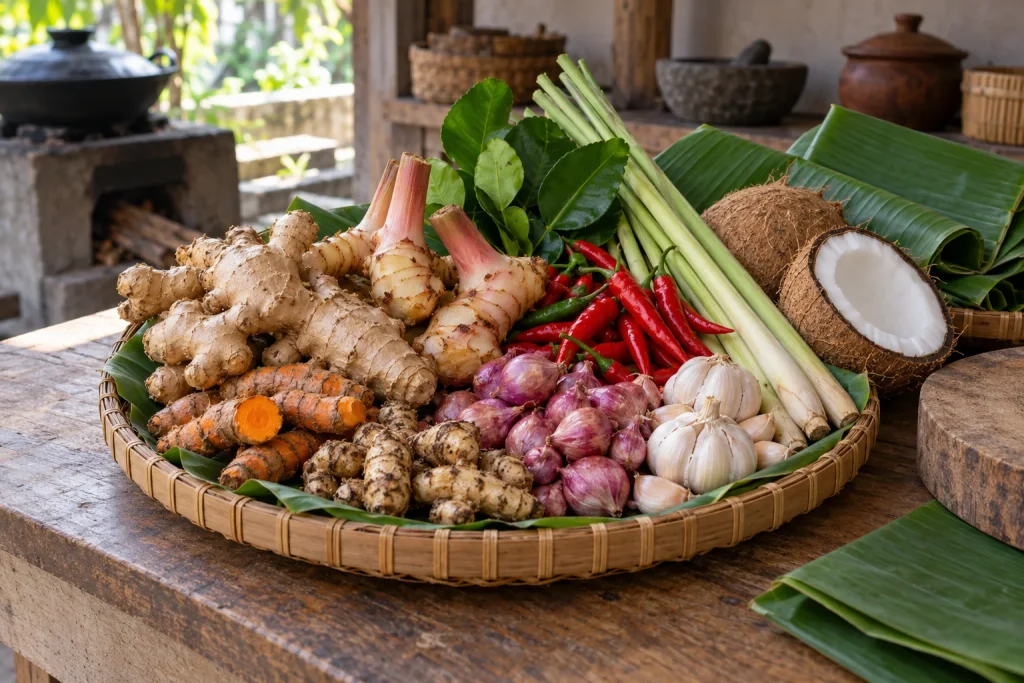

Ask someone to name Balinese ingredients and the answer often starts with a spice paste. That is a useful place to begin, but it is only part of the pantry. Coconut appears in several forms, banana leaves help prepare or carry food, and fresh aromatics can change the character of a dish before it reaches the pan. When examining balinese ingredients in the context of everyday kitchen work and guest planning in Gianyar and Ubud, separating specific ingredient names, preparation timing, and household customs prevents common misunderstandings before you shop or cook. When examining balinese ingredients in the context of everyday kitchen work and guest planning in Gianyar and Ubud, separating specific ingredient names, preparation timing, and household customs prevents common misunderstandings before you shop or cook.
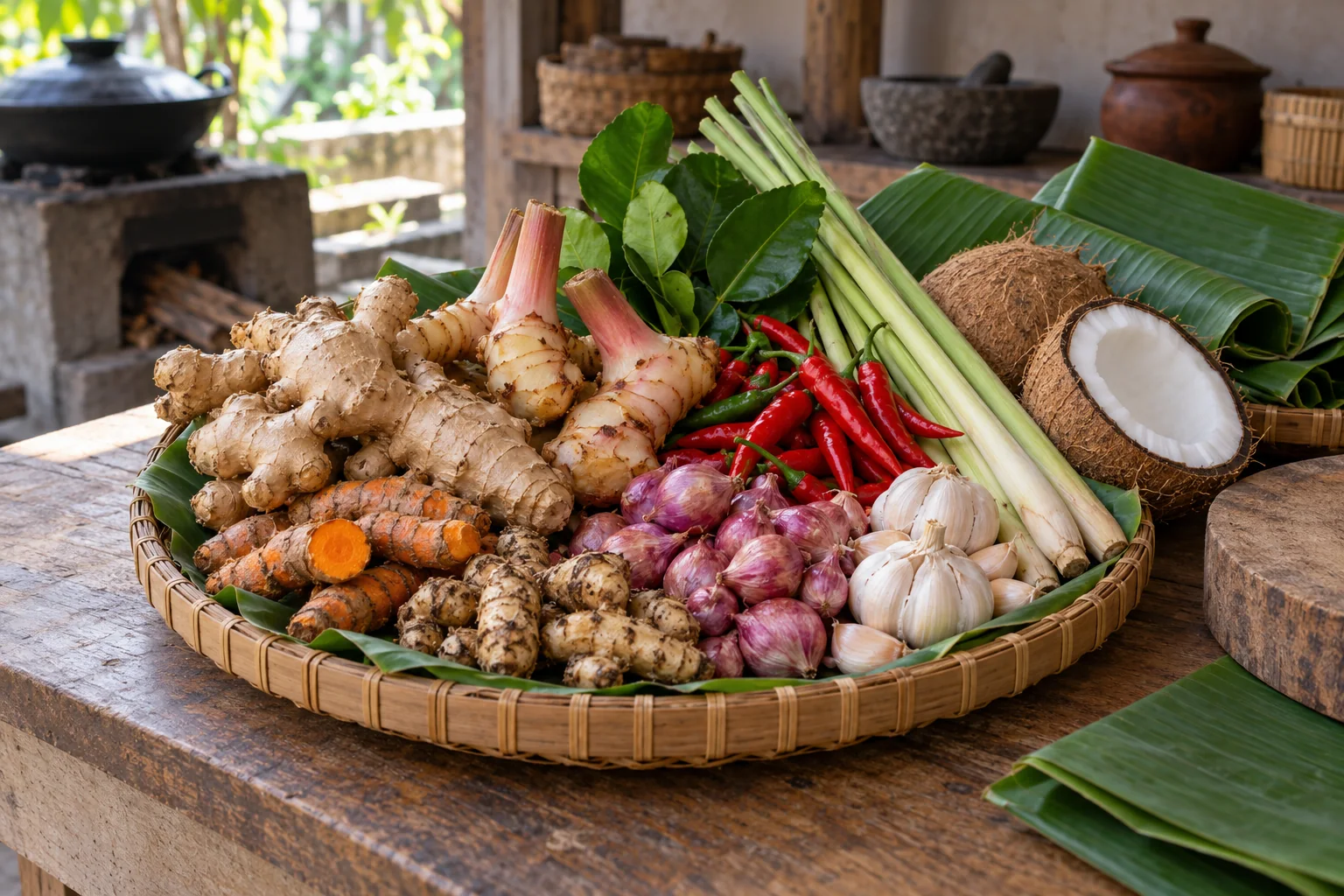
Start with the aromatic roots
There is no single checklist that belongs in every Balinese kitchen. Markets, household habits, the season and the dish all matter. A cook making a quick sambal reaches for a different set of ingredients than someone preparing a slow-cooked celebration meal. Think of this guide as a way to recognize the building blocks, not a claim that every recipe uses them all.
Coconut changes form as it is used
Ginger, galangal, turmeric and kencur are often grouped together because they grow as rhizomes and can look similar in a market basket. Their aromas are not interchangeable. Ginger brings a familiar, warming bite; galangal is firmer and more resinous; turmeric adds earthy notes and a deep yellow color; kencur has a distinct, sharper fragrance. Balinese seasoning pastes may draw on several of these, but the proportions vary.
Leaves and stalks bring more than decoration
Shallots, garlic, chilies, lemongrass, coriander, pepper and candlenut may appear alongside them. Some blends are pounded fresh, some include dried spices, and many cooks adjust the mix for a particular dish. “Base genep” is better understood as a family of complete seasoning approaches than as a single universal formula.
Learn to identify, then notice how a cook uses it
Grated coconut gives a dish texture; coconut milk adds body; coconut oil contributes aroma and helps carry a spice paste through cooking. These are related ingredients, but they do different jobs. In Balinese food, coconut can appear in savory dishes, sambals, sweets and traditional oil-making. The last practice still matters in some communities, though it is not the only oil used on the island today.
Banana leaves can wrap food for steaming or grilling, while lemongrass may be bruised into a seasoning paste or used as a sturdy handle for sate lilit. Torch ginger adds a bright, unusual aroma to certain sambals. Palm sugar brings depth to some sweets. None of these ingredients defines every Balinese dish, but each can help explain why two plates built from familiar staples taste different.
When you shop, look at the whole ingredient before you learn a recipe. Compare the cut surface of fresh roots, smell bruised lemongrass, and notice whether coconut is grated, pressed or cooked into oil. A cook’s choices often tell you more than a long ingredient list: what is pounded, what is sliced, and what is added late all affect the finished food.
If you want to handle these ingredients beside a cook and see how they move from market basket to plate, the Cooking Class Ubud homepage has the current experience details. Use the guides below to explore individual ingredients without mistaking one household’s method for a rule across Bali.
How A Guide to Balinese Ingredients, from Spices to Local Staples Connects Market Observation, Kitchen Technique, and Practical Planning in Ubud
For travellers and home cooks researching balinese ingredients, the biggest gap in general travel guides is that they treat Balinese food and daily life as a single uniform checklist rather than a living household system. In a traditional Balinese compound around Ubud, decisions about ingredients, prep sequence, and table pairing depend on whether a meal is prepared for a quiet family lunch, a morning market run, or a shared gathering. When you join an Ubud Cooking Class at Wayan’s Paon, every question around balinese ingredients is answered through direct hands-on observation rather than abstract theory.
A second practical principle when evaluating balinese ingredients is recognizing the boundary between what happens at the morning produce stalls, what happens at the stone mortar (ulekan), and how the final dishes are balanced on the plate. In our private sessions such as Market to Paon, your group works only with your own booking party and selects up to five dishes from the 53-dish menu (plus the foundational Base Genep spice paste), allowing you to test how each choice affects flavour, texture, and timing.
Comparative Reference Matrix: 10 Core Dimensions of Balinese Ingredients
Before diving into each specialized subtopic in this family of guides, the table below summarizes how the ten focused questions around balinese ingredients differ in scope, practical kitchen impact, and what you should verify before buying ingredients or confirming a menu in Ubud:
| Focus Topic / Keyword Owner | Specific Question Addressed | Key Practical Distinction in Ubud |
|---|---|---|
| 1. balinese spices | Balinese Spices Every Home Cook Should Know | The first clue to a Balinese spice mix is often its smell. A little ginger can be warm and familiar; kencur is sharper; turmeric brings an e… |
| 2. balinese root spices | How to Tell Galangal, Ginger, Turmeric and Kencur Apart in Balinese Cooking | Four knobbly roots on a market stall can look like one ingredient group until you cut them open or bring them close. Ginger, galangal, turme… |
| 3. balinese coconut | Coconut in Balinese Cooking, from Grated Flesh to Milk and Oil | Balinese coconut appears in several forms, and each behaves differently in the kitchen. A handful of grated flesh is not a substitute for co… |
| 4. palm sugar in balinese desserts | Why Palm Sugar Gives Balinese Sweets Their Deep Flavor | The syrup on a warm laklak cake does more than make it sweet. Palm sugar in Balinese desserts can bring a darker, rounder note beside rice f… |
| 5. banana leaf cooking | Banana Leaf Cooking and the Difference a Good Wrap Makes | In banana leaf cooking, the leaf is part of the method, not just a plate that happens to be green. It can hold ingredients together, keep a … |
| 6. candlenut in balinese cooking | Why Candlenut Appears in Balinese Spice Pastes | Candlenut in Balinese cooking rarely announces itself the way chili or turmeric does. It is pale, mild and easy to overlook in a long ingred… |
| 7. lemongrass in balinese cooking | How to Prepare Lemongrass for Balinese Cooking | Lemongrass in Balinese cooking gives a dish an aroma that is bright without tasting like lemon juice. It can be sliced into a spice mixture,… |
| 8. torch ginger in balinese cooking | Where Torch Ginger Shows Up in Balinese Cooking | Torch ginger in Balinese cooking is easy to recognize once you see the bright flower head, but its local names can be less straightforward. … |
| 9. fresh vs dried balinese spices | Fresh or Dried? Choosing Spices for a Balinese Paste | Should a Balinese spice paste use fresh roots or dried spices? Often, the answer is both. The question of fresh vs dried Balinese spices usu… |
| 10. balinese long pepper | Balinese Long Pepper: What the Name Means in Indonesian Cooking | The phrase “Balinese long pepper” sounds like the name of a standard spice in every Balinese kitchen. The evidence is more complicated. It i… |
Deep-Dive Guide to the 10 Specialized Subtopics Within Balinese Ingredients
Each of the ten companion articles in this topic family isolates one specific decision or ingredient question related to balinese ingredients so that you never confuse a broad category label with a concrete culinary rule. Below is how each specialized guide fits into the wider picture:
1. Balinese Spices Every Home Cook Should Know
When narrowing your focus from balinese ingredients to the specific question of balinese spices, the primary distinction is context and practical application. The first clue to a Balinese spice mix is often its smell. A little ginger can be warm and familiar; kencur is sharper; turmeric brings an earthy note before it colors the pan. Add shallot, garlic, chili and fragrant seeds, and the result becomes more than a list of ingredients. It becomes a base that a cook can adjust for the dish at hand. By keeping this specific scope distinct from neighbouring topics, you avoid applying a general rule where a precise ingredient check or timing adjustment is required.
In practice at the market or in the paon, Balinese spices commonly named in seasoning pastes include ginger, galangal, turmeric and kencur. Their shapes overlap, especially after they have been cleaned and cut, but their aromas differ. Galangal is usually harder and more fibrous than ginger. Turmeric shows a vivid yellow-orange center. Kencur is a smaller rhizome with a strong, distinctive scent that is easy to miss if you only know the English label “lesser galangal.” Whether you are comparing options before booking your private session or taking notes to cook at home after your trip, treating balinese spices as its own step ensures your preparation remains accurate and stress-free.
2. How to Tell Galangal, Ginger, Turmeric and Kencur Apart in Balinese Cooking
When narrowing your focus from balinese ingredients to the specific question of balinese root spices, the primary distinction is context and practical application. Four knobbly roots on a market stall can look like one ingredient group until you cut them open or bring them close. Ginger, galangal, turmeric and kencur all belong to the broader family of aromatic rhizomes, but a cook would not reach for them as if they were interchangeable. These Balinese root spices each bring a different aroma to a seasoning paste, so learning the differences makes the mix easier to understand. By keeping this specific scope distinct from neighbouring topics, you avoid applying a general rule where a precise ingredient check or timing adjustment is required.
In practice at the market or in the paon, Fresh ginger has a tan, thin skin and a pale yellow interior. It is juicy compared with the tougher roots around it, and a cut piece carries a clean, warming scent. In a spice paste, ginger can lift the mixture without supplying the color that turmeric does. Older pieces often feel more fibrous and may need a finer grind. Whether you are comparing options before booking your private session or taking notes to cook at home after your trip, treating balinese root spices as its own step ensures your preparation remains accurate and stress-free.
3. Coconut in Balinese Cooking, from Grated Flesh to Milk and Oil
When narrowing your focus from balinese ingredients to the specific question of balinese coconut, the primary distinction is context and practical application. Balinese coconut appears in several forms, and each behaves differently in the kitchen. A handful of grated flesh is not a substitute for coconut milk, and neither behaves like coconut oil. The fruit can add texture, richness or aroma depending on how it is prepared. Noticing the form is a small detail that makes a familiar dish easier to read. By keeping this specific scope distinct from neighbouring topics, you avoid applying a general rule where a precise ingredient check or timing adjustment is required.
In practice at the market or in the paon, Freshly grated coconut can be mixed into savory foods, used in a sambal or scattered over a sweet. Its texture stays present, so it gives the mouth something to bite into as well as a gentle richness. Some preparations use young coconut; others rely on mature flesh. The difference affects softness and oiliness, and household methods vary. Whether you are comparing options before booking your private session or taking notes to cook at home after your trip, treating balinese coconut as its own step ensures your preparation remains accurate and stress-free.
4. Why Palm Sugar Gives Balinese Sweets Their Deep Flavor
When narrowing your focus from balinese ingredients to the specific question of palm sugar in balinese desserts, the primary distinction is context and practical application. The syrup on a warm laklak cake does more than make it sweet. Palm sugar in Balinese desserts can bring a darker, rounder note beside rice flour and grated coconut. In some sweets, the contrast between a soft cake, coarse coconut and flowing syrup is the point. The sugar does not define every dessert on the island, but it is a useful ingredient to recognize. By keeping this specific scope distinct from neighbouring topics, you avoid applying a general rule where a precise ingredient check or timing adjustment is required.
In practice at the market or in the paon, Palm sugar is made by reducing sap, and the finished sugar can vary in color, firmness and aroma. Depending on its source and how it is processed, it may taste gently smoky, caramel-like or more mineral than refined white sugar. In a dessert, it can deepen a mild base without overwhelming it. A syrup can also coat a cake more evenly than a dry sweetener. Whether you are comparing options before booking your private session or taking notes to cook at home after your trip, treating palm sugar in balinese desserts as its own step ensures your preparation remains accurate and stress-free.
5. Banana Leaf Cooking and the Difference a Good Wrap Makes
When narrowing your focus from balinese ingredients to the specific question of banana leaf cooking, the primary distinction is context and practical application. In banana leaf cooking, the leaf is part of the method, not just a plate that happens to be green. It can hold ingredients together, keep a parcel from drying as quickly and lend a faint leafy aroma to food. The result depends on what is wrapped and how it is cooked. A leaf parcel is a method, not a flavoring that works the same way in every dish. By keeping this specific scope distinct from neighbouring topics, you avoid applying a general rule where a precise ingredient check or timing adjustment is required.
In practice at the market or in the paon, Leaves can be folded around rice, vegetables or seasoned fish, then steamed or placed near heat. They help keep the ingredients together while they cook. For certain preparations, the food stays moist inside the parcel; for others, the wrapper protects the outside while the contents take on flavor from the seasoning and heat. Whether you are comparing options before booking your private session or taking notes to cook at home after your trip, treating banana leaf cooking as its own step ensures your preparation remains accurate and stress-free.
6. Why Candlenut Appears in Balinese Spice Pastes
When narrowing your focus from balinese ingredients to the specific question of candlenut in balinese cooking, the primary distinction is context and practical application. Candlenut in Balinese cooking rarely announces itself the way chili or turmeric does. It is pale, mild and easy to overlook in a long ingredient list. Yet in some Balinese spice pastes, it helps turn a group of sharp aromatics into a mixture that feels fuller and more rounded once cooked. By keeping this specific scope distinct from neighbouring topics, you avoid applying a general rule where a precise ingredient check or timing adjustment is required.
In practice at the market or in the paon, Candlenut, called kemiri in Indonesian, has a light color and a rich, oily texture. When ground with shallot, garlic, ginger, galangal, turmeric or chili, it contributes body rather than a strong standalone flavor. The paste can feel less watery and more cohesive, especially after it is cooked. Whether you are comparing options before booking your private session or taking notes to cook at home after your trip, treating candlenut in balinese cooking as its own step ensures your preparation remains accurate and stress-free.
7. How to Prepare Lemongrass for Balinese Cooking
When narrowing your focus from balinese ingredients to the specific question of lemongrass in balinese cooking, the primary distinction is context and practical application. Lemongrass in Balinese cooking gives a dish an aroma that is bright without tasting like lemon juice. It can be sliced into a spice mixture, bruised to release fragrance or used as a sturdy handle for some sate lilit. Those are different jobs, so the stalk is prepared differently for each one. By keeping this specific scope distinct from neighbouring topics, you avoid applying a general rule where a precise ingredient check or timing adjustment is required.
In practice at the market or in the paon, The lower portion of a lemongrass stalk is usually the most tender and aromatic. The dry outer layers are tougher and may need to be removed. When a recipe calls for a paste, the inner stalk is cut finely or pounded so its fibers do not remain in large strings. For a broth or slow-cooked dish, a bruised stalk may be left whole so it can infuse the liquid and then be removed. Whether you are comparing options before booking your private session or taking notes to cook at home after your trip, treating lemongrass in balinese cooking as its own step ensures your preparation remains accurate and stress-free.
8. Where Torch Ginger Shows Up in Balinese Cooking
When narrowing your focus from balinese ingredients to the specific question of torch ginger in balinese cooking, the primary distinction is context and practical application. Torch ginger in Balinese cooking is easy to recognize once you see the bright flower head, but its local names can be less straightforward. In Indonesia it is known by several regional names. In Bali, sources use names such as kecicang or bongkot, and those terms may point to different parts of the plant or different preparations. Ask what the cook means before assuming the flower and stem are interchangeable. By keeping this specific scope distinct from neighbouring topics, you avoid applying a general rule where a precise ingredient check or timing adjustment is required.
In practice at the market or in the paon, Torch ginger is a member of the ginger family, but it is not the same ingredient as ginger root. The flower, stem and other parts can be used in Indonesian cooking. A 2025 review of kecombrang dishes records many regional names and preparations; it identifies Balinese sambal bongkot as a raw chili sauce made with a part of the torch ginger plant. Whether you are comparing options before booking your private session or taking notes to cook at home after your trip, treating torch ginger in balinese cooking as its own step ensures your preparation remains accurate and stress-free.
9. Fresh or Dried? Choosing Spices for a Balinese Paste
When narrowing your focus from balinese ingredients to the specific question of fresh vs dried balinese spices, the primary distinction is context and practical application. Should a Balinese spice paste use fresh roots or dried spices? Often, the answer is both. The question of fresh vs dried Balinese spices usually comes down to the ingredient, the dish and how it will be stored. A cook may pound fresh ginger, galangal, turmeric, shallots and garlic, then add dried seeds or seasonings that are easier to store. The balance changes with the dish, and a recipe’s list is more useful than a rule that declares one form always better. By keeping this specific scope distinct from neighbouring topics, you avoid applying a general rule where a precise ingredient check or timing adjustment is required.
In practice at the market or in the paon, Fresh roots and aromatics carry water as well as flavor. They can make a paste feel brighter and more pungent, especially when pounded shortly before cooking. Their strength changes with age and size, so two pieces of ginger may not taste exactly alike. Fresh chili also adds moisture and heat, while shallot and garlic contribute a savory base. Whether you are comparing options before booking your private session or taking notes to cook at home after your trip, treating fresh vs dried balinese spices as its own step ensures your preparation remains accurate and stress-free.
10. Balinese Long Pepper: What the Name Means in Indonesian Cooking
When narrowing your focus from balinese ingredients to the specific question of balinese long pepper, the primary distinction is context and practical application. The phrase “Balinese long pepper” sounds like the name of a standard spice in every Balinese kitchen. The evidence is more complicated. It is used as a common name for a long-pepper species, Piper retrofractum, also widely called Javanese long pepper or cabe jawa. But a plant name and a claim about everyday cuisine are not the same thing. By keeping this specific scope distinct from neighbouring topics, you avoid applying a general rule where a precise ingredient check or timing adjustment is required.
In practice at the market or in the paon, Long pepper is not a long version of the familiar black peppercorn. Piper retrofractum produces small fruiting spikes that are dried and used in some Indonesian contexts. It is distinct from Indian long pepper, Piper longum, even though the two plants are related. Common names overlap, so the scientific name helps when an ingredient label is vague. Whether you are comparing options before booking your private session or taking notes to cook at home after your trip, treating balinese long pepper as its own step ensures your preparation remains accurate and stress-free.
How to Apply These Notes When Planning Your Private Cooking Day at Wayan’s Paon
Bringing all ten facets of balinese ingredients together reveals a consistent lesson about Balinese culinary culture: clarity comes from asking specific questions before the cooking begins. In a private household setting in Ubud, your host does not rely on factory-made pastes or rigid group schedules. Instead, fresh roots (galangal, turmeric, ginger, and aromatic kencur), shallots, garlic, lemongrass, salam leaves, and kaffir lime are proportioned for the exact five dishes your group chooses to cook.
If you have dietary requirements—such as vegetarian or vegan preparation without fermented shrimp paste (terasi), gluten-free substitutions using pure rice flour and palm sugar (Gula Aren), dairy-free coconut milk infusions, or nut-free spice pastes omitting candlenut (kemiri)—discussing them when you select your menu allows the kitchen to prepare dedicated mortars, cutting boards, and filtered drinking-water washing stations in advance.
Finally, use this pillar overview on balinese ingredients alongside the ten focused cluster guides linked above whenever you want to verify a local Balinese term, compare morning market timing against afternoon kitchen sessions, or adapt a traditional Ubud technique for your own stove at home.