
Your first Balinese cooking class does not have to follow the same script as every travel guide. Some classes start at a market; others begin in the kitchen. Some mix several bookings at one table, while others are reserved for one group. The useful first step is to choose the kind of day you want, then check what the host actually offers. When examining first balinese cooking class in the context of everyday kitchen work and guest planning in Gianyar and Ubud, separating specific ingredient names, preparation timing, and household customs prevents common misunderstandings before you shop or cook. When examining first balinese cooking class in the context of everyday kitchen work and guest planning in Gianyar and Ubud, separating specific ingredient names, preparation timing, and household customs prevents common misunderstandings before you shop or cook.
Decide whether you want a market visit
At Wayan’s Paon, Market to Paon combines a market visit with a private cooking session. The morning option focuses on a busy produce market; the evening option includes selected street-food tastings. If you would rather make cooking the main event, Private Paon Table is a cooking-and-meal format without a market visit. Those options give a first-time visitor two different ways to meet Balinese food.
Keep the menu manageable
The approximate schedule depends on the experience. The morning market session usually starts with pickup around 8:00, spends about half an hour at the market, then begins cooking around 9:00 and finishes near noon. The evening market visit starts around 16:00, with cooking around 17:00 and dinner near 20:00. A Private Paon Table lunch or dinner has its own approximate pickup and cooking window. Ask Wayan to confirm the current timing for your date rather than treating an estimate as a guaranteed transfer.
Know who will be at the table
Most experiences let your group choose up to five dishes from a library of more than 30. You do not need to know every Balinese dish before you arrive. Start with what you enjoy eating, then choose a few different kinds of preparation: perhaps a grilled dish, vegetables, a rice staple or a sambal. Wayan can confirm which combinations work for the experience you selected. Tumpeng and Megibung use curated menus instead of the full choose-any-five format.
Send a complete request
Wayan’s Paon public cooking experiences are private to the booking group; unrelated guests are not intentionally added. That can suit a couple, family or solo traveler who wants to cook at their own table. If you specifically want a join-in class with strangers, ask before booking because that is a different format.
Include your preferred date, package, guest count, pickup area, menu ideas and any dietary needs or allergies. Ubud pickup and return are free; transport outside Ubud is quoted by location. An inquiry is not a confirmed booking: wait for Wayan’s reply with the practical details before you make plans around it. If an allergy is serious, explain it clearly and ask what can be accommodated; the site does not promise an allergen-free kitchen.
Once you know whether you want the market or cooking-only format, the Cooking Class Ubud homepage shows the current experience choices and booking details. Arrive with a small menu plan and questions you actually care about; the class is more enjoyable when the day fits your group rather than an imaginary standard itinerary.
How What to Expect from Your First Balinese Cooking Class Connects Market Observation, Kitchen Technique, and Practical Planning in Ubud
For travellers and home cooks researching first balinese cooking class, the biggest gap in general travel guides is that they treat Balinese food and daily life as a single uniform checklist rather than a living household system. In a traditional Balinese compound around Ubud, decisions about ingredients, prep sequence, and table pairing depend on whether a meal is prepared for a quiet family lunch, a morning market run, or a shared gathering. When you join an Ubud Cooking Class at Wayan’s Paon, every question around first balinese cooking class is answered through direct hands-on observation rather than abstract theory.
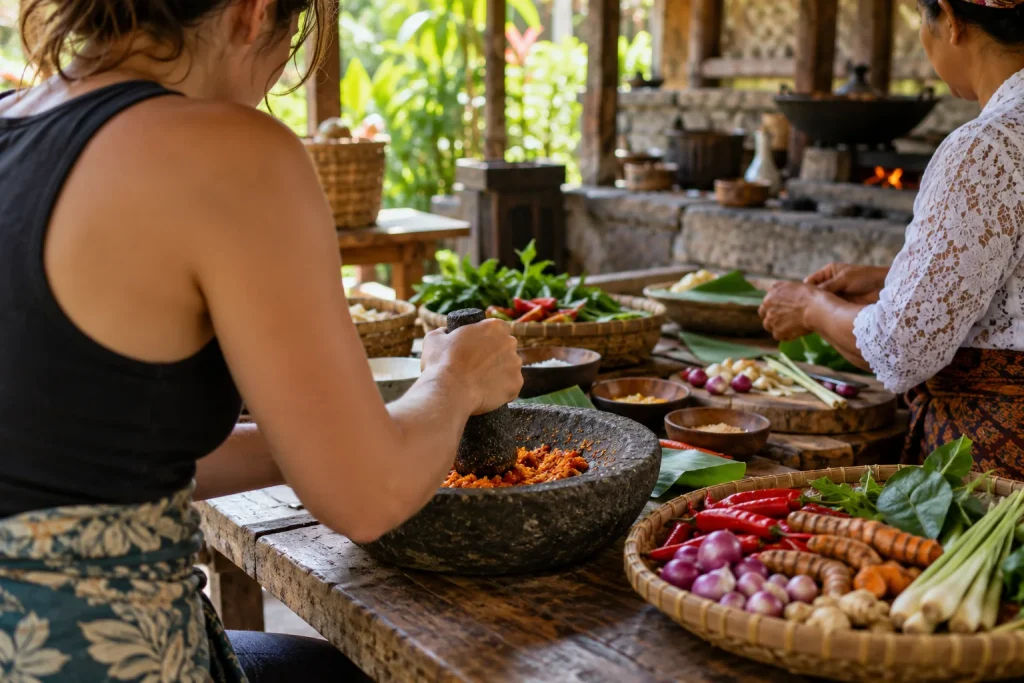
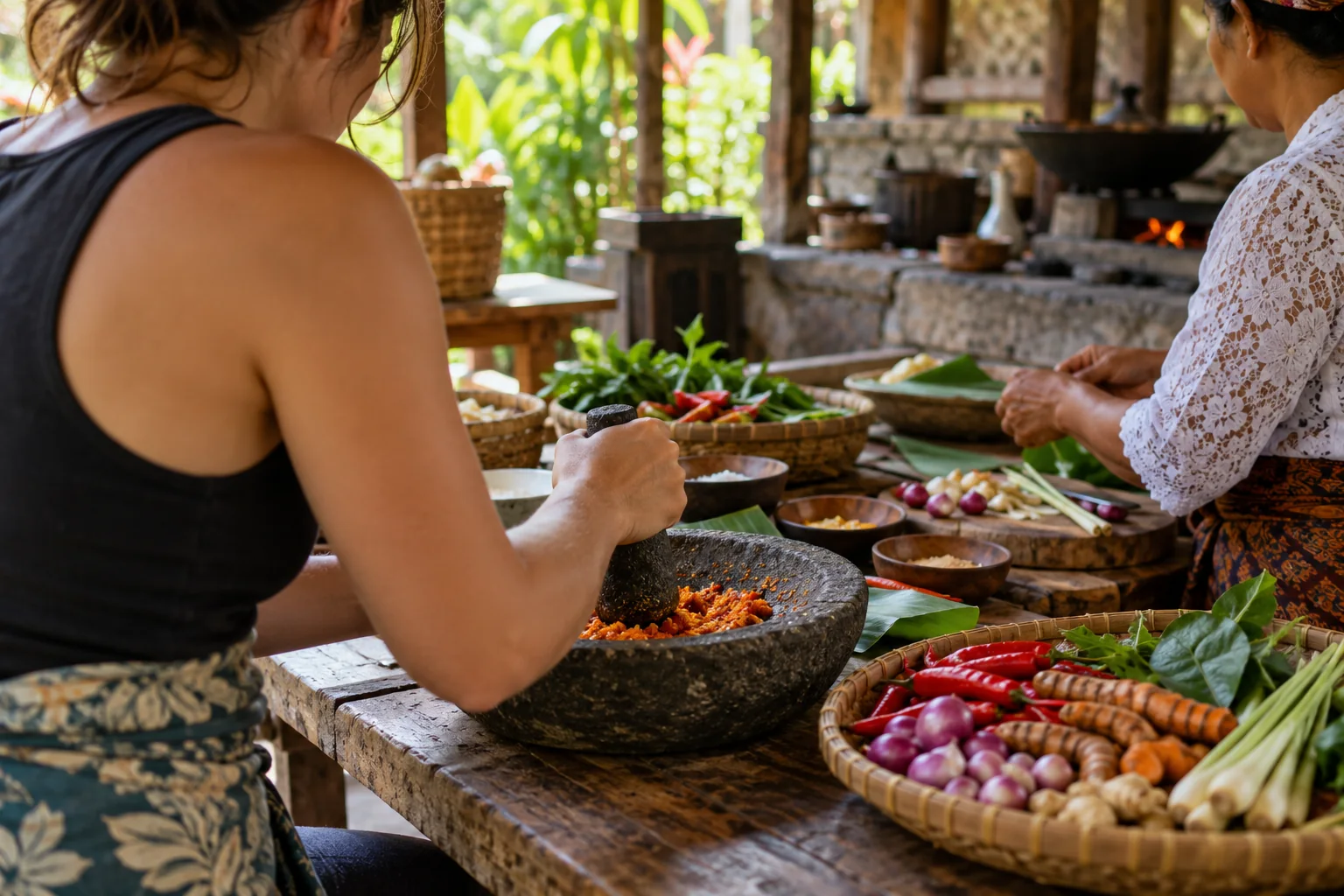
A second practical principle when evaluating first balinese cooking class is recognizing the boundary between what happens at the morning produce stalls, what happens at the stone mortar (ulekan), and how the final dishes are balanced on the plate. In our private sessions such as Private Paon Table, your group works only with your own booking party and selects up to five dishes from the 53-dish menu (plus the foundational Base Genep spice paste), allowing you to test how each choice affects flavour, texture, and timing.
Comparative Reference Matrix: 10 Core Dimensions of First Balinese Cooking Class
Before diving into each specialized subtopic in this family of guides, the table below summarizes how the ten focused questions around first balinese cooking class differ in scope, practical kitchen impact, and what you should verify before buying ingredients or confirming a menu in Ubud:
| Focus Topic / Keyword Owner | Specific Question Addressed | Key Practical Distinction in Ubud |
|---|---|---|
| 1. what happens in a balinese cooking class | What Happens in a Balinese Cooking Class? | What happens in a Balinese cooking class is easier to picture when you know which experience you have booked. A market-and-cooking session h… |
| 2. private vs shared cooking class ubud | Private or Shared? Choosing a Cooking Class in Ubud | A search for “private vs shared cooking class Ubud” usually comes down to one practical question: who will be at your table? A shared class … |
| 3. ubud cooking class vs food tour | Cooking Class or Food Tour in Ubud: Which Suits Your Day? | The useful difference in an Ubud cooking class vs food tour is what you want to do with the food. On a food tour, the emphasis is usually on… |
| 4. solo cooking class ubud | What a Private Cooking Class in Ubud Is Like When You’re Solo | A solo cooking class Ubud request does not have to mean joining a table of strangers. Wayan’s Paon lists private experiences for the booking… |
| 5. cooking class ubud booking checklist | Questions Worth Asking Before Booking a Cooking Class in Ubud | A cooking class Ubud booking checklist should make the plan easier to confirm, not turn a simple meal into paperwork. Send the host the deta… |
| 6. how long is a balinese cooking class | How Long Do Balinese Cooking Classes Take? | How long is a Balinese cooking class? There is no single duration that fits every package. A market visit adds time before cooking, while a … |
| 7. what to wear to cooking class ubud | What to Wear to a Balinese Cooking Class | If you are wondering what to wear to cooking class Ubud, start with the ordinary work of the session. You may stand at a prep table, handle … |
| 8. what to bring to cooking class ubud | What to Bring to a Cooking Class in Ubud | Most guests do not need to pack a kitchen kit for a cooking class in Ubud. The useful answer to what to bring to cooking class Ubud is: the … |
| 9. cooking class ubud morning or afternoon | Morning or Afternoon? Planning a Cooking Class Around Your Ubud Day | The question “cooking class Ubud morning or afternoon?” has a more useful answer when you compare the actual session, not just the clock. Wa… |
| 10. balinese cooking menu for beginners | Choosing a Balinese Menu for Your First Cooking Class | Choosing a Balinese cooking menu for beginners does not mean finding the five easiest dish names on a long list. Start with what you like to… |
Deep-Dive Guide to the 10 Specialized Subtopics Within First Balinese Cooking Class
Each of the ten companion articles in this topic family isolates one specific decision or ingredient question related to first balinese cooking class so that you never confuse a broad category label with a concrete culinary rule. Below is how each specialized guide fits into the wider picture:
1. What Happens in a Balinese Cooking Class?
When narrowing your focus from first balinese cooking class to the specific question of what happens in a balinese cooking class, the primary distinction is context and practical application. What happens in a Balinese cooking class is easier to picture when you know which experience you have booked. A market-and-cooking session has a different opening from a cooking-only lunch or dinner, but both can end with your group eating the food it prepared. By keeping this specific scope distinct from neighbouring topics, you avoid applying a general rule where a precise ingredient check or timing adjustment is required.
In practice at the market or in the paon, Market to Paon offers a morning produce-market visit or an evening street-food market visit with selected tastings. The morning plan is roughly: pickup around 8:00, about 30 minutes at the market, cooking beginning around 9:00 and a finish near noon. In the evening, pickup is around 16:00, the group visits the market as street food comes alive, then cooks around 17:00 and sits down to dinner near 20:00. Market activity and stalls change by day, so the host may confirm another suitable local market if the usual one is unavailable. Whether you are comparing options before booking your private session or taking notes to cook at home after your trip, treating what happens in a balinese cooking class as its own step ensures your preparation remains accurate and stress-free.
2. Private or Shared? Choosing a Cooking Class in Ubud
When narrowing your focus from first balinese cooking class to the specific question of private vs shared cooking class ubud, the primary distinction is context and practical application. A search for “private vs shared cooking class Ubud” usually comes down to one practical question: who will be at your table? A shared class brings people from separate bookings together. A private class is reserved for the group that made the booking. The difference affects conversation, pacing and how easily the group can ask questions. By keeping this specific scope distinct from neighbouring topics, you avoid applying a general rule where a precise ingredient check or timing adjustment is required.
In practice at the market or in the paon, If you enjoy meeting other travelers, a join-in table can add conversation and a sense of doing the activity together. You may hear someone ask a question you had not thought of. The trade-off is that the instructor divides attention among more people, and the session usually follows a pace that works for the whole table. Check how many guests may join, how much each person actually cooks and whether the menu is fixed. Whether you are comparing options before booking your private session or taking notes to cook at home after your trip, treating private vs shared cooking class ubud as its own step ensures your preparation remains accurate and stress-free.
3. Cooking Class or Food Tour in Ubud: Which Suits Your Day?
When narrowing your focus from first balinese cooking class to the specific question of ubud cooking class vs food tour, the primary distinction is context and practical application. The useful difference in an Ubud cooking class vs food tour is what you want to do with the food. On a food tour, the emphasis is usually on moving between places and tasting what other people have prepared. In a cooking class, preparation is part of the activity: you handle ingredients, follow techniques and sit down to a meal your group made. By keeping this specific scope distinct from neighbouring topics, you avoid applying a general rule where a precise ingredient check or timing adjustment is required.
In practice at the market or in the paon, A tour suits someone who wants to sample several ready-made foods, hear where they come from and let a guide handle the route. You may cover more stalls or dishes than you would in a cooking session, but you are there primarily to taste and observe. Ask how much walking is involved, what tastings are included and whether the route changes by day. Whether you are comparing options before booking your private session or taking notes to cook at home after your trip, treating ubud cooking class vs food tour as its own step ensures your preparation remains accurate and stress-free.
4. What a Private Cooking Class in Ubud Is Like When You’re Solo
When narrowing your focus from first balinese cooking class to the specific question of solo cooking class ubud, the primary distinction is context and practical application. A solo cooking class Ubud request does not have to mean joining a table of strangers. Wayan’s Paon lists private experiences for the booking group, including a one-guest rate. If you want to cook by yourself, ask for a date as one guest and confirm the current total before booking. By keeping this specific scope distinct from neighbouring topics, you avoid applying a general rule where a precise ingredient check or timing adjustment is required.
In practice at the market or in the paon, Market to Paon pairs a market visit with cooking. The morning version is about produce and ingredients; the evening version includes selected street-food tastings. Private Paon Table skips the market and centers the session on cooking and the meal. Both formats are private to your booking group, so a solo guest is not automatically added to another party. Whether you are comparing options before booking your private session or taking notes to cook at home after your trip, treating solo cooking class ubud as its own step ensures your preparation remains accurate and stress-free.
5. Questions Worth Asking Before Booking a Cooking Class in Ubud
When narrowing your focus from first balinese cooking class to the specific question of cooking class ubud booking checklist, the primary distinction is context and practical application. A cooking class Ubud booking checklist should make the plan easier to confirm, not turn a simple meal into paperwork. Send the host the details that affect the session and ask for the parts that are still unclear. At Wayan’s Paon, one complete request is easier to check than several messages with missing information. By keeping this specific scope distinct from neighbouring topics, you avoid applying a general rule where a precise ingredient check or timing adjustment is required.
In practice at the market or in the paon, Ask which format you are requesting: Market to Paon includes a market visit, while Private Paon Table is focused on cooking and the meal. For Market to Paon, say whether you prefer the morning produce market or the evening street-food visit. Include your preferred date and a backup if you have one. If another reservation or a flight affects your day, mention that before the session is agreed. Whether you are comparing options before booking your private session or taking notes to cook at home after your trip, treating cooking class ubud booking checklist as its own step ensures your preparation remains accurate and stress-free.
6. How Long Do Balinese Cooking Classes Take?
When narrowing your focus from first balinese cooking class to the specific question of how long is a balinese cooking class, the primary distinction is context and practical application. How long is a Balinese cooking class? There is no single duration that fits every package. A market visit adds time before cooking, while a cooking-only session follows a different pickup and meal schedule. The best estimate comes from the exact experience you are considering. By keeping this specific scope distinct from neighbouring topics, you avoid applying a general rule where a precise ingredient check or timing adjustment is required.
In practice at the market or in the paon, The morning Market to Paon plan lists pickup around 8:00, a market visit of about 30 minutes, cooking beginning around 9:00 and a finish near noon. The evening version starts with pickup around 16:00, visits a street-food market for selected tastings, begins cooking around 17:00 and finishes dinner around 20:00. Both include a private cooking session after the market stop. Whether you are comparing options before booking your private session or taking notes to cook at home after your trip, treating how long is a balinese cooking class as its own step ensures your preparation remains accurate and stress-free.
7. What to Wear to a Balinese Cooking Class
When narrowing your focus from first balinese cooking class to the specific question of what to wear to cooking class ubud, the primary distinction is context and practical application. If you are wondering what to wear to cooking class Ubud, start with the ordinary work of the session. You may stand at a prep table, handle ingredients and move between the kitchen and dining area. If your package includes a market visit, you will also be on your feet outside. Choose comfortable clothes that let you bend, reach and walk without fuss. By keeping this specific scope distinct from neighbouring topics, you avoid applying a general rule where a precise ingredient check or timing adjustment is required.
In practice at the market or in the paon, Lightweight clothes are usually more comfortable in a warm kitchen than heavy layers. A top you can move in and bottoms that stay secure while you chop or pound ingredients are practical choices. Cooking can be messy, so avoid a favorite white outfit or anything that would bother you if it picked up a small splash of coconut milk, oil or spice. Whether you are comparing options before booking your private session or taking notes to cook at home after your trip, treating what to wear to cooking class ubud as its own step ensures your preparation remains accurate and stress-free.
8. What to Bring to a Cooking Class in Ubud
When narrowing your focus from first balinese cooking class to the specific question of what to bring to cooking class ubud, the primary distinction is context and practical application. Most guests do not need to pack a kitchen kit for a cooking class in Ubud. The useful answer to what to bring to cooking class Ubud is: the booking information you need, a way to share dietary details and only the personal items that fit the experience you chose. By keeping this specific scope distinct from neighbouring topics, you avoid applying a general rule where a precise ingredient check or timing adjustment is required.
In practice at the market or in the paon, Keep your confirmed pickup details and Wayan’s contact information accessible on your phone. If you have food allergies or dietary restrictions, write them down clearly so you can describe them before the menu is finalized. Do not wait until the group is standing at the cooking station to explain something that affects the dishes. Whether you are comparing options before booking your private session or taking notes to cook at home after your trip, treating what to bring to cooking class ubud as its own step ensures your preparation remains accurate and stress-free.
9. Morning or Afternoon? Planning a Cooking Class Around Your Ubud Day
When narrowing your focus from first balinese cooking class to the specific question of cooking class ubud morning or afternoon, the primary distinction is context and practical application. The question “cooking class Ubud morning or afternoon?” has a more useful answer when you compare the actual session, not just the clock. Wayan’s Paon lists a morning produce-market visit and an evening street-food market visit for Market to Paon. Private Paon Table offers lunch and dinner timing without a market stop. By keeping this specific scope distinct from neighbouring topics, you avoid applying a general rule where a precise ingredient check or timing adjustment is required.
In practice at the market or in the paon, The morning Market to Paon session is built around a busy produce market. Published estimates put pickup around 8:00, the market visit at about 30 minutes, cooking around 9:00 and a finish near noon. It suits a group that wants to see ingredients before preparing its chosen dishes and would like the rest of the day free afterward. Whether you are comparing options before booking your private session or taking notes to cook at home after your trip, treating cooking class ubud morning or afternoon as its own step ensures your preparation remains accurate and stress-free.
10. Choosing a Balinese Menu for Your First Cooking Class
When narrowing your focus from first balinese cooking class to the specific question of balinese cooking menu for beginners, the primary distinction is context and practical application. Choosing a Balinese cooking menu for beginners does not mean finding the five easiest dish names on a long list. Start with what you like to eat, then pick a few different preparations that will teach you something. A useful menu has variety without making the session feel like a race. By keeping this specific scope distinct from neighbouring topics, you avoid applying a general rule where a precise ingredient check or timing adjustment is required.
In practice at the market or in the paon, Most Wayan’s Paon packages let your group choose up to five dishes from a library of more than 30. You might combine one grilled or wrapped dish, one vegetable, a rice or staple dish, and a sambal or sweet if those options fit your chosen package. The idea is to see different ingredients and techniques, not to reach the maximum just because it is available. Whether you are comparing options before booking your private session or taking notes to cook at home after your trip, treating balinese cooking menu for beginners as its own step ensures your preparation remains accurate and stress-free.
How to Apply These Notes When Planning Your Private Cooking Day at Wayan’s Paon
Bringing all ten facets of first balinese cooking class together reveals a consistent lesson about Balinese culinary culture: clarity comes from asking specific questions before the cooking begins. In a private household setting in Ubud, your host does not rely on factory-made pastes or rigid group schedules. Instead, fresh roots (galangal, turmeric, ginger, and aromatic kencur), shallots, garlic, lemongrass, salam leaves, and kaffir lime are proportioned for the exact five dishes your group chooses to cook.
If you have dietary requirements—such as vegetarian or vegan preparation without fermented shrimp paste (terasi), gluten-free substitutions using pure rice flour and palm sugar (Gula Aren), dairy-free coconut milk infusions, or nut-free spice pastes omitting candlenut (kemiri)—discussing them when you select your menu allows the kitchen to prepare dedicated mortars, cutting boards, and filtered drinking-water washing stations in advance.
Finally, use this pillar overview on first balinese cooking class alongside the ten focused cluster guides linked above whenever you want to verify a local Balinese term, compare morning market timing against afternoon kitchen sessions, or adapt a traditional Ubud technique for your own stove at home.