
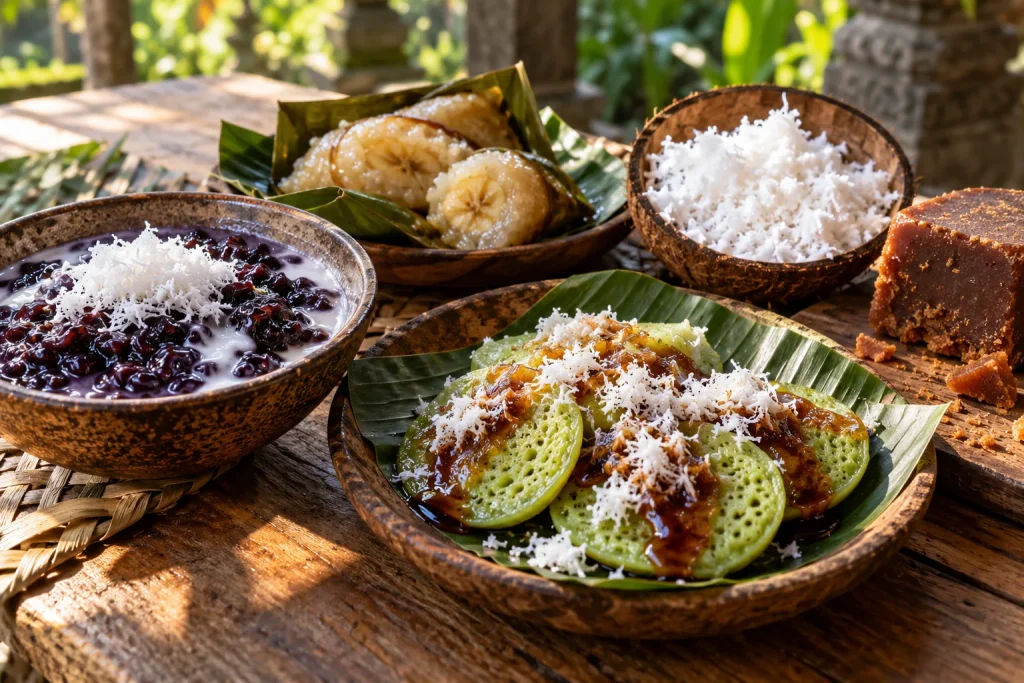

Balinese desserts are easier to understand as a family of small sweets than as one fixed course at the end of a meal. Rice flour, glutinous rice, coconut, banana and palm sugar appear in different combinations. Some cakes are soft and warm; others are chewy, sticky or served with a spoon. The same ingredient can behave differently depending on how it is mixed and cooked. When examining balinese desserts in the context of everyday kitchen work and guest planning in Gianyar and Ubud, separating specific ingredient names, preparation timing, and household customs prevents common misunderstandings before you shop or cook. When examining balinese desserts in the context of everyday kitchen work and guest planning in Gianyar and Ubud, separating specific ingredient names, preparation timing, and household customs prevents common misunderstandings before you shop or cook.
Start with the grain
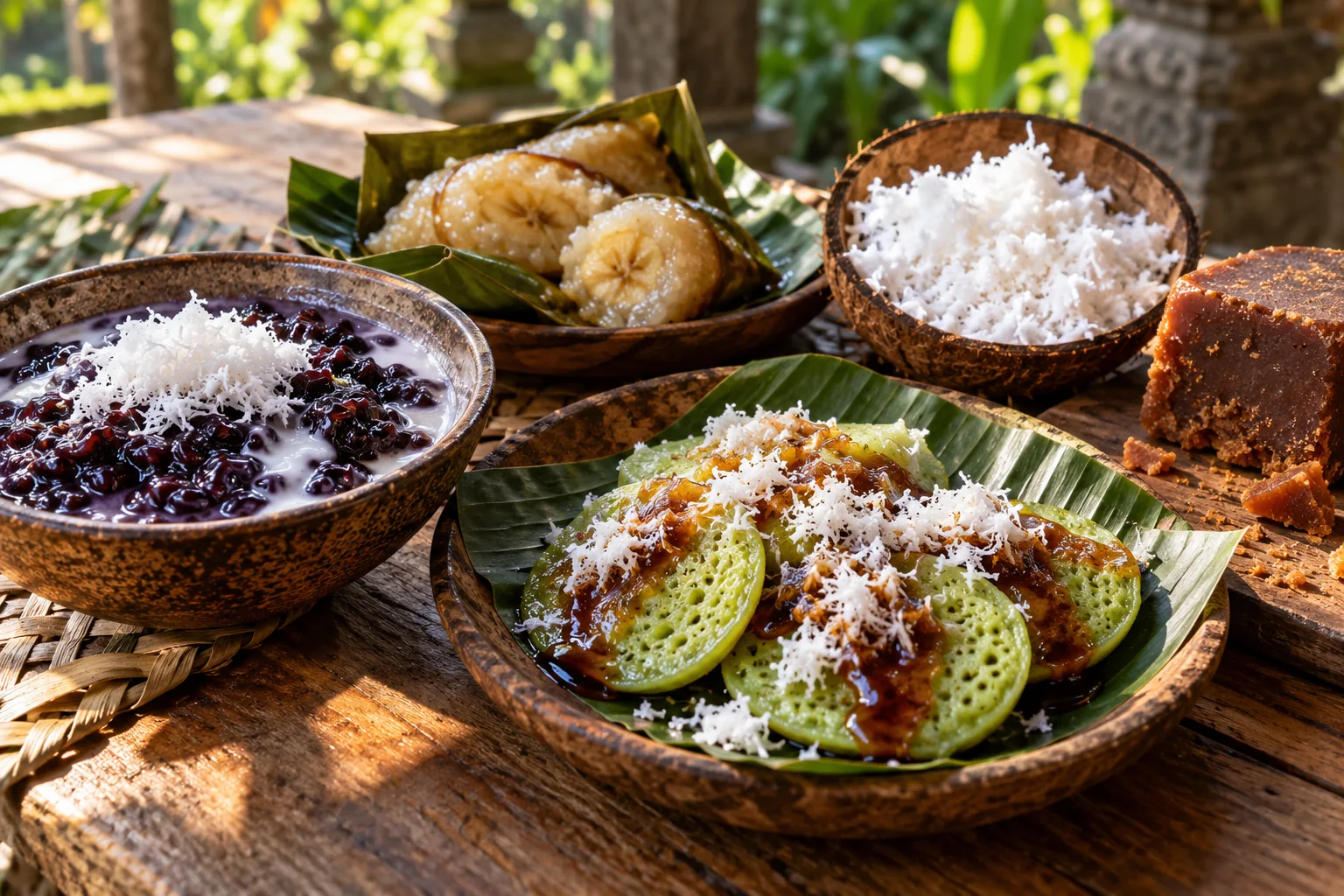
Rice flour and glutinous rice flour are not interchangeable in every recipe. Rice flour can produce a tender batter or a soft coating, while glutinous rice flour is valued for its elastic, chewy result. Whole glutinous rice, as in Bubur Injin, gives another texture again: the grains soften slowly into a pudding-like bowl. The word “glutinous” describes stickiness; it does not mean the rice contains wheat gluten. Anyone avoiding gluten for medical reasons still needs to check ingredients and cross-contact with the host.
Coconut does more than garnish
Fresh grated coconut gives a light, fibrous finish. Coconut milk or cream adds moisture and richness to a sauce or pudding. These forms are related but not identical: a topping should not drown a delicate cake, and a thin coconut liquid will not behave like thick cream. A small pinch of salt can make sweetness taste more rounded, while a generous amount can shift the dish toward savoury.
Palm sugar brings depth
Palm sugar is often melted into a syrup or mixed into a filling. Its caramel-like aroma can pair well with rice and coconut, but the sweetness level and texture vary by product and by cook. A syrup should coat a spoon and flow; a filling needs to stay put when the cake is cut or wrapped. Taste as you go instead of assuming that every palm sugar needs the same amount of water or cooking time.
Choose by texture and occasion
When planning a group of sweets, compare cooking method as well as ingredients. A soft griddled cake, a chewy dumpling and a spoonable black-rice pudding give a table more contrast than three dishes with the same texture. Balinese jaje may be enjoyed as everyday snacks, while particular foods also have ceremonial or community contexts. Those uses vary, so a visitor should not label every sweet a ritual food without checking the setting.
The site’s Balinese sweet menu lists dishes and class options, but availability and the final combination should be confirmed for a chosen date. If you want to practise the techniques with a host rather than only read about them, the Cooking Class Ubud homepage shows the current cooking experiences and booking details.
How A Guide to Balinese Desserts Made with Rice, Coconut and Palm Sugar Connects Market Observation, Kitchen Technique, and Practical Planning in Ubud
For travellers and home cooks researching balinese desserts, the biggest gap in general travel guides is that they treat Balinese food and daily life as a single uniform checklist rather than a living household system. In a traditional Balinese compound around Ubud, decisions about ingredients, prep sequence, and table pairing depend on whether a meal is prepared for a quiet family lunch, a morning market run, or a shared gathering. When you join an Ubud Cooking Class at Wayan’s Paon, every question around balinese desserts is answered through direct hands-on observation rather than abstract theory.
A second practical principle when evaluating balinese desserts is recognizing the boundary between what happens at the morning produce stalls, what happens at the stone mortar (ulekan), and how the final dishes are balanced on the plate. In our private sessions such as Balinese Sweet Cooking Class, your group works only with your own booking party and selects up to five dishes from the 53-dish menu (plus the foundational Base Genep spice paste), allowing you to test how each choice affects flavour, texture, and timing.
Comparative Reference Matrix: 10 Core Dimensions of Balinese Desserts
Before diving into each specialized subtopic in this family of guides, the table below summarizes how the ten focused questions around balinese desserts differ in scope, practical kitchen impact, and what you should verify before buying ingredients or confirming a menu in Ubud:
| Focus Topic / Keyword Owner | Specific Question Addressed | Key Practical Distinction in Ubud |
|---|---|---|
| 1. rice flour balinese desserts | How Rice Flour Changes the Texture of Balinese Sweets | Rice flour balinese desserts can look simple on a menu, yet the flour does not produce one standard texture. A small pancake, a steamed cake… |
| 2. palm sugar balinese desserts | Using Palm Sugar in Balinese Desserts, from Syrups to Fillings | Palm sugar balinese desserts often use the same ingredient in two different forms: a loose syrup poured over a cake, or a thicker mixture tu… |
| 3. coconut in balinese desserts | Fresh Coconut or Coconut Milk? Choosing the Right Finish for Balinese Sweets | Coconut in balinese desserts can be a garnish, a sauce or part of the mixture itself. Those forms do not behave the same way. Grated coconut… |
| 4. balinese dessert cooking methods | Steamed, Fried or Griddled? How Balinese Sweet Cakes Are Made | Balinese dessert cooking methods shape the final bite as much as the ingredient list. A rice-flour batter can be steamed into a tender cake,… |
| 5. balinese sweets for ceremonies | When Balinese Sweets Are Shared at Ceremonies | Balinese sweets for ceremonies should be discussed with care. The word jaje refers broadly to cakes and small sweets, but it does not mean e… |
| 6. vegan balinese desserts | Can Balinese Desserts Be Made Vegan? Ingredients to Check | Vegan balinese desserts are possible when the ingredients and preparation suit the person eating them. Rice, fruit, palm sugar and coconut a… |
| 7. gluten free balinese sweets | Can Rice Flour Make Balinese Sweets Gluten-Free? | Gluten free balinese sweets may use rice flour or glutinous rice, but the ingredient name alone cannot confirm that the finished dish is saf… |
| 8. balinese dessert textures | Balinese Sweets by Texture: Chewy, Soft, Sticky or Crisp | Balinese dessert textures make a useful guide when the names are unfamiliar. A sweet may be soft, chewy, sticky or crisp, and the texture of… |
| 9. balinese sweet menu | How to Plan a Balinese Sweet Menu Around Fruit, Coconut and Rice | A balinese sweet menu is easier to plan when each dish has a role. Rice may bring structure, fruit adds freshness, coconut gives richness an… |
| 10. what to serve with balinese sweets | Coffee, Tea or Something Cold? What to Serve with Balinese Sweets | What to serve with balinese sweets depends on the dish and the moment. A palm-sugar syrup or rich coconut sauce can make a sweet feel full, … |
Deep-Dive Guide to the 10 Specialized Subtopics Within Balinese Desserts
Each of the ten companion articles in this topic family isolates one specific decision or ingredient question related to balinese desserts so that you never confuse a broad category label with a concrete culinary rule. Below is how each specialized guide fits into the wider picture:
1. How Rice Flour Changes the Texture of Balinese Sweets
When narrowing your focus from balinese desserts to the specific question of rice flour balinese desserts, the primary distinction is context and practical application. Rice flour balinese desserts can look simple on a menu, yet the flour does not produce one standard texture. A small pancake, a steamed cake and a coating around banana all ask different things of the batter. The useful question is not only “which flour?” but also how much liquid, how the mixture is handled and where the heat comes from. By keeping this specific scope distinct from neighbouring topics, you avoid applying a general rule where a precise ingredient check or timing adjustment is required.
In practice at the market or in the paon, Regular rice flour can give a soft, tender structure when it is mixed into a pourable batter. Glutinous rice flour has a different starch profile and tends toward a more elastic, chewy bite. Whole glutinous rice softens into a spoonable pudding when simmered. These ingredients may all be rice-based, but swapping one for another can change the result enough to make the dish feel like something else. Whether you are comparing options before booking your private session or taking notes to cook at home after your trip, treating rice flour balinese desserts as its own step ensures your preparation remains accurate and stress-free.
2. Using Palm Sugar in Balinese Desserts, from Syrups to Fillings
When narrowing your focus from balinese desserts to the specific question of palm sugar balinese desserts, the primary distinction is context and practical application. Palm sugar balinese desserts often use the same ingredient in two different forms: a loose syrup poured over a cake, or a thicker mixture tucked inside a sweet. The difference is more than presentation. A syrup should spread across the plate; a filling needs to hold together when the dessert is picked up or cut. By keeping this specific scope distinct from neighbouring topics, you avoid applying a general rule where a precise ingredient check or timing adjustment is required.
In practice at the market or in the paon, Palm sugar can have a deep, rounded aroma, but its sweetness and moisture vary. Break a block into small pieces so it dissolves evenly, then warm it gently with a little water. Stir only as needed and watch how quickly the mixture thickens. A syrup that looks thin while hot will become thicker as it cools, so avoid reducing it until it is sticky unless the dish calls for that finish. Whether you are comparing options before booking your private session or taking notes to cook at home after your trip, treating palm sugar balinese desserts as its own step ensures your preparation remains accurate and stress-free.
3. Fresh Coconut or Coconut Milk? Choosing the Right Finish for Balinese Sweets
When narrowing your focus from balinese desserts to the specific question of coconut in balinese desserts, the primary distinction is context and practical application. Coconut in balinese desserts can be a garnish, a sauce or part of the mixture itself. Those forms do not behave the same way. Grated coconut gives a soft, fibrous finish; coconut milk adds liquid and body; thick coconut cream can make a pudding feel richer. Choosing one by habit may leave a delicate rice cake too wet or a bowl of black rice without enough contrast. By keeping this specific scope distinct from neighbouring topics, you avoid applying a general rule where a precise ingredient check or timing adjustment is required.
In practice at the market or in the paon, Freshly grated coconut can add a gentle chew and a clean aroma to a soft cake or banana sweet. It works best when sprinkled close to serving so it stays distinct instead of becoming soggy. Some cooks lightly steam or otherwise prepare the coconut before serving, but the right treatment depends on the dish and local practice. Keep the topping modest enough to let the rice or fruit remain noticeable. Whether you are comparing options before booking your private session or taking notes to cook at home after your trip, treating coconut in balinese desserts as its own step ensures your preparation remains accurate and stress-free.
4. Steamed, Fried or Griddled? How Balinese Sweet Cakes Are Made
When narrowing your focus from balinese desserts to the specific question of balinese dessert cooking methods, the primary distinction is context and practical application. Balinese dessert cooking methods shape the final bite as much as the ingredient list. A rice-flour batter can be steamed into a tender cake, cooked on a griddle until its surface sets, or fried for a richer, more browned finish. These are broad comparisons rather than rules for every named sweet: recipes and household methods vary. By keeping this specific scope distinct from neighbouring topics, you avoid applying a general rule where a precise ingredient check or timing adjustment is required.
In practice at the market or in the paon, Steam surrounds the food with gentle heat. It is useful when a cake needs to set without a dry crust, or when a wrapped parcel should stay soft. Because steam is humid, the surface may remain delicate after cooking. Let a sweet settle before moving it, and make sure the centre is cooked through rather than relying only on the outside appearance. Whether you are comparing options before booking your private session or taking notes to cook at home after your trip, treating balinese dessert cooking methods as its own step ensures your preparation remains accurate and stress-free.
5. When Balinese Sweets Are Shared at Ceremonies
When narrowing your focus from balinese desserts to the specific question of balinese sweets for ceremonies, the primary distinction is context and practical application. Balinese sweets for ceremonies should be discussed with care. The word jaje refers broadly to cakes and small sweets, but it does not mean every snack has the same role. Some foods are prepared for ordinary eating, some may be part of a gathering, and particular foods can be included in offerings or ceremonial meals. The occasion, community and preparation matter. By keeping this specific scope distinct from neighbouring topics, you avoid applying a general rule where a precise ingredient check or timing adjustment is required.
In practice at the market or in the paon, Visitors may see small cakes at a market, in a home or near a ceremony and assume that the same sweet always has a ritual purpose. That is too simple. A food’s role can depend on the specific event and how it is presented. A plate of laklak sold as a snack is not automatically an offering, and not every Balinese dessert should be described as sacred. Whether you are comparing options before booking your private session or taking notes to cook at home after your trip, treating balinese sweets for ceremonies as its own step ensures your preparation remains accurate and stress-free.
6. Can Balinese Desserts Be Made Vegan? Ingredients to Check
When narrowing your focus from balinese desserts to the specific question of vegan balinese desserts, the primary distinction is context and practical application. Vegan balinese desserts are possible when the ingredients and preparation suit the person eating them. Rice, fruit, palm sugar and coconut are plant-based, and several sweets can be prepared without dairy or eggs. But a traditional-sounding name does not prove that every version is vegan. Recipes change between cooks, and a topping or cooking fat can alter the answer. By keeping this specific scope distinct from neighbouring topics, you avoid applying a general rule where a precise ingredient check or timing adjustment is required.
In practice at the market or in the paon, Ask about the batter, filling, sauce and garnish separately. A cake may be made from rice flour yet finished with a dairy ingredient. Coconut milk is plant-based, but it may be served alongside another topping. A sweet cooked in oil can still share a pan or utensils with non-vegan food. Request the ingredients in the version that will actually be prepared, not only a general description of the dish. Whether you are comparing options before booking your private session or taking notes to cook at home after your trip, treating vegan balinese desserts as its own step ensures your preparation remains accurate and stress-free.
7. Can Rice Flour Make Balinese Sweets Gluten-Free?
When narrowing your focus from balinese desserts to the specific question of gluten free balinese sweets, the primary distinction is context and practical application. Gluten free balinese sweets may use rice flour or glutinous rice, but the ingredient name alone cannot confirm that the finished dish is safe for someone with coeliac disease or another serious gluten-related condition. “Glutinous” describes a sticky texture; it does not mean that the rice contains wheat gluten. The rest of the recipe and the kitchen process still matter. By keeping this specific scope distinct from neighbouring topics, you avoid applying a general rule where a precise ingredient check or timing adjustment is required.
In practice at the market or in the paon, Rice flour, black glutinous rice and coconut are naturally gluten-free ingredients. A dessert can still include a sauce, flavouring, thickener or packaged product that needs checking. Ask whether any wheat-based ingredient is used and whether the ingredients come from labelled packages. If the answer is uncertain, choose another option or avoid the dish. Whether you are comparing options before booking your private session or taking notes to cook at home after your trip, treating gluten free balinese sweets as its own step ensures your preparation remains accurate and stress-free.
8. Balinese Sweets by Texture: Chewy, Soft, Sticky or Crisp
When narrowing your focus from balinese desserts to the specific question of balinese dessert textures, the primary distinction is context and practical application. Balinese dessert textures make a useful guide when the names are unfamiliar. A sweet may be soft, chewy, sticky or crisp, and the texture often hints at the grain and cooking method. It does not identify the recipe by itself, but it helps a visitor choose a plate with more variety. By keeping this specific scope distinct from neighbouring topics, you avoid applying a general rule where a precise ingredient check or timing adjustment is required.
In practice at the market or in the paon, Rice-flour batter cooked on a small griddle can produce a tender cake with a lightly set surface. A rice-flour coating around banana is soft and moist rather than crunchy. These sweets are easy to eat warm, but their delicate structure can become heavy if they are covered with too much syrup or coconut topping. Whether you are comparing options before booking your private session or taking notes to cook at home after your trip, treating balinese dessert textures as its own step ensures your preparation remains accurate and stress-free.
9. How to Plan a Balinese Sweet Menu Around Fruit, Coconut and Rice
When narrowing your focus from balinese desserts to the specific question of balinese sweet menu, the primary distinction is context and practical application. A balinese sweet menu is easier to plan when each dish has a role. Rice may bring structure, fruit adds freshness, coconut gives richness and palm sugar supplies depth. The aim is not to place every ingredient on one plate; it is to choose a few sweets that taste different and still fit the meal. By keeping this specific scope distinct from neighbouring topics, you avoid applying a general rule where a precise ingredient check or timing adjustment is required.
In practice at the market or in the paon, Start with the kind of sweet you want to serve: a soft griddled cake, a chewy rice dumpling, a banana-based bite or a spoonable black-rice pudding. Then add a second item that contrasts with it. Two very soft, syrup-heavy desserts can feel repetitive even when their names and colours differ. Whether you are comparing options before booking your private session or taking notes to cook at home after your trip, treating balinese sweet menu as its own step ensures your preparation remains accurate and stress-free.
10. Coffee, Tea or Something Cold? What to Serve with Balinese Sweets
When narrowing your focus from balinese desserts to the specific question of what to serve with balinese sweets, the primary distinction is context and practical application. What to serve with balinese sweets depends on the dish and the moment. A palm-sugar syrup or rich coconut sauce can make a sweet feel full, while a plain rice cake may invite a stronger drink. There is no single pairing that fits every household or occasion, so plan for balance rather than presenting one combination as a rule of Balinese food culture. By keeping this specific scope distinct from neighbouring topics, you avoid applying a general rule where a precise ingredient check or timing adjustment is required.
In practice at the market or in the paon, Unsweetened coffee gives a more bitter counterpoint to palm sugar and coconut. A small cup can work well after a meal or with a snack, especially when the dessert is not already paired with a sweet drink. Coffee styles and roast levels vary, so let guests choose the strength they prefer. Whether you are comparing options before booking your private session or taking notes to cook at home after your trip, treating what to serve with balinese sweets as its own step ensures your preparation remains accurate and stress-free.
How to Apply These Notes When Planning Your Private Cooking Day at Wayan’s Paon
Bringing all ten facets of balinese desserts together reveals a consistent lesson about Balinese culinary culture: clarity comes from asking specific questions before the cooking begins. In a private household setting in Ubud, your host does not rely on factory-made pastes or rigid group schedules. Instead, fresh roots (galangal, turmeric, ginger, and aromatic kencur), shallots, garlic, lemongrass, salam leaves, and kaffir lime are proportioned for the exact five dishes your group chooses to cook.
If you have dietary requirements—such as vegetarian or vegan preparation without fermented shrimp paste (terasi), gluten-free substitutions using pure rice flour and palm sugar (Gula Aren), dairy-free coconut milk infusions, or nut-free spice pastes omitting candlenut (kemiri)—discussing them when you select your menu allows the kitchen to prepare dedicated mortars, cutting boards, and filtered drinking-water washing stations in advance.
Finally, use this pillar overview on balinese desserts alongside the ten focused cluster guides linked above whenever you want to verify a local Balinese term, compare morning market timing against afternoon kitchen sessions, or adapt a traditional Ubud technique for your own stove at home.