
Balinese cooking techniques make more sense when you look at what each method does to an ingredient. Grinding breaks aromatics into a paste. A banana-leaf parcel protects a filling from direct heat. A covered, slow cook gives a larger piece of meat time to soften, while a hot grill adds a browned or smoky surface. These methods are related, but they are not interchangeable steps in one standard recipe. When examining balinese cooking techniques in the context of everyday kitchen work and guest planning in Gianyar and Ubud, separating specific ingredient names, preparation timing, and household customs prevents common misunderstandings before you shop or cook. When examining balinese cooking techniques in the context of everyday kitchen work and guest planning in Gianyar and Ubud, separating specific ingredient names, preparation timing, and household customs prevents common misunderstandings before you shop or cook.
Start with the texture of the spice base
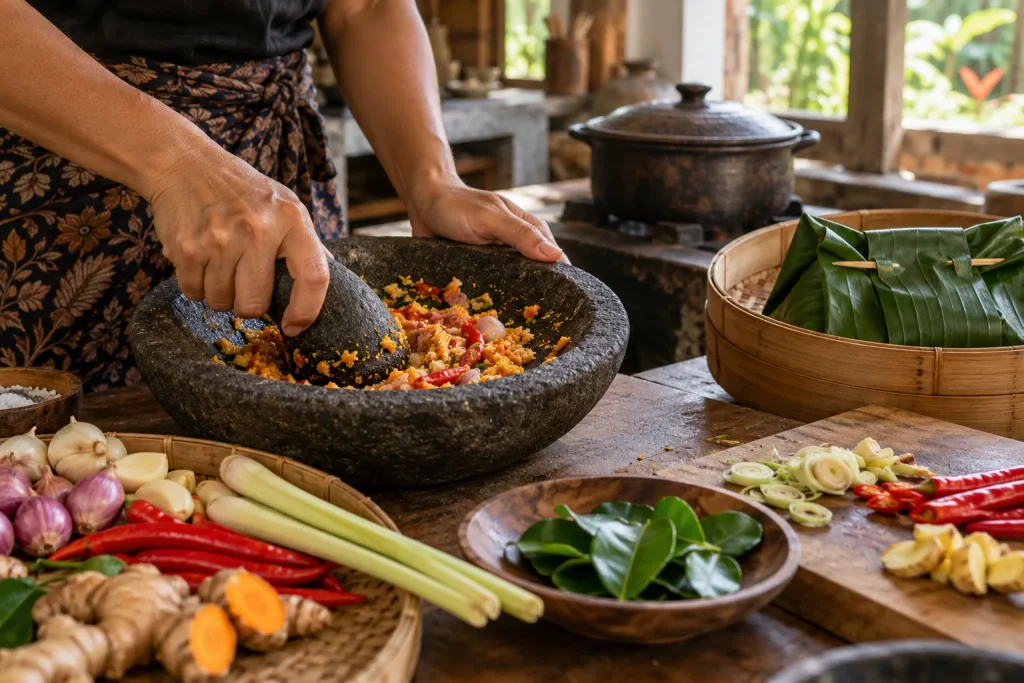
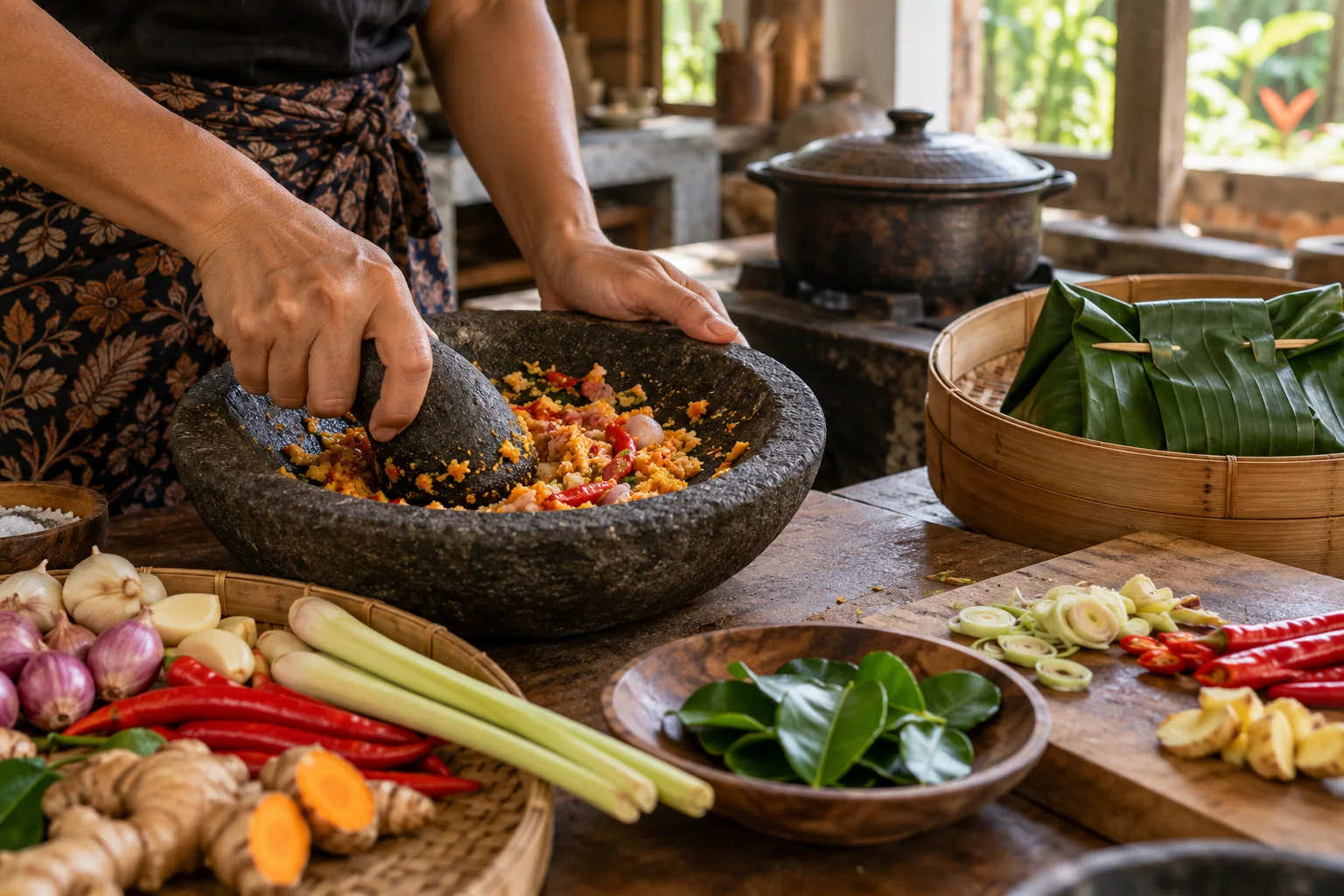
Fresh aromatics such as shallot, garlic, chilli, ginger, turmeric and lemongrass can be crushed by hand or processed in a machine. A stone mortar gives a cook close control over a small batch and makes it easy to stop while the mixture is still coarse. A blender works quickly for a larger amount, though small batches may need short pulses and scraping. Add only enough liquid for the ingredients to move; a watery paste takes longer to cook down.
Match the heat to the food
The next step depends on the dish. Dry spices may be toasted when a recipe calls for it. A cooked base can be fried gently so its raw aroma mellows before the main ingredient goes in. Fresh sambal matah is different: its sliced aromatics are mixed shortly before serving, and frying would change its fresh character. Follow the dish rather than assuming every spice mixture should be toasted, ground smooth and fried in the same order.
Prepare banana leaves to fold cleanly
Betutu is associated with a slow, covered cook and a generous spice mixture. The size of the bird or portion, the vessel and the heat all affect the time, so a fixed number of hours cannot be transferred between every kitchen. Keep poultry covered as the recipe directs and use a reliable thermometer to check that it is safely cooked.
Give rice its own timing
Pepes ikan and tum ayam use leaf parcels for a different reason. The wrapping keeps fish or seasoned chicken with its aromatics while steam cooks the filling. Pepes may be finished on a grill in some recipes, but it can also be served after steaming. Tum ayam is generally portioned into smaller parcels. Their folds help hold the filling together; they are not a guarantee that every parcel is sealed against liquid or heat.
Finish the meal in a useful order
Direct grilling gives the fish more contact with the grate and makes browning visible. A banana-leaf wrap shields delicate flesh and produces a softer result. A cook can choose between them by considering the fish, the seasoning and the texture wanted at the table. Finely ground spices can darken before a thick piece cooks through, so moderate heat and similar portion sizes make the result easier to manage.
Stiff leaves can split at the corners. Briefly warming or steaming them makes them easier to bend. Wipe the surface, cut a piece large enough for an overlap and leave room around the filling. A second layer can cover a tear. Fold the long sides first, then tuck the ends underneath or secure them as the recipe requires. Leave gaps in the steamer so steam can circulate around the parcels.
Opening a hot parcel releases trapped steam, so let it stand briefly and handle it carefully. If the recipe calls for a grilled finish, use that stage for aroma and light charring on the outside of the leaf. Do not assume that every steamed parcel needs the same finish.
Rice varieties, storage age and cooking equipment affect how much water a batch needs. Use the package or tested recipe for the grain in front of you, measure the water and keep the lid closed during cooking. A rice cooker and a saucepan do not always use the same ratio. Let the pot stand covered after the heat stops, then fluff the grains gently. This short rest helps the rice serve cleanly beside moist stews, grilled fish and fresh sambal.
Begin with the dish that needs the longest steady heat. While it cooks, measure spice ingredients, prepare leaves, wash vegetables and set out serving dishes. Keep raw meat and fish separate from ingredients that will be served fresh. Start rice early enough to rest, but avoid letting it sit for hours. Grill delicate fish and cook quick vegetables close to serving; mix fresh sambal near the end so its sliced aromatics stay bright.
This sequence is a planning aid, not a rule for every Balinese household or menu. A meal with a long-cooked betutu needs a different timeline from one built around fresh fish and quick greens. Keep the recipe, equipment and portion sizes in view, and allow a little time for a dish to finish.
Visitors who want to ask about these methods in a hands-on setting can check the current menu and class formats on the Cooking Class Ubud homepage before choosing a date.
How Balinese Cooking Techniques: Spice Pastes, Leaf Wraps and Heat Connects Market Observation, Kitchen Technique, and Practical Planning in Ubud
For travellers and home cooks researching balinese cooking techniques, the biggest gap in general travel guides is that they treat Balinese food and daily life as a single uniform checklist rather than a living household system. In a traditional Balinese compound around Ubud, decisions about ingredients, prep sequence, and table pairing depend on whether a meal is prepared for a quiet family lunch, a morning market run, or a shared gathering. When you join an Ubud Cooking Class at Wayan’s Paon, every question around balinese cooking techniques is answered through direct hands-on observation rather than abstract theory.
A second practical principle when evaluating balinese cooking techniques is recognizing the boundary between what happens at the morning produce stalls, what happens at the stone mortar (ulekan), and how the final dishes are balanced on the plate. In our private sessions such as Market to Paon, your group works only with your own booking party and selects up to five dishes from the 53-dish menu (plus the foundational Base Genep spice paste), allowing you to test how each choice affects flavour, texture, and timing.
Comparative Reference Matrix: 10 Core Dimensions of Balinese Cooking Techniques
Before diving into each specialized subtopic in this family of guides, the table below summarizes how the ten focused questions around balinese cooking techniques differ in scope, practical kitchen impact, and what you should verify before buying ingredients or confirming a menu in Ubud:
| Focus Topic / Keyword Owner | Specific Question Addressed | Key Practical Distinction in Ubud |
|---|---|---|
| 1. mortar vs blender balinese spice paste | Mortar or Blender? Grinding a Balinese Spice Paste at Home | A *mortar vs blender balinese spice paste* decision is mostly about the texture you want and the amount you need to make. A mortar gives you… |
| 2. slow cooked betutu technique | How Slow Cooking Gives Betutu Its Tender Texture | The *slow cooked betutu technique* is easier to understand when you separate the seasoning from the cooking. Betutu is known for a generous … |
| 3. pepes ikan steaming method | What a Banana-Leaf Wrap Does for Steamed Pepes Ikan | In a *pepes ikan steaming method*, the banana leaf does more than make a parcel look attractive. It keeps the fish and seasoning together wh… |
| 4. tum ayam wrapping technique | Folding and Steaming Tum Ayam in Banana Leaves | The *tum ayam wrapping technique* is about making a small parcel that holds seasoned chicken without squeezing it into a dense lump. Tum aya… |
| 5. balinese fish grilling methods | Choosing Between Spice, Banana Leaf and Direct Heat for Grilled Fish | *Balinese fish grilling methods* are not one fixed recipe. A cook can season fish with a spice paste and place it directly over heat, protec… |
| 6. balinese rice cooking method | A Simple Method for Getting Balinese Steamed Rice Right | A reliable *balinese rice cooking method* starts with the rice in your kitchen, not with a single water ratio claimed to work everywhere. Gr… |
| 7. balinese spice preparation steps | Toast, Grind or Fry? The Order Behind Balinese Spice Pastes | *Balinese spice preparation steps* depend on what the finished dish needs. A fresh sambal is not handled like a cooked base, and a dry spice… |
| 8. balinese meal cooking order | What to Cook First When Preparing a Balinese Meal | A practical *balinese meal cooking order* begins with the task that needs the most time, not the dish that looks most impressive. A slow-coo… |
| 9. balinese meal timing | How to Time Sambal, Vegetables and Grilled Dishes for One Meal | Good *balinese meal timing* is less about starting every dish at once and more about knowing which parts hold and which lose their best text… |
| 10. balinese curry paste recipe | Balinese Curry Paste Recipe for a Small Home Batch | This balinese curry paste recipe is a small home batch built around fresh roots, shallots, garlic and chilli. Balinese bumbu changes from ho… |
Deep-Dive Guide to the 10 Specialized Subtopics Within Balinese Cooking Techniques
Each of the ten companion articles in this topic family isolates one specific decision or ingredient question related to balinese cooking techniques so that you never confuse a broad category label with a concrete culinary rule. Below is how each specialized guide fits into the wider picture:
1. Mortar or Blender? Grinding a Balinese Spice Paste at Home
When narrowing your focus from balinese cooking techniques to the specific question of mortar vs blender balinese spice paste, the primary distinction is context and practical application. A *mortar vs blender balinese spice paste* decision is mostly about the texture you want and the amount you need to make. A mortar gives you a close feel for each ingredient as it breaks down. A blender is faster for a larger batch, but it can turn a small amount into a thin, wet mixture unless you work in short pulses. Neither tool makes a paste automatically better; the cook still has to choose the right consistency for the dish. By keeping this specific scope distinct from neighbouring topics, you avoid applying a general rule where a precise ingredient check or timing adjustment is required.
In practice at the market or in the paon, A stone mortar is useful when you want a coarse, textured paste or when the batch is too small for blender blades to catch. Cut fibrous roots and lemongrass into manageable pieces first. Work gradually, starting with the firmest ingredients and adding softer ones as they become easier to crush. The pestle’s pressure breaks and smears the ingredients together, so you can pause when the paste is still slightly textured instead of grinding it completely smooth. This takes time, but the sound and resistance make the progress easy to judge. Whether you are comparing options before booking your private session or taking notes to cook at home after your trip, treating mortar vs blender balinese spice paste as its own step ensures your preparation remains accurate and stress-free.
2. How Slow Cooking Gives Betutu Its Tender Texture
When narrowing your focus from balinese cooking techniques to the specific question of slow cooked betutu technique, the primary distinction is context and practical application. The *slow cooked betutu technique* is easier to understand when you separate the seasoning from the cooking. Betutu is known for a generous Balinese spice mixture and a long, gentle cook. The goal is not simply to brown the outside. Time gives the seasoning a chance to perfume the meat while the covered cooking environment limits direct exposure to dry heat. Recipes and household methods differ, so there is no single clock time that fits every bird, oven or pot. By keeping this specific scope distinct from neighbouring topics, you avoid applying a general rule where a precise ingredient check or timing adjustment is required.
In practice at the market or in the paon, A large cut of chicken or duck does not soften at the same rate as a small portion. When heat is moderate and sustained, connective tissue has more time to soften and the meat can become easier to pull apart. If the heat is too aggressive, the outside may dry before the centre is ready. A covered pot, leaf wrapping or another enclosed method can help manage moisture, but each one behaves differently. Treat the wrap as part of the cooking method, not as a guarantee that the meat will stay juicy. Whether you are comparing options before booking your private session or taking notes to cook at home after your trip, treating slow cooked betutu technique as its own step ensures your preparation remains accurate and stress-free.
3. What a Banana-Leaf Wrap Does for Steamed Pepes Ikan
When narrowing your focus from balinese cooking techniques to the specific question of pepes ikan steaming method, the primary distinction is context and practical application. In a *pepes ikan steaming method*, the banana leaf does more than make a parcel look attractive. It keeps the fish and seasoning together while steam cooks the filling. The wrap also helps the aromatics stay close to the fish, so opening the parcel releases a concentrated smell. Pepes can be steamed or grilled, and some recipes use both stages. The order depends on the recipe; the leaf does not mean that every version follows one fixed method. By keeping this specific scope distinct from neighbouring topics, you avoid applying a general rule where a precise ingredient check or timing adjustment is required.
In practice at the market or in the paon, Fresh banana leaves can split if they are folded cold and stiff. Briefly warming a piece over gentle heat or passing it through steam makes it more pliable. Wipe it clean, trim a practical size, and remove only the tough central rib if it prevents a neat fold. If a leaf has a small tear, use a second layer rather than trying to seal the gap with a large knot. Whether you are comparing options before booking your private session or taking notes to cook at home after your trip, treating pepes ikan steaming method as its own step ensures your preparation remains accurate and stress-free.
4. Folding and Steaming Tum Ayam in Banana Leaves
When narrowing your focus from balinese cooking techniques to the specific question of tum ayam wrapping technique, the primary distinction is context and practical application. The *tum ayam wrapping technique* is about making a small parcel that holds seasoned chicken without squeezing it into a dense lump. Tum ayam is commonly described as chicken mixed with aromatics, wrapped in banana leaf and steamed. The exact filling and shape vary by cook. A neat wrap helps the parcel stay together and makes the portion easy to lift from the steamer. By keeping this specific scope distinct from neighbouring topics, you avoid applying a general rule where a precise ingredient check or timing adjustment is required.
In practice at the market or in the paon, Cut the leaf into pieces large enough to wrap the filling with an overlap. If the leaf feels stiff, warm it briefly over low heat or steam it until it bends without cracking. This is a practical step: a flexible leaf folds more cleanly and is less likely to split at the corners. Wipe the surface, then place the filling in the centre, leaving a border on every side. Avoid overfilling; too much mixture makes the final folds harder to keep closed. Whether you are comparing options before booking your private session or taking notes to cook at home after your trip, treating tum ayam wrapping technique as its own step ensures your preparation remains accurate and stress-free.
5. Choosing Between Spice, Banana Leaf and Direct Heat for Grilled Fish
When narrowing your focus from balinese cooking techniques to the specific question of balinese fish grilling methods, the primary distinction is context and practical application. *Balinese fish grilling methods* are not one fixed recipe. A cook can season fish with a spice paste and place it directly over heat, protect it with a banana leaf, or cook a wrapped parcel before finishing it on a grill. Each choice changes the surface, aroma and handling. Start with the fish and the seasoning, then choose the method that suits their thickness and texture. By keeping this specific scope distinct from neighbouring topics, you avoid applying a general rule where a precise ingredient check or timing adjustment is required.
In practice at the market or in the paon, A firm fillet or small whole fish can be grilled directly when the grate is clean and the heat is controlled. Pat the surface reasonably dry, season it, and oil the grate or fish lightly if the recipe calls for it. Direct contact makes browning easier to see, but sugary or finely ground spice pastes can darken before the fish cooks through. Keep the heat moderate and turn the fish only when it releases easily. Whether you are comparing options before booking your private session or taking notes to cook at home after your trip, treating balinese fish grilling methods as its own step ensures your preparation remains accurate and stress-free.
6. A Simple Method for Getting Balinese Steamed Rice Right
When narrowing your focus from balinese cooking techniques to the specific question of balinese rice cooking method, the primary distinction is context and practical application. A reliable *balinese rice cooking method* starts with the rice in your kitchen, not with a single water ratio claimed to work everywhere. Grain shape, age, milling and the cooking pot all affect how much water the rice needs. Steamed white rice served with Balinese dishes is a useful, quiet base for sambal, vegetables and richly seasoned sides. It should be tender and separate enough to scoop, rather than wet or clumped. By keeping this specific scope distinct from neighbouring topics, you avoid applying a general rule where a precise ingredient check or timing adjustment is required.
In practice at the market or in the paon, Choose the rice variety your recipe or package recommends. Rinse it if the grains are dusty or if you want to remove loose surface starch, then drain it well. Measure both the rice and water instead of changing the amount by eye each time. A rice cooker’s markings are calibrated for its own bowl; a saucepan may need a different ratio and heat setting. Keep a short note of the brand, water amount and result so the next batch is easier to repeat. Whether you are comparing options before booking your private session or taking notes to cook at home after your trip, treating balinese rice cooking method as its own step ensures your preparation remains accurate and stress-free.
7. Toast, Grind or Fry? The Order Behind Balinese Spice Pastes
When narrowing your focus from balinese cooking techniques to the specific question of balinese spice preparation steps, the primary distinction is context and practical application. *Balinese spice preparation steps* depend on what the finished dish needs. A fresh sambal is not handled like a cooked base, and a dry spice that benefits from toasting should not be treated like a watery aromatic. Rather than follow one universal order, check the recipe and group ingredients by how they respond to heat, moisture and grinding. By keeping this specific scope distinct from neighbouring topics, you avoid applying a general rule where a precise ingredient check or timing adjustment is required.
In practice at the market or in the paon, Wash and dry fresh aromatics, remove any tough outer layers, and cut firm roots into small, even pieces. This makes grinding more predictable. If a recipe includes dry spices or nuts that need to be toasted, do that separately over moderate heat and keep them moving. The aim is to release aroma without burning them; black edges or a bitter smell are a sign to stop. Let toasted ingredients cool if the recipe calls for grinding them with fresh ingredients. Whether you are comparing options before booking your private session or taking notes to cook at home after your trip, treating balinese spice preparation steps as its own step ensures your preparation remains accurate and stress-free.
8. What to Cook First When Preparing a Balinese Meal
When narrowing your focus from balinese cooking techniques to the specific question of balinese meal cooking order, the primary distinction is context and practical application. A practical *balinese meal cooking order* begins with the task that needs the most time, not the dish that looks most impressive. A slow-cooked protein, a pot of rice and a fresh sambal all need different timing. Treat the sequence below as a home-cook planning tool rather than a fixed Balinese rule; households and menus vary. By keeping this specific scope distinct from neighbouring topics, you avoid applying a general rule where a precise ingredient check or timing adjustment is required.
In practice at the market or in the paon, Read every recipe once and write down the total cook time, hands-on time and any resting or marinating time. Start the dish that needs the longest steady heat first, especially if it can hold safely while you finish the rest. Betutu is a good example of a long process, while a fresh sambal should be left until close to serving. If no dish needs a long cook, begin with the ingredients that can be prepared ahead and stored appropriately. Whether you are comparing options before booking your private session or taking notes to cook at home after your trip, treating balinese meal cooking order as its own step ensures your preparation remains accurate and stress-free.
9. How to Time Sambal, Vegetables and Grilled Dishes for One Meal
When narrowing your focus from balinese cooking techniques to the specific question of balinese meal timing, the primary distinction is context and practical application. Good *balinese meal timing* is less about starting every dish at once and more about knowing which parts hold and which lose their best texture quickly. A covered braise may wait while the table is set. Grilled fish and crisp vegetables usually need closer attention. Fresh sambal can be mixed at the end, when its aromatics still smell bright. This is a practical serving plan, not a claim that every Balinese meal follows one timetable. By keeping this specific scope distinct from neighbouring topics, you avoid applying a general rule where a precise ingredient check or timing adjustment is required.
In practice at the market or in the paon, Write down the expected finish time, then work backwards. Put long-cooking dishes on first and note any rest time. Decide when the rice should finish so it can stand covered while you complete the faster dishes. If a recipe requires a marinade or a safe cooling step, include that in the timeline rather than squeezing it into the last few minutes. Whether you are comparing options before booking your private session or taking notes to cook at home after your trip, treating balinese meal timing as its own step ensures your preparation remains accurate and stress-free.
10. Balinese Curry Paste Recipe for a Small Home Batch
When narrowing your focus from balinese cooking techniques to the specific question of balinese curry paste recipe, the primary distinction is context and practical application. This balinese curry paste recipe is a small home batch built around fresh roots, shallots, garlic and chilli. Balinese bumbu changes from household to household and from dish to dish, so treat these quantities as a practical starting point rather than one official formula. The paste is inspired by the fresh-aromatic approach of base genep; it is a seasoning base, not a finished curry sauce. By keeping this specific scope distinct from neighbouring topics, you avoid applying a general rule where a precise ingredient check or timing adjustment is required.
In practice at the market or in the paon, This amount seasons one medium curry for about four people. For a gentler paste, begin with one large red chilli and add more after cooking. Whether you are comparing options before booking your private session or taking notes to cook at home after your trip, treating balinese curry paste recipe as its own step ensures your preparation remains accurate and stress-free.
How to Apply These Notes When Planning Your Private Cooking Day at Wayan’s Paon
Bringing all ten facets of balinese cooking techniques together reveals a consistent lesson about Balinese culinary culture: clarity comes from asking specific questions before the cooking begins. In a private household setting in Ubud, your host does not rely on factory-made pastes or rigid group schedules. Instead, fresh roots (galangal, turmeric, ginger, and aromatic kencur), shallots, garlic, lemongrass, salam leaves, and kaffir lime are proportioned for the exact five dishes your group chooses to cook.
If you have dietary requirements—such as vegetarian or vegan preparation without fermented shrimp paste (terasi), gluten-free substitutions using pure rice flour and palm sugar (Gula Aren), dairy-free coconut milk infusions, or nut-free spice pastes omitting candlenut (kemiri)—discussing them when you select your menu allows the kitchen to prepare dedicated mortars, cutting boards, and filtered drinking-water washing stations in advance.
Finally, use this pillar overview on balinese cooking techniques alongside the ten focused cluster guides linked above whenever you want to verify a local Balinese term, compare morning market timing against afternoon kitchen sessions, or adapt a traditional Ubud technique for your own stove at home.