
Balinese side dishes do more than fill the space around rice. A small parcel can make a compact meal, a rice cake can carry vegetables and sauce, and a sambal can bring either raw freshness or fried shallot crunch. This guide follows the rice, vegetables and condiments around a Balinese meal, with regional preparations to explore along the way. When examining balinese side dishes in the context of everyday kitchen work and guest planning in Gianyar and Ubud, separating specific ingredient names, preparation timing, and household customs prevents common misunderstandings before you shop or cook.
Rice can arrive as a parcel, a bowl or a mixed grain
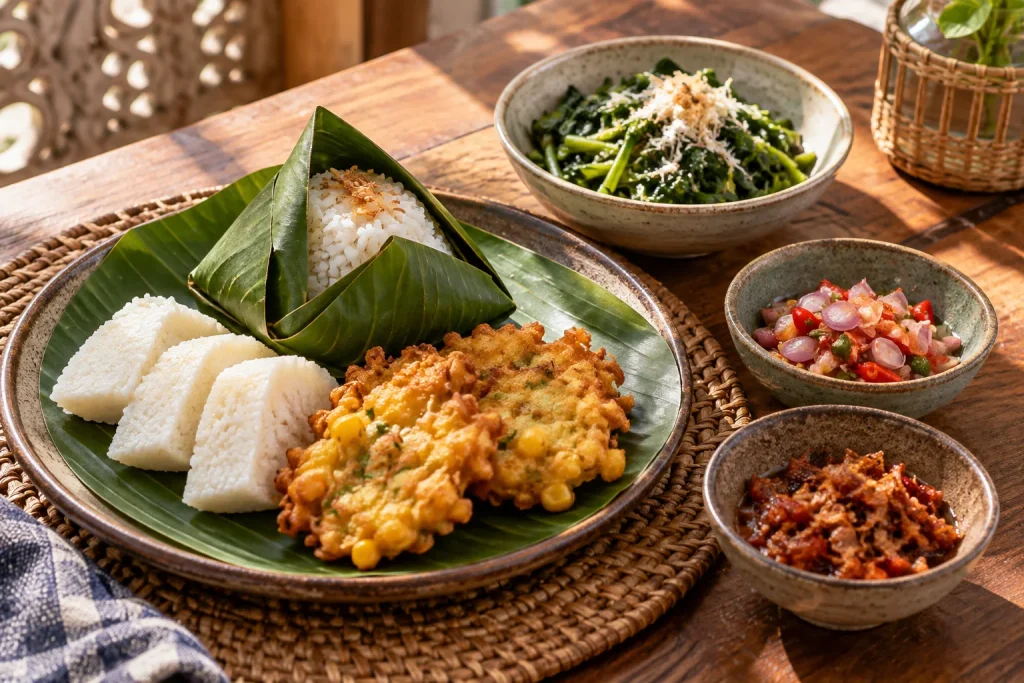
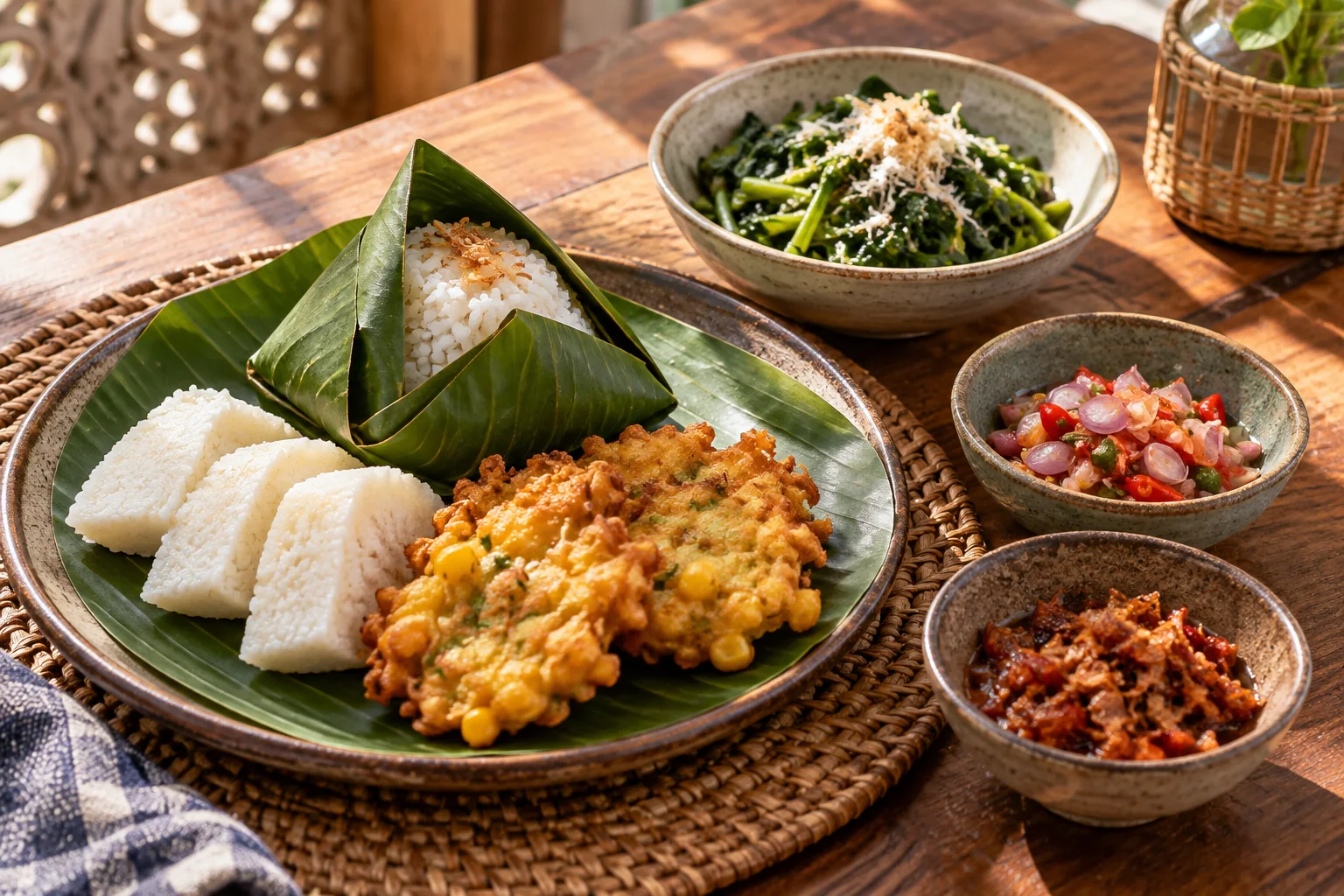
nasi jinggo bali wraps a compact portion of rice and small savoury accompaniments in banana leaf. It is designed as a small meal, not simply a full mixed-rice plate made smaller. nasi tepeng bali has a different feel: soft, porridge-like spiced rice associated with Gianyar.
Tipat lets the sauce and vegetables take the lead
For a simple rice-and-root contrast, nasi sela bali cooks rice with sweet potato. The shape and texture tell you what kind of meal each one makes: portable parcel, spoonable rice or a soft grain-and-tuber combination. These are related rice dishes, but they should not be flattened into one recipe or one region-wide serving rule.
Sambal changes the finish of a meal
tipat plecing bali pairs rice cake with fresh vegetables and a bright, spicy plecing sambal. tipat cantok bali also uses sliced rice cake, but the live menu describes steamed vegetables with peanut sauce ground fresh to order. That sauce changes the whole direction of the dish.
Finish with vegetables or a crisp fritter
A comparison between the two is useful at the level of texture: both start with compacted rice, while the sauce and vegetable combination shape the final bite. Ask about chilli and peanuts if those ingredients matter to you. Recipe details vary by cook, so the pages focus on the current menu descriptions rather than claiming a single canonical version.
Regional rice and accompaniments worth recognising
sambal matah bali is mixed fresh from shallot, lemongrass, chilli and citrusy aromatics. sambal embe / mbe bali takes the shallot in a fried direction, adding a crisp, savoury finish. They can both be served beside rice, but their temperatures and textures make them distinct.
Choose by what you want to learn or taste
sambal bongkot bali centres on torch ginger, with a fragrant, floral and gently spicy character in the current menu. Comparing the three makes the differences in method and aroma easier to recognise. A word like sambal does not guarantee the same heat, ingredients or preparation, so ask what is in the batch being served.
jukut urab bali tosses steamed vegetables with grated coconut and Balinese seasoning. Its freshness and texture make it adaptable beside rice or other dishes. perkedel jagung bali offers another contrast: the live menu describes crisp corn fritters with aromatics and seasoning.
A plate feels more balanced when not every component is soft or heavily seasoned. The vegetable side gives a different bite from a fritter, while a sambal can be offered separately for diners who want more heat. These are options rather than a fixed combination; the menu and the cook determine what is available on a particular day.
Rice itself changes the meal. Read about Balinese red rice for the grain, then compare it with entil, a leaf-wrapped rice preparation associated with Tabanan. A rice variety and a wrapped dish describe different things.
Vegetables arrive in different forms. jukut rambanan introduces a mixed vegetable preparation, while jukut buangit follows a named green used in Sangsit. jukut kelentang turns attention to young moringa pods rather than the leaves. The vegetable name alone does not explain the seasoning or broth.
Compare the eggplant in sambal tuwung with the dried long-bean seeds used in sambal batun kacang. Check the complete ingredients before choosing: a main plant ingredient does not establish that the finished condiment is vegetarian.
Three further preparations offer different textures: the thin dried fish of sudang lepet, the steamed prawn mixture in palem udang, and the young coconut shell used in lawar klungah. Ask about added ingredients; these dishes are distinct options, not a fixed set served together.
The existing dish pages keep each preparation and menu detail in one place. Use the parcel when portability matters, a tipat dish when you want sauce and texture together, or a sambal when you want to compare fresh and cooked aromatics. If you are planning a meal for several people, ask about portion size and ingredients instead of assuming the photo shows a standard set.
For current class formats in Ubud, visit the Cooking Class Ubud homepage and confirm the menu for your date. The dishes here are linked as a food guide, not a promise that every class prepares all ten. Start with the one method you want to practise, confirm the menu for your date.
How Balinese Side Dishes: Rice Meals, Tipat and Sambal Connects Market Observation, Kitchen Technique, and Practical Planning in Ubud
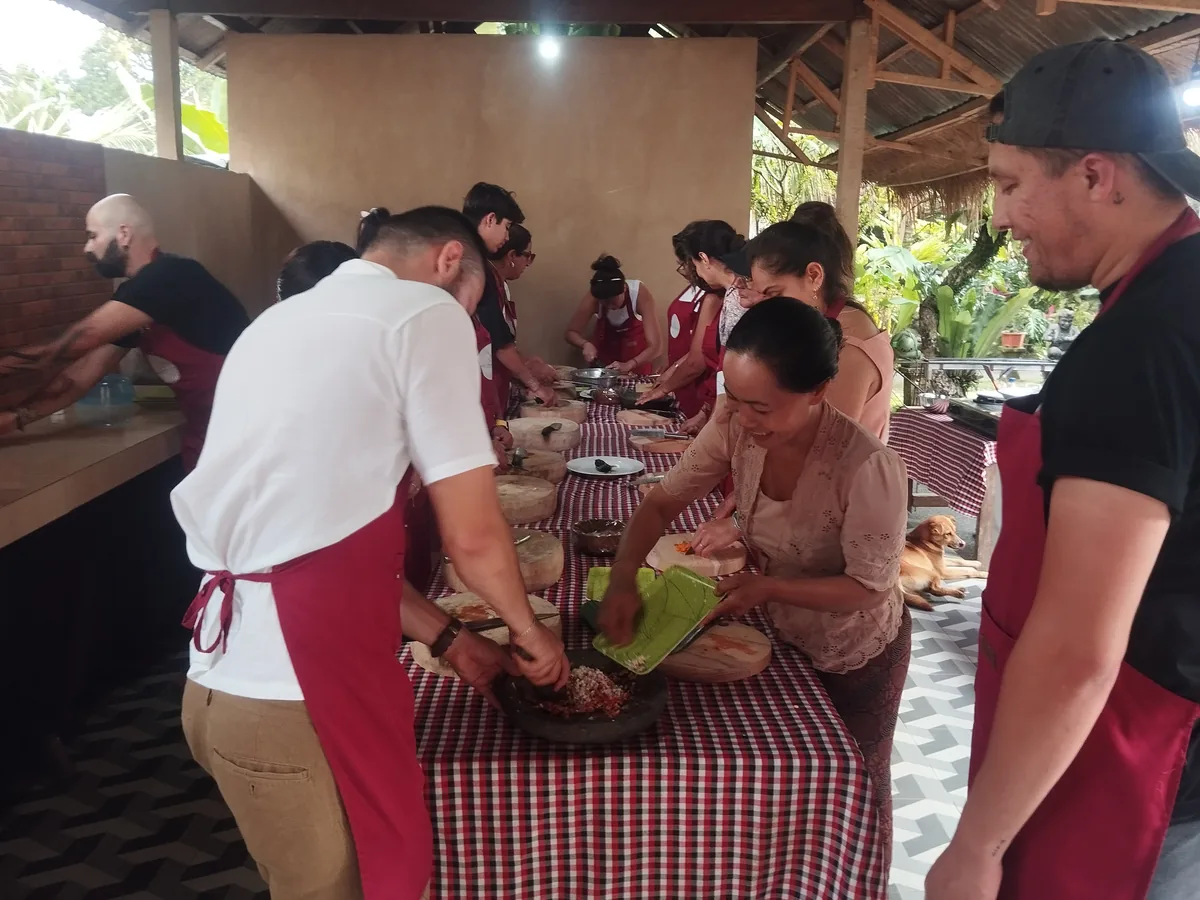
For travellers and home cooks researching balinese side dishes, the biggest gap in general travel guides is that they treat Balinese food and daily life as a single uniform checklist rather than a living household system. In a traditional Balinese compound around Ubud, decisions about ingredients, prep sequence, and table pairing depend on whether a meal is prepared for a quiet family lunch, a morning market run, or a shared gathering. When you join an Ubud Cooking Class at Wayan’s Paon, every question around balinese side dishes is answered through direct hands-on observation rather than abstract theory.
A second practical principle when evaluating balinese side dishes is recognizing the boundary between what happens at the morning produce stalls, what happens at the stone mortar (ulekan), and how the final dishes are balanced on the plate. In our private sessions such as Private Paon Table, your group works only with your own booking party and selects up to five dishes from the 53-dish menu (plus the foundational Base Genep spice paste), allowing you to test how each choice affects flavour, texture, and timing.
Comparative Reference Matrix: 10 Core Dimensions of Balinese Side Dishes
Before diving into each specialized subtopic in this family of guides, the table below summarizes how the ten focused questions around balinese side dishes differ in scope, practical kitchen impact, and what you should verify before buying ingredients or confirming a menu in Ubud:
| Focus Topic / Keyword Owner | Specific Question Addressed | Key Practical Distinction in Ubud |
|---|---|---|
| 1. Balinese red rice | Getting to Know Bali’s Red Rice Before You Cook It | A plate of Balinese red rice deserves a closer look before the sambal is mixed through it. The colour tells you something about the grain, b… |
| 2. jukut rambanan | The Rice-Thickened Sauce That Makes Jukut Rambanan | Jukut rambanan brings several vegetables together under a thick, seasoned sauce. The useful detail is what thickens it: descriptions from No… |
| 3. jukut buangit | Jukut Buangit and a Vegetable Tradition from Sangsit | Jukut buangit is a North Bali vegetable preparation associated with Sangsit in Buleleng. Its name is worth keeping if you enjoy learning abo… |
| 4. entil | Entil from Tabanan and the Leaves That Wrap It | Entil is a rice preparation to recognise by both its grain and its wrapping. Bali’s provincial cultural inventory associates it with Pupuan … |
| 5. sudang lepet | Sudang Lepet Gives a Buleleng Rice Meal Its Salty Crunch | Sudang lepet is a salted, dried fish preparation associated with Buleleng, particularly Sangsit. Thin fish pieces on a rice plate can be eas… |
| 6. sambal tuwung | Sambal Tuwung Puts Eggplant at the Centre of the Condiment | Sambal tuwung is an eggplant condiment, rather than simply another chilli paste. A Buleleng food study documents white eggplant combined wit… |
| 7. sambal batun kacang | Sambal Batun Kacang Starts with Long-Bean Seeds | Sambal batun kacang deserves a more precise description than “peanut sauce”. The Buleleng study’s version combines not-yet-dried long-bean s… |
| 8. jukut kelentang | Jukut Kelentang Uses Moringa Pods Rather Than Leaves | Jukut kelentang uses the young pods of the moringa tree. It is a different ingredient from the leaves called kelor. The Buleleng monograph d… |
| 9. lawar klungah | The Young Coconut Shell in Lawar Klungah | Lawar klungah uses a coconut ingredient that an English description can easily obscure: the very young shell. Bali’s cultural dictionary ide… |
| 10. palem udang | Palem Udang Is a Prawn Parcel Worth Learning by Name | Palem udang is a useful name to keep beside an English menu description of a steamed prawn parcel. A study of food translations on Bali hote… |
Deep-Dive Guide to the 10 Specialized Subtopics Within Balinese Side Dishes
Each of the ten companion articles in this topic family isolates one specific decision or ingredient question related to balinese side dishes so that you never confuse a broad category label with a concrete culinary rule. Below is how each specialized guide fits into the wider picture:
1. Getting to Know Bali’s Red Rice Before You Cook It
When narrowing your focus from balinese side dishes to the specific question of Balinese red rice, the primary distinction is context and practical application. A plate of Balinese red rice deserves a closer look before the sambal is mixed through it. The colour tells you something about the grain, but it does not give you the variety name, its growing location or a reliable cooking time. Those details are worth keeping separate when you buy rice or follow a cook’s demonstration. By keeping this specific scope distinct from neighbouring topics, you avoid applying a general rule where a precise ingredient check or timing adjustment is required.
In practice at the market or in the paon, This is a guide to identifying the ingredient and understanding what you have been served. For the accompaniments around it, see our guide to balinese side dishes. Whether you are comparing options before booking your private session or taking notes to cook at home after your trip, treating Balinese red rice as its own step ensures your preparation remains accurate and stress-free.
2. The Rice-Thickened Sauce That Makes Jukut Rambanan
When narrowing your focus from balinese side dishes to the specific question of jukut rambanan, the primary distinction is context and practical application. Jukut rambanan brings several vegetables together under a thick, seasoned sauce. The useful detail is what thickens it: descriptions from North Bali include ground rice alongside coconut milk and spices. It is a different starting point from a plate dressed with peanut sauce, even when some of the vegetables look familiar. By keeping this specific scope distinct from neighbouring topics, you avoid applying a general rule where a precise ingredient check or timing adjustment is required.
In practice at the market or in the paon, RRI’s September 2026 report from a Singaraja home cook describes boiled vegetables with a coconut-milk sauce containing spices and ground rice. The vegetables can include long beans, bayam, kangkung, bean sprouts, banana blossom, young jackfruit, bitter melon and chayote. The cook describes boiling the vegetables separately so their doneness can be judged individually. Whether you are comparing options before booking your private session or taking notes to cook at home after your trip, treating jukut rambanan as its own step ensures your preparation remains accurate and stress-free.
3. Jukut Buangit and a Vegetable Tradition from Sangsit
When narrowing your focus from balinese side dishes to the specific question of jukut buangit, the primary distinction is context and practical application. Jukut buangit is a North Bali vegetable preparation associated with Sangsit in Buleleng. Its name is worth keeping if you enjoy learning about dishes beyond the island’s familiar restaurant menus. The seasoning can be relatively short, while the handling of the buangit itself matters to the result. By keeping this specific scope distinct from neighbouring topics, you avoid applying a general rule where a precise ingredient check or timing adjustment is required.
In practice at the market or in the paon, In a March 2021 field report, Buleleng’s communications team visited long-time seller Ketut Seringanis from Banjar Tegal, Sangsit. She described seasoning her jukut buangit with salt, tamarind, sugar and a flavour enhancer. She also explained that careless boiling could leave the vegetable bitter. Whether you are comparing options before booking your private session or taking notes to cook at home after your trip, treating jukut buangit as its own step ensures your preparation remains accurate and stress-free.
4. Entil from Tabanan and the Leaves That Wrap It
When narrowing your focus from balinese side dishes to the specific question of entil, the primary distinction is context and practical application. Entil is a rice preparation to recognise by both its grain and its wrapping. Bali’s provincial cultural inventory associates it with Pupuan and Penebel in Tabanan. Its account describes rice mixed with red rice, enclosed in kalingidi leaves and tied with bamboo before a long boil. By keeping this specific scope distinct from neighbouring topics, you avoid applying a general rule where a precise ingredient check or timing adjustment is required.
In practice at the market or in the paon, In the inventory’s preparation, the folded parcels are flat and rectangular. Two are tied together with their folds facing inward. This is a more useful identifying detail than simply calling entil a rice cake. Whether you are comparing options before booking your private session or taking notes to cook at home after your trip, treating entil as its own step ensures your preparation remains accurate and stress-free.
5. Sudang Lepet Gives a Buleleng Rice Meal Its Salty Crunch
When narrowing your focus from balinese side dishes to the specific question of sudang lepet, the primary distinction is context and practical application. Sudang lepet is a salted, dried fish preparation associated with Buleleng, particularly Sangsit. Thin fish pieces on a rice plate can be easy to pass over when your attention is on the sambal. Learning the name gives this accompaniment an identity of its own. By keeping this specific scope distinct from neighbouring topics, you avoid applying a general rule where a precise ingredient check or timing adjustment is required.
In practice at the market or in the paon, Buleleng’s culture and tourism office describes sudang lepet made from blambang, or flying fish, which is dried and salted. Its account includes fried preparations with Balinese seasoning and grilled versions served with sambal matah. It describes a salty, savoury taste and a crisp texture. Whether you are comparing options before booking your private session or taking notes to cook at home after your trip, treating sudang lepet as its own step ensures your preparation remains accurate and stress-free.
6. Sambal Tuwung Puts Eggplant at the Centre of the Condiment
When narrowing your focus from balinese side dishes to the specific question of sambal tuwung, the primary distinction is context and practical application. Sambal tuwung is an eggplant condiment, rather than simply another chilli paste. A Buleleng food study documents white eggplant combined with shallot, chillies, shrimp paste, salt, lime and coconut oil. Its preparation thinly slices the eggplant, pours hot water over it and squeezes it before mixing. By keeping this specific scope distinct from neighbouring topics, you avoid applying a general rule where a precise ingredient check or timing adjustment is required.
In practice at the market or in the paon, The eggplant gives you something visible to look for in the finished condiment. If a menu offers only an English description such as “eggplant sambal”, keep the local name too. It lets you ask about the same preparation again without having to reconstruct the dish from a photograph. Whether you are comparing options before booking your private session or taking notes to cook at home after your trip, treating sambal tuwung as its own step ensures your preparation remains accurate and stress-free.
7. Sambal Batun Kacang Starts with Long-Bean Seeds
When narrowing your focus from balinese side dishes to the specific question of sambal batun kacang, the primary distinction is context and practical application. Sambal batun kacang deserves a more precise description than “peanut sauce”. The Buleleng study’s version combines not-yet-dried long-bean seeds with fried dried anchovies, garlic and salt. The seeds are pounded finely with seasoning, while the anchovies are worked in more coarsely. By keeping this specific scope distinct from neighbouring topics, you avoid applying a general rule where a precise ingredient check or timing adjustment is required.
In practice at the market or in the paon, An English menu translation can hide an important ingredient distinction. If someone describes this condiment simply as a bean sambal, ask which bean is being used. Keeping the full local name with that answer makes your notes useful for another meal. Whether you are comparing options before booking your private session or taking notes to cook at home after your trip, treating sambal batun kacang as its own step ensures your preparation remains accurate and stress-free.
8. Jukut Kelentang Uses Moringa Pods Rather Than Leaves
When narrowing your focus from balinese side dishes to the specific question of jukut kelentang, the primary distinction is context and practical application. Jukut kelentang uses the young pods of the moringa tree. It is a different ingredient from the leaves called kelor. The Buleleng monograph describes peeled, cut pods cooked in seasoned liquid, with lemongrass and salam leaves among the aromatics. Its seasoning also includes shrimp paste. By keeping this specific scope distinct from neighbouring topics, you avoid applying a general rule where a precise ingredient check or timing adjustment is required.
In practice at the market or in the paon, A general description such as “moringa soup” leaves a useful question unanswered: which part of the plant is in the bowl? Keep kelentang beside the pod preparation in your notes and kelor beside the leaves. That distinction helps when a menu uses an English ingredient name for both. Whether you are comparing options before booking your private session or taking notes to cook at home after your trip, treating jukut kelentang as its own step ensures your preparation remains accurate and stress-free.
9. The Young Coconut Shell in Lawar Klungah
When narrowing your focus from balinese side dishes to the specific question of lawar klungah, the primary distinction is context and practical application. Lawar klungah uses a coconut ingredient that an English description can easily obscure: the very young shell. Bali’s cultural dictionary identifies klungah as a coconut whose shell is still very young and used for lawar. It is worth distinguishing that ingredient from ordinary grated coconut flesh. By keeping this specific scope distinct from neighbouring topics, you avoid applying a general rule where a precise ingredient check or timing adjustment is required.
In practice at the market or in the paon, A 2022 study at Eka Sri Nadi in Ekasari, Jembrana, records the young shell being boiled, cooled, finely sliced and squeezed. Cooked pork and fried seasoning are combined with it. The finishing ingredients include citrus leaf, fried shallot, fried chilli, lime juice and grated coconut. Whether you are comparing options before booking your private session or taking notes to cook at home after your trip, treating lawar klungah as its own step ensures your preparation remains accurate and stress-free.
10. Palem Udang Is a Prawn Parcel Worth Learning by Name
When narrowing your focus from balinese side dishes to the specific question of palem udang, the primary distinction is context and practical application. Palem udang is a useful name to keep beside an English menu description of a steamed prawn parcel. A study of food translations on Bali hotel menus records Bejana Restaurant’s version as minced prawns with Balinese spices, steamed in a leaf wrapper. By keeping this specific scope distinct from neighbouring topics, you avoid applying a general rule where a precise ingredient check or timing adjustment is required.
In practice at the market or in the paon, That short description identifies an ingredient, a cooking method and a form. Prawns are the main named component; steaming is the method; the leaf holds the parcel. It does not identify the leaf species or list the complete spice mixture. Whether you are comparing options before booking your private session or taking notes to cook at home after your trip, treating palem udang as its own step ensures your preparation remains accurate and stress-free.
How to Apply These Notes When Planning Your Private Cooking Day at Wayan’s Paon
Bringing all ten facets of balinese side dishes together reveals a consistent lesson about Balinese culinary culture: clarity comes from asking specific questions before the cooking begins. In a private household setting in Ubud, your host does not rely on factory-made pastes or rigid group schedules. Instead, fresh roots (galangal, turmeric, ginger, and aromatic kencur), shallots, garlic, lemongrass, salam leaves, and kaffir lime are proportioned for the exact five dishes your group chooses to cook.
If you have dietary requirements—such as vegetarian or vegan preparation without fermented shrimp paste (terasi), gluten-free substitutions using pure rice flour and palm sugar (Gula Aren), dairy-free coconut milk infusions, or nut-free spice pastes omitting candlenut (kemiri)—discussing them when you select your menu allows the kitchen to prepare dedicated mortars, cutting boards, and filtered drinking-water washing stations in advance.
Finally, use this pillar overview on balinese side dishes alongside the ten focused cluster guides linked above whenever you want to verify a local Balinese term, compare morning market timing against afternoon kitchen sessions, or adapt a traditional Ubud technique for your own stove at home.