
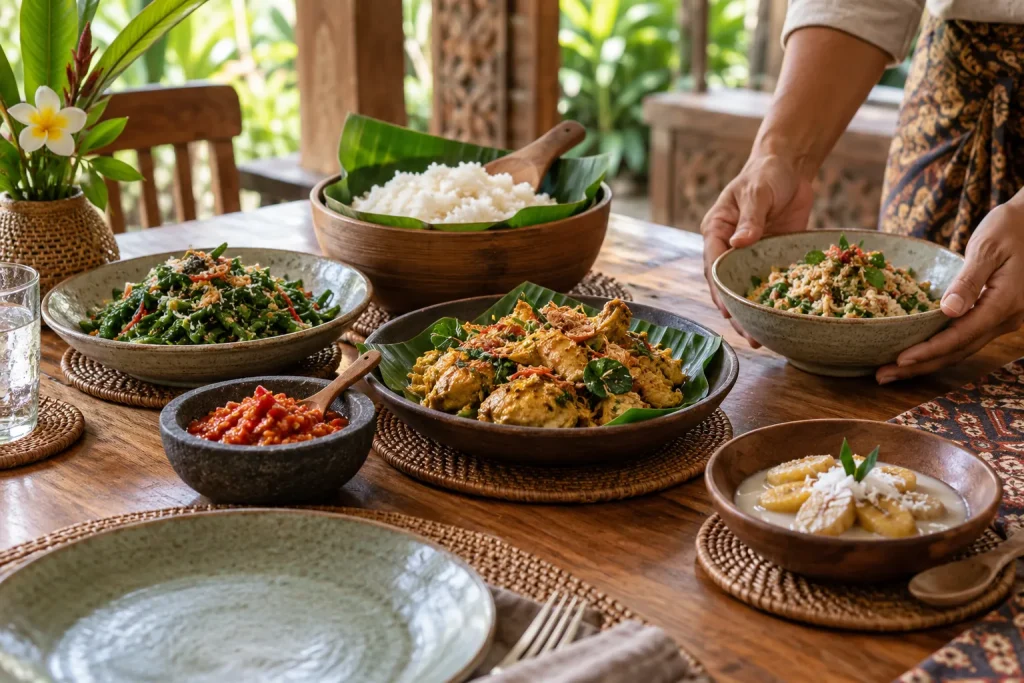
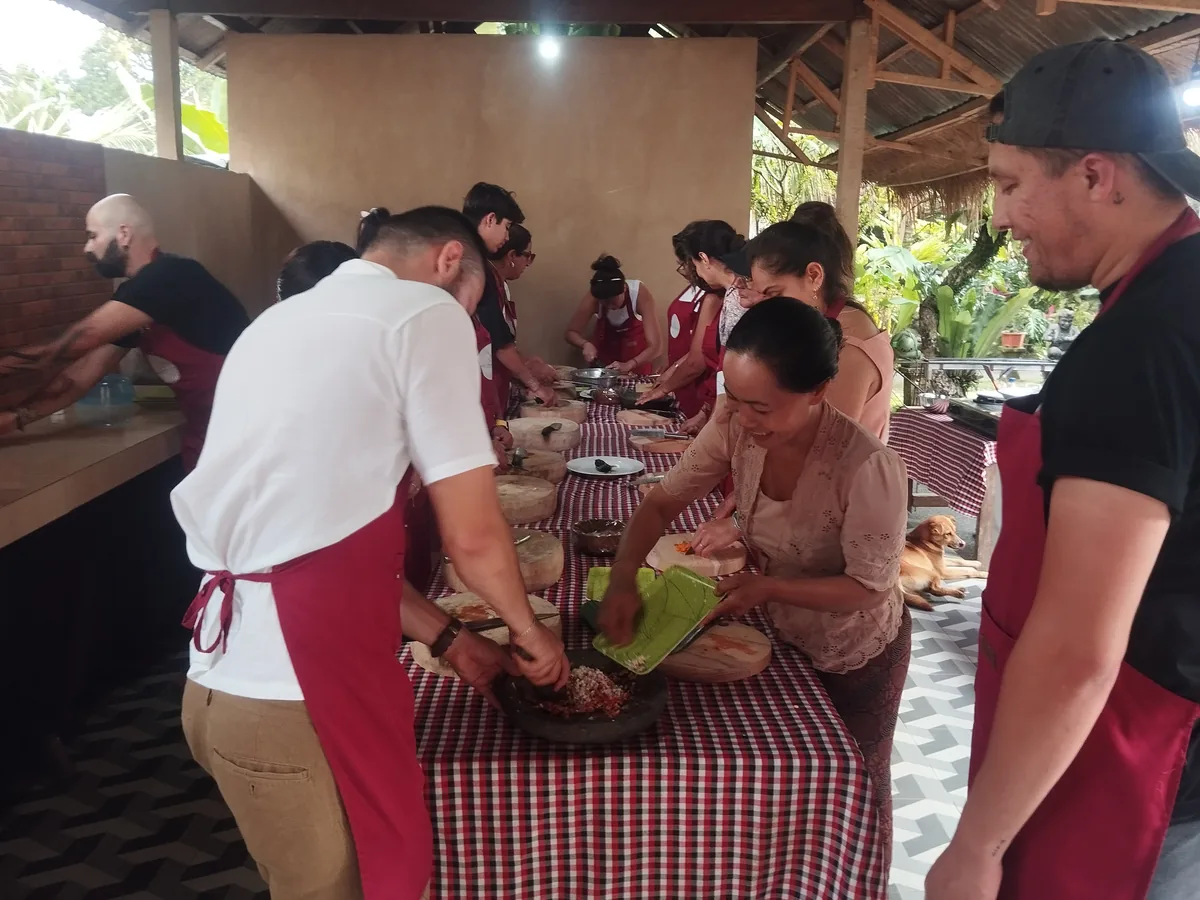
A five-dish meal can feel generous without becoming a crowded menu. In this guide, balinese feast menu planning means choosing a small set of dishes for flavour, timing and the people at the table. The number is a planning limit, not a traditional rule: Balinese meals vary by household, occasion, ingredients and the cook. Choose one anchor, give the other plates different jobs, then check that the work fits the time and kitchen you have. This keeps the meal considered rather than simply adding more bowls. When examining balinese feast menu planning in the context of everyday kitchen work and guest planning in Gianyar and Ubud, separating specific ingredient names, preparation timing, and household customs prevents common misunderstandings before you shop or cook.
Give each dish a clear job
Start by writing down who will eat, how much time is available and what kind of cooking you want to practise. A table for curious guests has different needs from a weekday meal, and a menu built around a slow preparation needs a different rhythm from one made mostly on the stove. If you are learning locally, a hands-on Cooking Class Ubud can show how menu choices and kitchen work meet in practice; use the confirmed menu for that session rather than assuming every dish is available.
Choose the anchor before filling the gaps
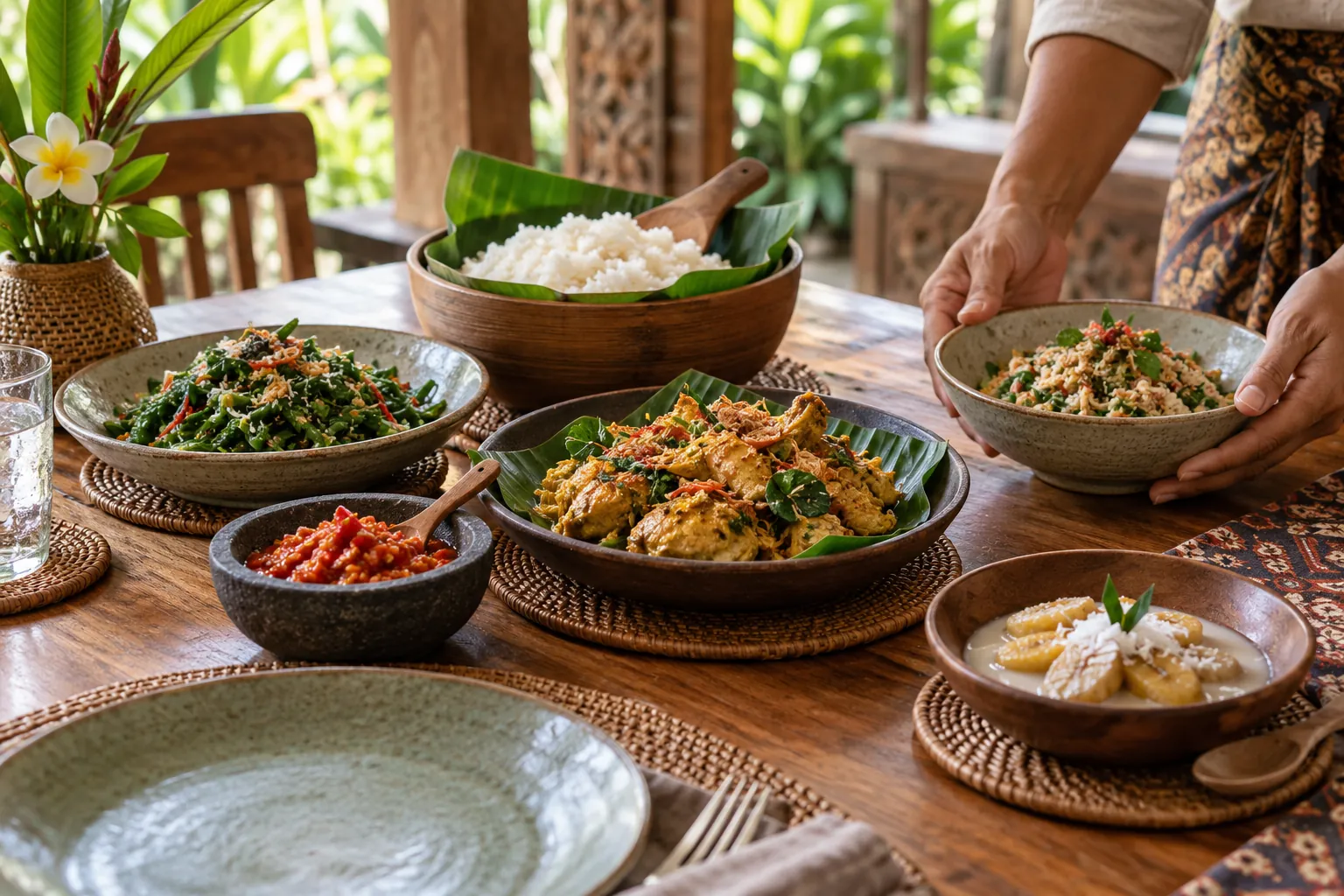
For a planning exercise, think in roles rather than fixed categories. One dish might carry the strongest savoury flavour; another might bring vegetables or freshness; rice or another staple can make the meal more substantial; a condiment can let diners adjust heat; and a small sweet finish can close the table. These are useful prompts, not a required Balinese arrangement. A dish can do more than one job, and a home menu does not need to imitate a ceremonial meal.
Let the sides support the meal
Write the role beside each proposed dish. If two choices both need long attention and have similar richness, decide whether you truly need both. If several are chilli-forward, choose whether that is deliberate or whether a brighter, milder plate would make the food easier to explore. The purpose is contrast and pacing, not a scorecard for how many traditional names appear on the table.
Plan the work, not only the flavours
Let one dish set the menu’s direction. It could be a preparation you particularly want to learn, a dish that uses an ingredient you already have, or the recipe with the longest cooking time. Consider how much active work it needs and whether it uses the equipment you can access. A slow-cooked dish may be an excellent anchor if you can begin early; it is less practical when the whole meal must be finished in a short window.
Use a final five-minute menu check
Once the anchor is chosen, look for a partner with a different pace or texture. A rich main may sit more comfortably with a fresh vegetable preparation than with another heavy sauce. If a dish already contains a strong seasoning paste, a second plate does not have to repeat the same flavour. Keep the ingredients and exact recipe open until they are confirmed; the examples in a class menu are possibilities, not a universal feast template.
Rice, vegetables and sambal can each make a distinct contribution, but none has to be treated as decoration. Rice can steady a strongly seasoned bite. Vegetables may bring crunch, tenderness or a fresh contrast, depending on how they are prepared. A sambal served separately gives each person a choice about heat and intensity. Use small serving bowls and clear utensils so the table remains easy to navigate.
Think about quantity as well as variety. Five full-size dishes can be too much for a small group, while tasting portions allow a broader menu without waste. If the meal has a dessert, decide whether it should be a light finish or a second centrepiece. A menu becomes more coherent when every item has a reason to be there and the portions reflect the people eating.
List the tasks in the order they happen: washing and cutting, grinding or mixing, cooking items that need time, preparing quick dishes, and finishing near the meal. Mark which jobs can overlap safely and which need your full attention. This simple sequence reveals whether too many hot pans, knives or hands will be needed at once. It also shows where someone can help without interrupting a delicate step.
Keep food-safety decisions recipe-specific. Separate raw ingredients from ready-to-eat food, use clean equipment between tasks, and follow reliable handling guidance for any meat or seafood. Do not leave cooked food waiting without a plan. If a guest has an allergy or a strict dietary requirement, verify every ingredient and preparation detail with the cook; a menu description alone cannot establish that a kitchen is free from cross-contact.
Before shopping or booking, read the menu aloud. Can you explain the purpose of every dish? Does the main preparation fit your available time? Are the strongest flavours balanced by something fresh or simple? Do the portions suit the group? Are the ingredients, equipment and dietary details confirmed? If an answer is unclear, remove a dish or ask the cook rather than filling the gap with a guess.
A good five-dish menu is not the one with the most elaborate list. It is the one the cook can prepare with care and the table can enjoy at a comfortable pace. Use Cooking Class Ubud if you want to see what a local cooking session offers, then confirm its actual menu and timing before treating it as your own plan.
How Planning a Balinese Feast Menu: Five Dishes That Work as One Connects Market Observation, Kitchen Technique, and Practical Planning in Ubud
For travellers and home cooks researching balinese feast menu planning, the biggest gap in general travel guides is that they treat Balinese food and daily life as a single uniform checklist rather than a living household system. In a traditional Balinese compound around Ubud, decisions about ingredients, prep sequence, and table pairing depend on whether a meal is prepared for a quiet family lunch, a morning market run, or a shared gathering. When you join an Ubud Cooking Class at Wayan’s Paon, every question around balinese feast menu planning is answered through direct hands-on observation rather than abstract theory.
A second practical principle when evaluating balinese feast menu planning is recognizing the boundary between what happens at the morning produce stalls, what happens at the stone mortar (ulekan), and how the final dishes are balanced on the plate. In our private sessions such as Grand Balinese Feast, your group works only with your own booking party and selects up to five dishes from the 53-dish menu (plus the foundational Base Genep spice paste), allowing you to test how each choice affects flavour, texture, and timing.
Comparative Reference Matrix: 10 Core Dimensions of Balinese Feast Menu Planning
Before diving into each specialized subtopic in this family of guides, the table below summarizes how the ten focused questions around balinese feast menu planning differ in scope, practical kitchen impact, and what you should verify before buying ingredients or confirming a menu in Ubud:
| Focus Topic / Keyword Owner | Specific Question Addressed | Key Practical Distinction in Ubud |
|---|---|---|
| 1. five dish balinese feast menu | Five Dishes, One Table: Building a Balanced Balinese Feast | Five dishes sound like a fixed format, but there is no single five-plate pattern that every Balinese household follows. Think of a five dish… |
| 2. balinese feast main dish | Choosing the Main Dish for a Balinese Feast | The main dish gives a menu direction, but it does not have to be the most complicated or expensive plate. Choosing a balinese feast main dis… |
| 3. balinese feast side dishes | Rice, Vegetables and Sambal: Balinese Feast Side Dishes | Side dishes are easiest to choose when you stop treating them as extras. Balinese feast side dishes can make separate contributions: rice ca… |
| 4. balinese feast cooking order | The Cooking Order Behind a Well-Timed Balinese Feast | A menu can look balanced on paper and still become stressful when every dish needs the stove at the same moment. A balinese feast cooking or… |
| 5. balinese feast ingredient list | A Practical Ingredient List for a Balinese Feast | A useful shopping list starts with confirmed dishes, not a generic basket labelled “Balinese ingredients.” A balinese feast ingredient list … |
| 6. balinese feast flavor balance | Balancing Heat, Freshness and Richness in a Balinese Feast | A menu does not need every plate to taste bold. Balinese feast flavor balance comes from tasting the dishes together and noticing when rich,… |
| 7. balinese feast prep ahead | What to Prepare Ahead for a Balinese Feast | Preparing ahead can make a feast calmer, but not every dish improves when made early. Balinese feast prep ahead should follow the recipe, th… |
| 8. balinese feast cooking tools | Balinese Feast Cooking Tools for a Home Kitchen | You do not need a room full of special equipment to plan a multi-dish meal. Balinese feast cooking tools are the items each chosen recipe ac… |
| 9. balinese feast menu textures | A Balinese Feast with More Than One Texture | Two dishes can use different ingredients and still feel repetitive if both are soft, rich and saucy. Balinese feast menu textures are easier… |
| 10. serving a balinese feast | Serving a Balinese Feast from a Home Kitchen | Serving a balinese feast is part of cooking, not a task to solve after the last pan is turned off. A small kitchen can handle several dishes… |
Deep-Dive Guide to the 10 Specialized Subtopics Within Balinese Feast Menu Planning
Each of the ten companion articles in this topic family isolates one specific decision or ingredient question related to balinese feast menu planning so that you never confuse a broad category label with a concrete culinary rule. Below is how each specialized guide fits into the wider picture:
1. Five Dishes, One Table: Building a Balanced Balinese Feast
When narrowing your focus from balinese feast menu planning to the specific question of five dish balinese feast menu, the primary distinction is context and practical application. Five dishes sound like a fixed format, but there is no single five-plate pattern that every Balinese household follows. Think of a five dish balinese feast menu as a helpful limit for a home meal: enough room for variety, few enough choices to cook with attention. The first question is not which five famous dishes to collect. Ask what each plate will add, how it will be prepared and whether the group can enjoy it without rushing. By keeping this specific scope distinct from neighbouring topics, you avoid applying a general rule where a precise ingredient check or timing adjustment is required.
In practice at the market or in the paon, For a broader framework, see balinese feast menu planning. This article narrows the idea to a simple table map. It can help you compare candidate dishes before you shop or choose a class menu. If you would rather watch a local cook coordinate several preparations, a Ubud Cooking Class offers a practical way to learn from the work; confirm the dishes for your date rather than assuming a sample menu is a promise. Whether you are comparing options before booking your private session or taking notes to cook at home after your trip, treating five dish balinese feast menu as its own step ensures your preparation remains accurate and stress-free.
2. Choosing the Main Dish for a Balinese Feast
When narrowing your focus from balinese feast menu planning to the specific question of balinese feast main dish, the primary distinction is context and practical application. The main dish gives a menu direction, but it does not have to be the most complicated or expensive plate. Choosing a balinese feast main dish begins with the time, equipment and kind of cooking you want to learn. Think about those practical points before settling on a recipe. A dish that needs long, steady cooking can be a good centrepiece when it can start early; it can create needless pressure if everything must be finished at once. By keeping this specific scope distinct from neighbouring topics, you avoid applying a general rule where a precise ingredient check or timing adjustment is required.
In practice at the market or in the paon, In a five-dish menu, the main is only one part of the plan. The guide to balinese feast menu planning explains how the other plates can support it. If you are choosing a local class, a Cooking Class Ubud may give you a chance to see a dish come together, but ask which preparations are actually confirmed for your session. Whether you are comparing options before booking your private session or taking notes to cook at home after your trip, treating balinese feast main dish as its own step ensures your preparation remains accurate and stress-free.
3. Rice, Vegetables and Sambal: Balinese Feast Side Dishes
When narrowing your focus from balinese feast menu planning to the specific question of balinese feast side dishes, the primary distinction is context and practical application. Side dishes are easiest to choose when you stop treating them as extras. Balinese feast side dishes can make separate contributions: rice can steady a strongly seasoned bite, vegetables add colour and a different texture, and sambal can bring heat or brightness in a small amount. That is a practical way to plan a home table, not a claim that every Balinese meal follows the same arrangement. Let the dishes and the people eating determine what belongs. By keeping this specific scope distinct from neighbouring topics, you avoid applying a general rule where a precise ingredient check or timing adjustment is required.
In practice at the market or in the paon, For the larger menu framework, return to balinese feast menu planning. The aim is to give each side a distinct purpose. A local Ubud Cooking Class can also show how an instructor fits accompaniments around a main dish; confirm the actual menu for your date rather than assuming every example is included. Whether you are comparing options before booking your private session or taking notes to cook at home after your trip, treating balinese feast side dishes as its own step ensures your preparation remains accurate and stress-free.
4. The Cooking Order Behind a Well-Timed Balinese Feast
When narrowing your focus from balinese feast menu planning to the specific question of balinese feast cooking order, the primary distinction is context and practical application. A menu can look balanced on paper and still become stressful when every dish needs the stove at the same moment. A balinese feast cooking order is simply a plan for when each task begins, pauses and finishes. List the tasks, note which can happen ahead, and identify the steps that need your full attention. This is a home-kitchen planning method rather than a single traditional Balinese sequence; each recipe and cook has its own order. By keeping this specific scope distinct from neighbouring topics, you avoid applying a general rule where a precise ingredient check or timing adjustment is required.
In practice at the market or in the paon, The guide to balinese feast menu planning helps choose dishes that fit together. Once the list is settled, a Cooking Class Ubud can be a place to observe how preparation is organised in practice. Ask which steps are demonstrated and which are prepared before guests arrive. Whether you are comparing options before booking your private session or taking notes to cook at home after your trip, treating balinese feast cooking order as its own step ensures your preparation remains accurate and stress-free.
5. A Practical Ingredient List for a Balinese Feast
When narrowing your focus from balinese feast menu planning to the specific question of balinese feast ingredient list, the primary distinction is context and practical application. A useful shopping list starts with confirmed dishes, not a generic basket labelled “Balinese ingredients.” A balinese feast ingredient list should follow the actual recipes because names do not guarantee the same method or seasoning in every kitchen. Choose the menu first, then list what each dish needs. This prevents buying duplicate aromatics, forgetting a small but important condiment, or assuming an ingredient is interchangeable without changing the result. By keeping this specific scope distinct from neighbouring topics, you avoid applying a general rule where a precise ingredient check or timing adjustment is required.
In practice at the market or in the paon, For the full menu framework, see balinese feast menu planning. If you want to learn how a local cook prepares a set menu, check what a Ubud Cooking Class currently includes; use the confirmed list for that session rather than shopping from an old example. Whether you are comparing options before booking your private session or taking notes to cook at home after your trip, treating balinese feast ingredient list as its own step ensures your preparation remains accurate and stress-free.
6. Balancing Heat, Freshness and Richness in a Balinese Feast
When narrowing your focus from balinese feast menu planning to the specific question of balinese feast flavor balance, the primary distinction is context and practical application. A menu does not need every plate to taste bold. Balinese feast flavor balance comes from tasting the dishes together and noticing when rich, salty or chilli-heavy flavours compete. Decide what can stay strong, what should be quieter and where a fresh note would help. It is a flexible cooking tool, not a rulebook for all Balinese food. By keeping this specific scope distinct from neighbouring topics, you avoid applying a general rule where a precise ingredient check or timing adjustment is required.
In practice at the market or in the paon, The broader method is in balinese feast menu planning. Try the same way of thinking during a local Ubud Cooking Class: watch when a cook tastes, what they adjust and whether the seasoning changes as the food cooks. Confirm the session’s actual menu before expecting a particular dish or ingredient. Whether you are comparing options before booking your private session or taking notes to cook at home after your trip, treating balinese feast flavor balance as its own step ensures your preparation remains accurate and stress-free.
7. What to Prepare Ahead for a Balinese Feast
When narrowing your focus from balinese feast menu planning to the specific question of balinese feast prep ahead, the primary distinction is context and practical application. Preparing ahead can make a feast calmer, but not every dish improves when made early. Balinese feast prep ahead should follow the recipe, the way the food will be stored and what needs a fresh finish. Some ingredients can be measured or washed before the cook starts; other preparations are best finished close to serving. Build your plan from the actual menu rather than assuming all Balinese dishes share one timetable. By keeping this specific scope distinct from neighbouring topics, you avoid applying a general rule where a precise ingredient check or timing adjustment is required.
In practice at the market or in the paon, First choose the menu using balinese feast menu planning. If you are attending a local Cooking Class Ubud, ask which ingredients are prepared before the lesson and what guests will do themselves. A useful class explanation should distinguish a demonstration step from a task each participant can practise. Whether you are comparing options before booking your private session or taking notes to cook at home after your trip, treating balinese feast prep ahead as its own step ensures your preparation remains accurate and stress-free.
8. Balinese Feast Cooking Tools for a Home Kitchen
When narrowing your focus from balinese feast menu planning to the specific question of balinese feast cooking tools, the primary distinction is context and practical application. You do not need a room full of special equipment to plan a multi-dish meal. Balinese feast cooking tools are the items each chosen recipe actually requires. A stable cutting board, sharp knife, bowls for prepared ingredients, a suitable pan and clean serving utensils may matter more than buying a tool because it appears in a photograph. If you plan to pound a paste, a mortar and pestle can be useful, but size, stability and the recipe determine whether it is practical. By keeping this specific scope distinct from neighbouring topics, you avoid applying a general rule where a precise ingredient check or timing adjustment is required.
In practice at the market or in the paon, The full menu framework is in balinese feast menu planning. In a local Ubud Cooking Class, you can ask why a particular tool is used and watch how the cook works with it. Confirm what the session covers; tools and techniques vary by menu. Whether you are comparing options before booking your private session or taking notes to cook at home after your trip, treating balinese feast cooking tools as its own step ensures your preparation remains accurate and stress-free.
9. A Balinese Feast with More Than One Texture
When narrowing your focus from balinese feast menu planning to the specific question of balinese feast menu textures, the primary distinction is context and practical application. Two dishes can use different ingredients and still feel repetitive if both are soft, rich and saucy. Balinese feast menu textures are easier to plan when you notice whether each plate is tender, crisp, chewy, juicy or dry, then choose a preparation that changes the pace. This is a planning tool for your table, not a rule that every Balinese meal must contain a set of textures. When examining balinese feast menu textures in the context of everyday kitchen work and guest planning in Gianyar and Ubud, separating specific ingredient names, preparation timing, and household customs prevents common misunderstandings before you shop or cook. By keeping this specific scope distinct from neighbouring topics, you avoid applying a general rule where a precise ingredient check or timing adjustment is required.
In practice at the market or in the paon, The main framework sits in balinese feast menu planning. If you want to see how a cook adjusts a menu as ingredients are prepared, a Ubud Cooking Class can make the contrast between chopping, grinding and cooking easier to notice. Ask which dishes are actually planned for the session. Whether you are comparing options before booking your private session or taking notes to cook at home after your trip, treating balinese feast menu textures as its own step ensures your preparation remains accurate and stress-free.
10. Serving a Balinese Feast from a Home Kitchen
When narrowing your focus from balinese feast menu planning to the specific question of serving a balinese feast, the primary distinction is context and practical application. Serving a balinese feast is part of cooking, not a task to solve after the last pan is turned off. A small kitchen can handle several dishes when there is a clear place for hot cookware, a separate area for ready-to-eat food and enough room for guests to reach the table. The meal does not need a formal sequence. Plan a relaxed arrangement that fits the food, the people and the available counter space. By keeping this specific scope distinct from neighbouring topics, you avoid applying a general rule where a precise ingredient check or timing adjustment is required.
In practice at the market or in the paon, Use balinese feast menu planning to keep the number of dishes manageable. A local Ubud Cooking Class can also show what it feels like to finish a shared meal after cooking; confirm the session format and meal details directly instead of assuming every class follows the same service style. Whether you are comparing options before booking your private session or taking notes to cook at home after your trip, treating serving a balinese feast as its own step ensures your preparation remains accurate and stress-free.
How to Apply These Notes When Planning Your Private Cooking Day at Wayan’s Paon
Bringing all ten facets of balinese feast menu planning together reveals a consistent lesson about Balinese culinary culture: clarity comes from asking specific questions before the cooking begins. In a private household setting in Ubud, your host does not rely on factory-made pastes or rigid group schedules. Instead, fresh roots (galangal, turmeric, ginger, and aromatic kencur), shallots, garlic, lemongrass, salam leaves, and kaffir lime are proportioned for the exact five dishes your group chooses to cook.
If you have dietary requirements—such as vegetarian or vegan preparation without fermented shrimp paste (terasi), gluten-free substitutions using pure rice flour and palm sugar (Gula Aren), dairy-free coconut milk infusions, or nut-free spice pastes omitting candlenut (kemiri)—discussing them when you select your menu allows the kitchen to prepare dedicated mortars, cutting boards, and filtered drinking-water washing stations in advance.
Finally, use this pillar overview on balinese feast menu planning alongside the ten focused cluster guides linked above whenever you want to verify a local Balinese term, compare morning market timing against afternoon kitchen sessions, or adapt a traditional Ubud technique for your own stove at home.