
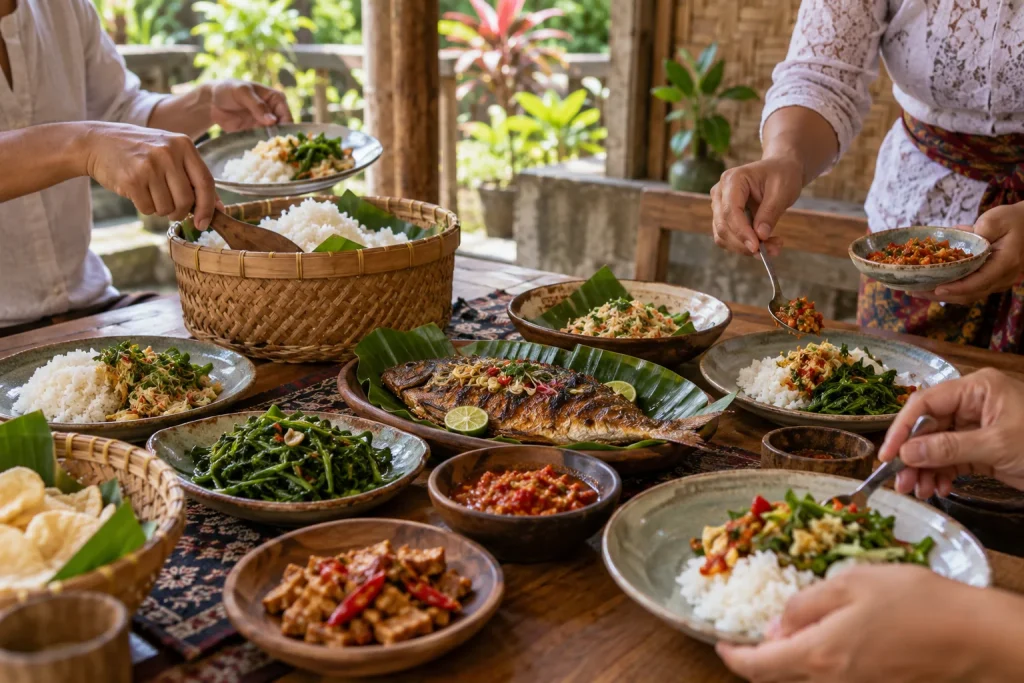
Balinese food is often introduced through a short list of famous dishes. That list can be useful, but it leaves out the more interesting part: the same island’s food changes with the household, the occasion, the ingredients at hand and the reason people are cooking. A meal at a warung, food prepared for a family gathering and food made for a ceremony do not have to look alike to belong to the same food culture. When examining balinese food culture in the context of everyday kitchen work and guest planning in Gianyar and Ubud, separating specific ingredient names, preparation timing, and household customs prevents common misunderstandings before you shop or cook. When examining balinese food culture in the context of everyday kitchen work and guest planning in Gianyar and Ubud, separating specific ingredient names, preparation timing, and household customs prevents common misunderstandings before you shop or cook.
Rice connects food to the landscape
Rice is a good place to start, though it is not the whole story. Around it sit vegetables, meat or fish, sambal, spice pastes and dishes with their own local histories. Some are everyday food; others appear more often at a feast or in a ritual setting. The useful question is not simply “What is the traditional Balinese dish?” It is “Who is eating, where, and for what occasion?”
A meal may be built from separate parts
Rice farming in Bali is tied to more than a field and a harvest. The island’s subak system coordinates irrigation through farmer communities and water temples. Canals and weirs carry water to rice fields, while local networks coordinate allocation and timing. The system also connects agricultural work with ritual and the principle of Tri Hita Karana. It is one reason rice can be understood as part of a social landscape, not just an ingredient on a plate.
Spice pastes give dishes their character
That connection should not be turned into a claim that every Balinese household eats the same rice meal or grows its own rice. Bali includes urban neighborhoods, farming villages, tourist districts and many different household routines. Rice remains a useful reference point, but the dishes served alongside it—and how often rice appears—vary.
Everyday food and ceremonial food have different jobs
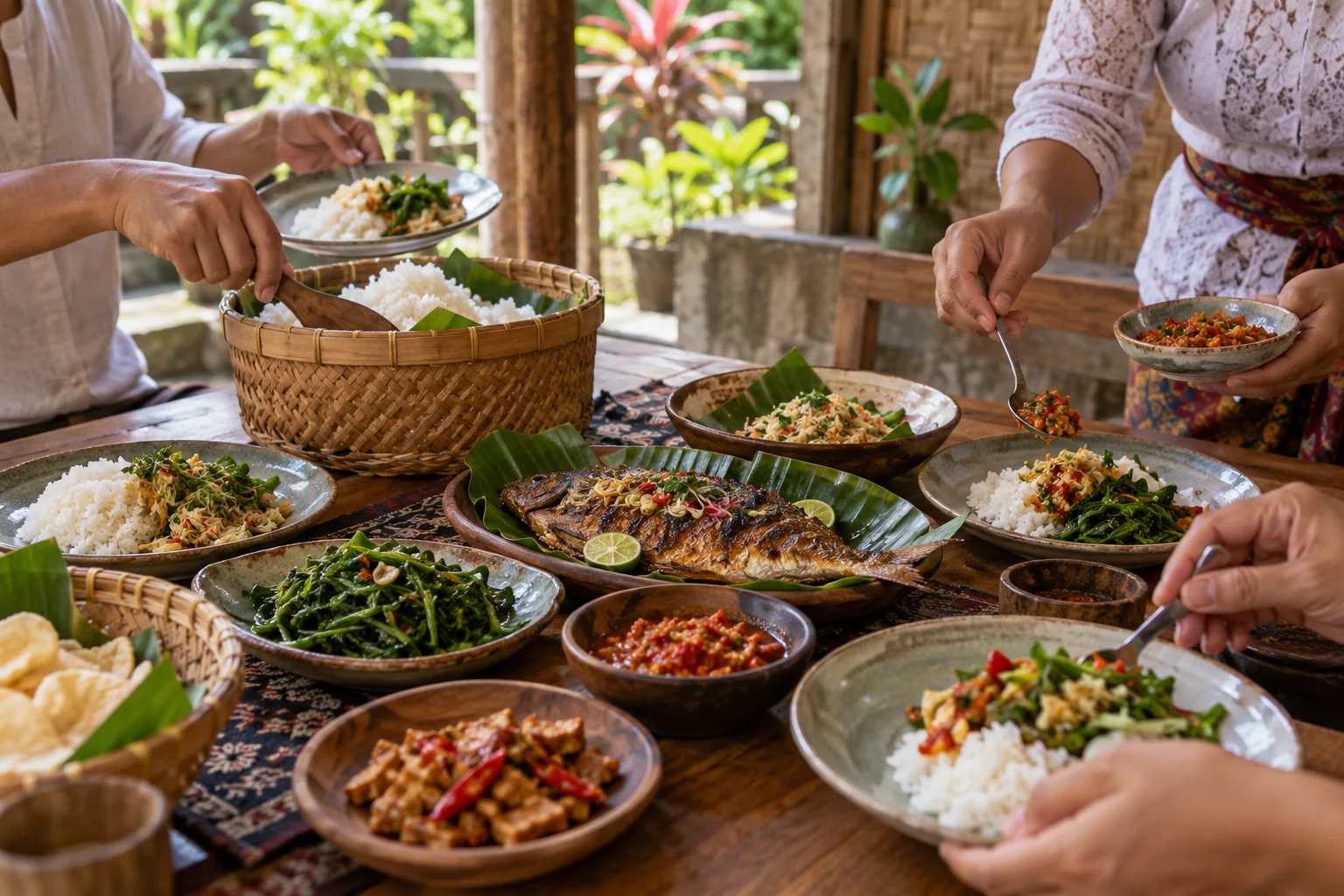
One way to understand a Balinese meal is to notice how its parts are arranged. Rice may sit at the center while vegetables, sambal and other dishes are served beside it. A plate of rice with a selection of side dishes, often called nasi campur, is a helpful example of components that keep their own textures and seasoning. It is a useful lens, not a rule for every meal in Bali. Ingredients and cooking methods have also travelled across regions and histories.
Shared meals are local traditions, not island-wide templates
Names such as lawar, sate lilit, betutu, jukut urab and sambal matah point to different preparations rather than one fixed menu. Lawar, for example, has many versions; recipes and ingredients differ by place and cook. Sate lilit binds seasoned minced ingredients around a skewer, while betutu refers to a slow-cooked preparation whose details also vary. A menu can show a few of these at once, but no single plate represents every household or occasion.
How to explore Balinese food with care
This is why a short dish list is best treated as an invitation to ask questions. What is in this version of lawar? Is the sambal mixed through the dish or served on the side? Is the meal intended for an everyday lunch or a special gathering? Those answers explain more than a label such as “authentic” ever can.
Balinese cooking is often associated with aromatic spice pastes made by pounding ingredients together. Ginger, turmeric, galangal, shallots, garlic and chilli are among the ingredients discussed in the culinary literature, though no one fixed paste belongs in every recipe. The point is the method as much as the list: pounding releases and combines ingredients before they meet the pan, grill or pot.
The balance shifts from dish to dish. A paste for a grilled preparation will not necessarily play the same role as a seasoning for vegetables or a slow-cooked dish. Fresh herbs, coconut, citrus and fermented ingredients may enter the picture too. For a visitor, tasting a finished meal reveals the result; watching the preparation—or learning the role of each ingredient—helps explain how that result was built.
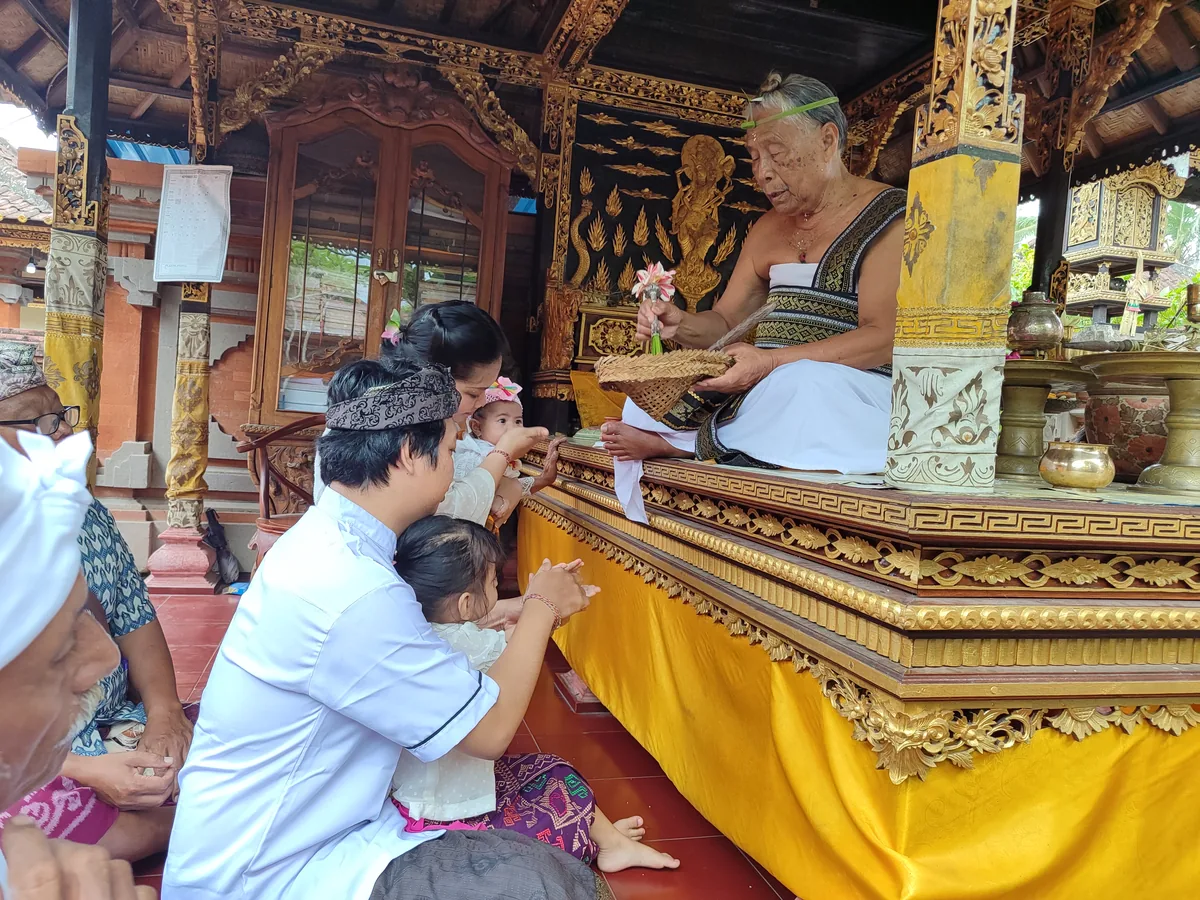
Food in Bali also appears in religious and family life. Some foods are prepared for eating; some are prepared as offerings; and some may take part in both contexts. These roles should not be collapsed into a single category called “ceremony food.” A rice dish on a restaurant menu does not automatically carry the same meaning as food prepared for a ritual.
In some Balinese Hindu contexts, fruit, cakes and rice-based foods may be prepared for ceremonies. How food is handled after an offering has been used depends on local custom, timing and the people responsible for it. Visitors should treat offerings with respect and follow their host’s guidance rather than assuming they are leftovers or samples to try.
Celebration cooking can also be a social activity. People may prepare food together for a family or community event, but the exact work, menu and customs vary. Visitors should be cautious about turning one observed event into a claim about all Balinese households. A better account names the place and occasion when those details are known, and leaves them open when they are not.
Megibung is a useful example of why regional detail matters. It is associated with Karangasem, where people share food together at religious, customary and everyday gatherings. That makes megibung a meaningful subject in Balinese food culture—but not a custom to attribute automatically to every part of the island.
When a shared table is part of a gathering, the social pattern may matter as much as the dishes. Who prepares the food, how it is served and who is invited can all shape the occasion. Those questions are more useful than asking whether a meal is “the” traditional Bali feast.
Start with the dish in front of you, then ask about its ingredients and context. A dish name may cover several local versions. If you avoid pork, seafood, nuts or another ingredient, ask directly; do not assume a familiar-looking plate contains what you expect. If food is part of an offering or ceremony, follow the host’s instructions and do not handle it without permission.
You can also choose what kind of experience you want. A warung meal is a way to encounter food as it is served in that setting. A market visit foregrounds ingredients and daily trade. Reading about subak adds the agricultural landscape behind rice. For travelers who want to learn how local ingredients are prepared, Wayan’s Paon’s Ubud Cooking Class is a relevant next step; check the site for the current class details.
Balinese food traditions are easier to understand when they are not reduced to a checklist. Rice, spice pastes, shared meals and ceremonial foods each open a different door. The details change across households and occasions, and that variation is part of the story—not an exception to it.
How Balinese Food Traditions, from Daily Meals to Shared Feasts Connects Market Observation, Kitchen Technique, and Practical Planning in Ubud
For travellers and home cooks researching balinese food culture, the biggest gap in general travel guides is that they treat Balinese food and daily life as a single uniform checklist rather than a living household system. In a traditional Balinese compound around Ubud, decisions about ingredients, prep sequence, and table pairing depend on whether a meal is prepared for a quiet family lunch, a morning market run, or a shared gathering. When you join an Ubud Cooking Class at Wayan’s Paon, every question around balinese food culture is answered through direct hands-on observation rather than abstract theory.
A second practical principle when evaluating balinese food culture is recognizing the boundary between what happens at the morning produce stalls, what happens at the stone mortar (ulekan), and how the final dishes are balanced on the plate. In our private sessions such as Megibung Cooking Class, your group works only with your own booking party and selects up to five dishes from the 53-dish menu (plus the foundational Base Genep spice paste), allowing you to test how each choice affects flavour, texture, and timing.
Comparative Reference Matrix: 10 Core Dimensions of Balinese Food Culture
Before diving into each specialized subtopic in this family of guides, the table below summarizes how the ten focused questions around balinese food culture differ in scope, practical kitchen impact, and what you should verify before buying ingredients or confirming a menu in Ubud:
| Focus Topic / Keyword Owner | Specific Question Addressed | Key Practical Distinction in Ubud |
|---|---|---|
| 1. what do balinese people eat | What Do Balinese People Eat in a Typical Day? | Ask what people in Bali eat in a typical day and you will rarely get one fixed menu. A household near a market, a family working in the fiel… |
| 2. megibung bali | Megibung Bali: Why Karangasem Shares a Meal | Megibung is a way of sharing a meal associated especially with Karangasem in eastern Bali. People gather around food and eat together, makin… |
| 3. subak system bali | Subak System Bali: How Shared Water Supports Rice | The rice on a Balinese plate begins long before it reaches a kitchen. Across parts of the island, water moves through canals and weirs manag… |
| 4. balinese offerings | What Balinese Food Offerings Mean in Daily Life | Food in Balinese Hindu life is not always prepared for an ordinary meal. Fruit, rice-based foods and traditional cakes may form part of an o… |
| 5. balinese home dining etiquette | Eating in a Balinese Home: Customs Worth Knowing Before the Meal | The best guide to eating in a Balinese home is the person who invited you. Households differ, and a meal may be an ordinary visit, a family … |
| 6. traditional balinese breakfast | Traditional Balinese Breakfasts Beyond the Hotel Buffet | A traditional Balinese breakfast does not come as one fixed set. Morning food changes with the town, the household and the workday. In some … |
| 7. tumpeng meaning | Tumpeng in Bali: What the Dish Means and Where Its Roots Lie | Tumpeng is a cone-shaped serving of rice, usually arranged with side dishes around it. In Indonesia it is often associated with gratitude, c… |
| 8. balinese meal structure | How a Balinese Meal Is Put Together | There is no formal template that every Balinese meal follows. Still, looking at how food is arranged can help a visitor understand a plate. … |
| 9. balinese ceremony food | Preparing Food for a Balinese Ceremony: What Visitors Should Understand | Food preparation for a Balinese ceremony can involve more than cooking a menu. An event may require offerings, food for people attending, pr… |
| 10. balinese celebration food | Balinese Celebration Food: Rice, Lawar and Shared Dishes | A celebration meal in Bali may include foods that feel richer or more elaborate than an everyday lunch, but there is no single menu used acr… |
Deep-Dive Guide to the 10 Specialized Subtopics Within Balinese Food Culture
Each of the ten companion articles in this topic family isolates one specific decision or ingredient question related to balinese food culture so that you never confuse a broad category label with a concrete culinary rule. Below is how each specialized guide fits into the wider picture:
1. What Do Balinese People Eat in a Typical Day?
When narrowing your focus from balinese food culture to the specific question of what do balinese people eat, the primary distinction is context and practical application. Ask what people in Bali eat in a typical day and you will rarely get one fixed menu. A household near a market, a family working in the fields and someone living in Denpasar may keep different routines. Work hours, religion, budget, season and personal taste all shape the table. Rice is a useful starting point, but it is not the whole answer. By keeping this specific scope distinct from neighbouring topics, you avoid applying a general rule where a precise ingredient check or timing adjustment is required.
In practice at the market or in the paon, Some people begin with rice porridge, a small rice packet or a snack bought on the way to work. Others eat later, take coffee first or choose something familiar from a nearby warung. In tourist districts, breakfast menus often include Western dishes alongside Indonesian and Balinese options. That mix reflects the place and the people being served; it does not define what every Balinese person eats. Whether you are comparing options before booking your private session or taking notes to cook at home after your trip, treating what do balinese people eat as its own step ensures your preparation remains accurate and stress-free.
2. Megibung Bali: Why Karangasem Shares a Meal
When narrowing your focus from balinese food culture to the specific question of megibung bali, the primary distinction is context and practical application. Megibung is a way of sharing a meal associated especially with Karangasem in eastern Bali. People gather around food and eat together, making the meal a social occasion as well as a way to satisfy hunger. The name is often explained through gibung, a word connected with sharing. The detail that matters is the shared act; the precise arrangement can differ between communities and occasions. By keeping this specific scope distinct from neighbouring topics, you avoid applying a general rule where a precise ingredient check or timing adjustment is required.
In practice at the market or in the paon, Accounts of megibung describe people sitting together and sharing food from a common serving arrangement. That format changes the pace of a meal. People have time to talk, notice who is present and take part in a gathering rather than eating alone from separate plates. A community account from Karangasem describes the tradition in religious, customary and everyday settings, which helps explain why it carries a social meaning beyond the food itself. Whether you are comparing options before booking your private session or taking notes to cook at home after your trip, treating megibung bali as its own step ensures your preparation remains accurate and stress-free.
3. Subak System Bali: How Shared Water Supports Rice
When narrowing your focus from balinese food culture to the specific question of subak system bali, the primary distinction is context and practical application. The rice on a Balinese plate begins long before it reaches a kitchen. Across parts of the island, water moves through canals and weirs managed by farmer communities known as subak. The system links irrigation with shared decisions about when and how water reaches fields. Water temples are part of those networks, so agriculture, community organization and ritual are connected in ways that a menu alone cannot show. By keeping this specific scope distinct from neighbouring topics, you avoid applying a general rule where a precise ingredient check or timing adjustment is required.
In practice at the market or in the paon, Subak is not simply the name for a rice terrace or a canal. It is a cooperative system for managing irrigation across farming areas. Water is distributed through channels to paddy fields, and local groups coordinate allocation and timing. Those decisions matter because farmers share water that must reach different plots across the landscape. Whether you are comparing options before booking your private session or taking notes to cook at home after your trip, treating subak system bali as its own step ensures your preparation remains accurate and stress-free.
4. What Balinese Food Offerings Mean in Daily Life
When narrowing your focus from balinese food culture to the specific question of balinese offerings, the primary distinction is context and practical application. Food in Balinese Hindu life is not always prepared for an ordinary meal. Fruit, rice-based foods and traditional cakes may form part of an offering, alongside flowers and other materials. The meaning depends on the kind of offering and the setting. A plate of food in a ritual context should not be read as a restaurant dish waiting to be sampled. By keeping this specific scope distinct from neighbouring topics, you avoid applying a general rule where a precise ingredient check or timing adjustment is required.
In practice at the market or in the paon, Balinese offerings take many forms. Some are simple and part of daily practice; others are prepared for ceremonies and involve more elaborate arrangements. Food items such as fruit, jaja (traditional cakes) and Balinese dishes may appear in different types of offerings, but not every offering contains the same foods. The items and their arrangement can carry meanings connected to gratitude, devotion and the relationship between people, nature and the divine. Whether you are comparing options before booking your private session or taking notes to cook at home after your trip, treating balinese offerings as its own step ensures your preparation remains accurate and stress-free.
5. Eating in a Balinese Home: Customs Worth Knowing Before the Meal
When narrowing your focus from balinese food culture to the specific question of balinese home dining etiquette, the primary distinction is context and practical application. The best guide to eating in a Balinese home is the person who invited you. Households differ, and a meal may be an ordinary visit, a family gathering or part of a ceremony. A short question asked at the right time is more useful than memorizing a list of rules that may not fit the situation. By keeping this specific scope distinct from neighbouring topics, you avoid applying a general rule where a precise ingredient check or timing adjustment is required.
In practice at the market or in the paon, If you can, ask your host what time to come and whether there is anything you should bring. Mention allergies and dietary restrictions before food is served. Be specific: say which ingredients you avoid and whether cross-contact matters. “I don’t eat meat” may not answer a question about fish sauce, broth or food cooked on shared equipment. Whether you are comparing options before booking your private session or taking notes to cook at home after your trip, treating balinese home dining etiquette as its own step ensures your preparation remains accurate and stress-free.
6. Traditional Balinese Breakfasts Beyond the Hotel Buffet
When narrowing your focus from balinese food culture to the specific question of traditional balinese breakfast, the primary distinction is context and practical application. A traditional Balinese breakfast does not come as one fixed set. Morning food changes with the town, the household and the workday. In some places, a visitor may find rice porridge or a small packet of rice from a stall; in others, the easiest breakfast is a sweet market snack or whatever the household already has ready. Hotel buffets add another layer, often mixing local dishes with international choices. By keeping this specific scope distinct from neighbouring topics, you avoid applying a general rule where a precise ingredient check or timing adjustment is required.
In practice at the market or in the paon, Rice porridge is a useful morning option because it can be served in savory or sweet forms. In northern Bali, bubur mengguh is associated with Tejakula and the wider Buleleng area. It is a savory porridge that may be served with broth, vegetables, shredded chicken and fried shallots. Its specific form belongs to a regional food tradition, so it should not be treated as the standard breakfast across the island. Whether you are comparing options before booking your private session or taking notes to cook at home after your trip, treating traditional balinese breakfast as its own step ensures your preparation remains accurate and stress-free.
7. Tumpeng in Bali: What the Dish Means and Where Its Roots Lie
When narrowing your focus from balinese food culture to the specific question of tumpeng meaning, the primary distinction is context and practical application. Tumpeng is a cone-shaped serving of rice, usually arranged with side dishes around it. In Indonesia it is often associated with gratitude, celebration and a meal shared with other people. It appears at events in Bali too, but seeing tumpeng at a celebration does not make it a uniquely Balinese dish or mean every Balinese ceremony uses it. By keeping this specific scope distinct from neighbouring topics, you avoid applying a general rule where a precise ingredient check or timing adjustment is required.
In practice at the market or in the paon, Tumpeng is often made with yellow rice, though white rice and other preparations are also used. The pointed shape is commonly interpreted as directing attention upward, and the mountain-like form can be connected with ideas of life, prosperity and gratitude. These explanations are useful starting points, not a single official meaning that applies to every tumpeng. Whether you are comparing options before booking your private session or taking notes to cook at home after your trip, treating tumpeng meaning as its own step ensures your preparation remains accurate and stress-free.
8. How a Balinese Meal Is Put Together
When narrowing your focus from balinese food culture to the specific question of balinese meal structure, the primary distinction is context and practical application. There is no formal template that every Balinese meal follows. Still, looking at how food is arranged can help a visitor understand a plate. Rice may sit at the center, with vegetables, sambal and one or more side dishes served beside it. Each component keeps its own texture and seasoning, so a meal can feel varied without being mixed into one pot. By keeping this specific scope distinct from neighbouring topics, you avoid applying a general rule where a precise ingredient check or timing adjustment is required.
In practice at the market or in the paon, Rice is widely used in Bali, but that does not mean every person eats it at every meal. A household’s choices depend on the people eating, what is available and what the meal is for. At a warung, rice may be served with a selection of cooked dishes. At home, the spread may be simpler. A feast can include a larger range of food prepared for an occasion. Whether you are comparing options before booking your private session or taking notes to cook at home after your trip, treating balinese meal structure as its own step ensures your preparation remains accurate and stress-free.
9. Preparing Food for a Balinese Ceremony: What Visitors Should Understand
When narrowing your focus from balinese food culture to the specific question of balinese ceremony food, the primary distinction is context and practical application. Food preparation for a Balinese ceremony can involve more than cooking a menu. An event may require offerings, food for people attending, preparation spaces, ingredients and coordination among family or community members. Which tasks happen, who takes part and when the food is prepared depend on the ceremony and the local community. A visitor should not expect one island-wide arrangement. By keeping this specific scope distinct from neighbouring topics, you avoid applying a general rule where a precise ingredient check or timing adjustment is required.
In practice at the market or in the paon, Food can have different roles around the same ceremony. Some items are prepared as offerings; other food is meant to be eaten by participants. In some settings, edible food may move from one role to another after a ritual, under local rules and with permission. These distinctions matter. A dish placed for an offering is not automatically available for guests to sample, and food served to people is not necessarily part of the ritual itself. Whether you are comparing options before booking your private session or taking notes to cook at home after your trip, treating balinese ceremony food as its own step ensures your preparation remains accurate and stress-free.
10. Balinese Celebration Food: Rice, Lawar and Shared Dishes
When narrowing your focus from balinese food culture to the specific question of balinese celebration food, the primary distinction is context and practical application. A celebration meal in Bali may include foods that feel richer or more elaborate than an everyday lunch, but there is no single menu used across the island. Family traditions, the event, the local community and available ingredients all shape what is served. Some dishes have ceremonial associations; others are prepared for guests to eat. The setting matters as much as the name of the food. By keeping this specific scope distinct from neighbouring topics, you avoid applying a general rule where a precise ingredient check or timing adjustment is required.
In practice at the market or in the paon, Rice appears in many forms at celebrations. Nasi kuning and nasi yasa are examples of rice dishes associated with special occasions in some Balinese settings. A cone-shaped tumpeng may appear at an Indonesian celebration too, but it should not be treated as a universal Balinese ceremony dish. Ask the host what is customary for that particular family or event. Whether you are comparing options before booking your private session or taking notes to cook at home after your trip, treating balinese celebration food as its own step ensures your preparation remains accurate and stress-free.
How to Apply These Notes When Planning Your Private Cooking Day at Wayan’s Paon
Bringing all ten facets of balinese food culture together reveals a consistent lesson about Balinese culinary culture: clarity comes from asking specific questions before the cooking begins. In a private household setting in Ubud, your host does not rely on factory-made pastes or rigid group schedules. Instead, fresh roots (galangal, turmeric, ginger, and aromatic kencur), shallots, garlic, lemongrass, salam leaves, and kaffir lime are proportioned for the exact five dishes your group chooses to cook.
If you have dietary requirements—such as vegetarian or vegan preparation without fermented shrimp paste (terasi), gluten-free substitutions using pure rice flour and palm sugar (Gula Aren), dairy-free coconut milk infusions, or nut-free spice pastes omitting candlenut (kemiri)—discussing them when you select your menu allows the kitchen to prepare dedicated mortars, cutting boards, and filtered drinking-water washing stations in advance.
Finally, use this pillar overview on balinese food culture alongside the ten focused cluster guides linked above whenever you want to verify a local Balinese term, compare morning market timing against afternoon kitchen sessions, or adapt a traditional Ubud technique for your own stove at home.