
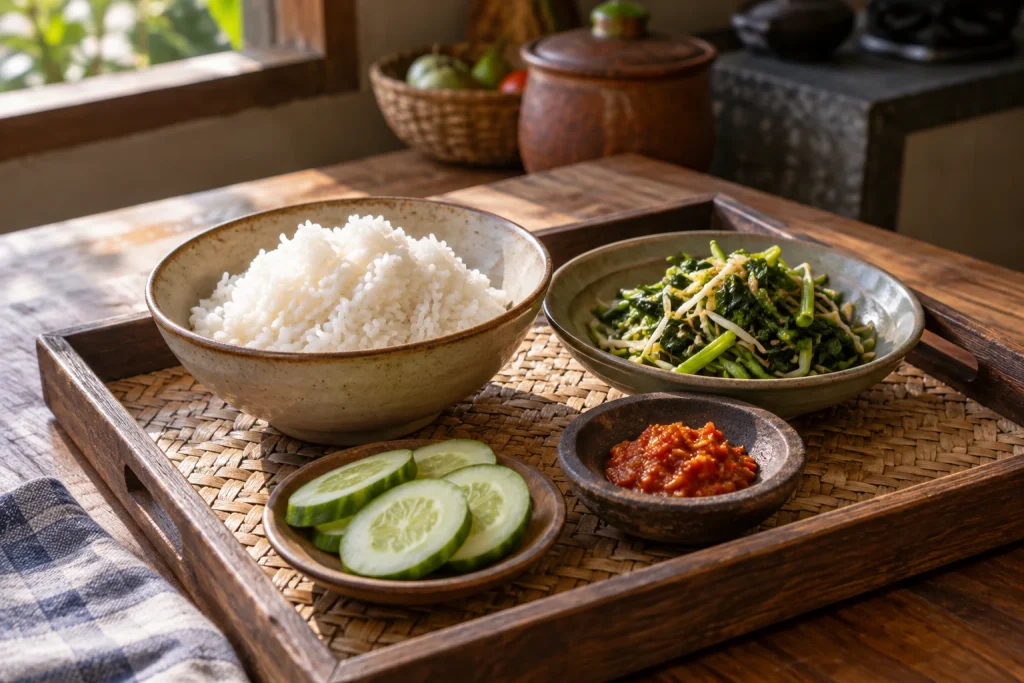
A Balinese rice meal does not always arrive as a full plate of rice with several dishes arranged around it. Sometimes the rice is wrapped in a leaf as a compact portion; sometimes it is cooked soft and spoonable; sometimes the rice is pressed into a cake and served with vegetables and sambal. Those formats affect how a dish is carried, served and eaten, but they do not all describe the same recipe. When examining balinese rice parcels and wrapped meals in the context of everyday kitchen work and guest planning in Gianyar and Ubud, separating specific ingredient names, preparation timing, and household customs prevents common misunderstandings before you shop or cook.
Three formats, three different jobs
Nasi Jinggo is known as a small rice portion wrapped in banana leaf and served with modest accompaniments. The leaf is the wrapper and serving format; it does not automatically mean the rice was cooked inside it. Nasi Sela takes a different route: pieces of sweet potato are cooked with rice, adding a softer, sweeter note and stretching the grain in a dish associated with Karangasem.
Follow the ingredient and the texture
Nasi Tepeng is soft and seasoned, often described as porridge-like, with accompaniments that vary by cook. Tipat Plecing begins with tipat, a compact rice cake, then brings it together with vegetables and a fresh, spicy plecing sambal. A parcel, a soft rice dish and a rice cake each ask for a different texture and way of serving.
Read the dish pages, then choose a focused guide
If you want a portable portion, ask what comes inside a Nasi Jinggo parcel and how spicy the sambal is. If you are curious about rice mixed with another staple, read about Nasi Sela and its sweet potato. For a spoonable bowl, Nasi Tepeng is the relevant name. If you want rice with a chewy, sliceable bite under a bright sauce, Tipat Plecing is closer to that description. The names make a useful start, while a menu description tells you what that kitchen actually serves.
Ask about the serving in front of you
Begin with the existing menu pages for nasi jinggo bali, nasi sela bali, nasi tepeng bali and tipat plecing bali. They introduce the named dishes; the articles below answer narrower questions about assembling, comparing, serving or reheating them.
Rice dishes change between households and restaurants. Check the accompaniments, broth, sambal and portion rather than assuming every version follows one fixed list. For a small rice meal, the balance can be as simple as a suitable portion of rice, one vegetable and a sauce whose heat you enjoy. If you want to explore Balinese food with a local cook in Ubud, see the Cooking Class Ubud experience and ask which rice dishes are part of the current class.
How Balinese Rice Parcels and Wrapped Meals: A Guide to Bali’s Small Rice Dishes Connects Market Observation, Kitchen Technique, and Practical Planning in Ubud
For travellers and home cooks researching balinese rice parcels and wrapped meals, the biggest gap in general travel guides is that they treat Balinese food and daily life as a single uniform checklist rather than a living household system. In a traditional Balinese compound around Ubud, decisions about ingredients, prep sequence, and table pairing depend on whether a meal is prepared for a quiet family lunch, a morning market run, or a shared gathering. When you join an Ubud Cooking Class at Wayan’s Paon, every question around balinese rice parcels and wrapped meals is answered through direct hands-on observation rather than abstract theory.
A second practical principle when evaluating balinese rice parcels and wrapped meals is recognizing the boundary between what happens at the morning produce stalls, what happens at the stone mortar (ulekan), and how the final dishes are balanced on the plate. In our private sessions such as Private Paon Table, your group works only with your own booking party and selects up to five dishes from the 53-dish menu (plus the foundational Base Genep spice paste), allowing you to test how each choice affects flavour, texture, and timing.
Comparative Reference Matrix: 10 Core Dimensions of Balinese Rice Parcels And Wrapped Meals
Before diving into each specialized subtopic in this family of guides, the table below summarizes how the ten focused questions around balinese rice parcels and wrapped meals differ in scope, practical kitchen impact, and what you should verify before buying ingredients or confirming a menu in Ubud:
| Focus Topic / Keyword Owner | Specific Question Addressed | Key Practical Distinction in Ubud |
|---|---|---|
| 1. nasi jinggo parcel meal | Making a Nasi Jinggo-Style Rice Parcel at Home | A nasi jinggo parcel meal is small by design: a measured portion of rice sits with a few savoury additions, then the parcel is wrapped for c… |
| 2. nasi sela karangasem | Nasi Sela in Karangasem: Rice, Sweet Potato and a Local Story | Nasi sela is closely associated with Karangasem in eastern Bali. Its defining idea is straightforward: chopped sweet potato cooks together w… |
| 3. nasi tepeng gianyar rice | Nasi Tepeng from Gianyar: How Soft Should the Rice Be? | Nasi Tepeng is a soft, seasoned rice dish associated with Gianyar. It is often described as porridge-like, but that word can make it sound t… |
| 4. tipat plecing rice cake method | Preparing Tipat Plecing: Rice Cake, Greens and Sambal | Tipat Plecing is easiest to understand as a plate built in layers: tipat provides the rice, vegetables bring freshness and bite, and plecing… |
| 5. balinese banana leaf rice parcel | Why Banana Leaves Suit a Balinese Rice Parcel | A banana leaf gives a small rice parcel a practical shape: it can hold a modest portion together, keep the rice and accompaniments in one bu… |
| 6. nasi jinggo vs nasi sela | Nasi Jinggo vs Nasi Sela: Two Different Small Rice Meals | Nasi Jinggo and Nasi Sela can both make a modest rice meal, but they are small in different ways. Nasi Jinggo is recognized by its compact b… |
| 7. reheat balinese rice parcel | How to Reheat a Balinese Rice Parcel Safely at Home | To reheat a Balinese rice parcel, treat the rice and its accompaniments as perishable leftovers. The banana leaf is a wrapper, not a storage… |
| 8. balinese rice dishes glossary | Nasi, Tipat and Parcel: A Balinese Rice Menu Glossary | Balinese rice names often tell you about the main ingredient or serving style, but they do not always describe a complete recipe. A short gl… |
| 9. tipat plecing side dishes | What to Serve with Tipat Plecing: Rice Cake and Sambal | Tipat Plecing already brings together three strong elements: compact rice cake, vegetables and a bright chilli sambal. A side dish should ad… |
| 10. balinese rice meal for one | Build a Small Balinese Rice Meal for One at Home | A balinese rice meal for one can be satisfying without recreating a full ceremonial spread. Think in parts: a portion of rice, one vegetable… |
Deep-Dive Guide to the 10 Specialized Subtopics Within Balinese Rice Parcels And Wrapped Meals
Each of the ten companion articles in this topic family isolates one specific decision or ingredient question related to balinese rice parcels and wrapped meals so that you never confuse a broad category label with a concrete culinary rule. Below is how each specialized guide fits into the wider picture:
1. Making a Nasi Jinggo-Style Rice Parcel at Home
When narrowing your focus from balinese rice parcels and wrapped meals to the specific question of nasi jinggo parcel meal, the primary distinction is context and practical application. A nasi jinggo parcel meal is small by design: a measured portion of rice sits with a few savoury additions, then the parcel is wrapped for carrying and serving. A home cook can borrow that compact format without pretending that one list of sides represents every vendor or household. Start with a portion you can close comfortably in a leaf, then choose two or three additions that hold their shape. By keeping this specific scope distinct from neighbouring topics, you avoid applying a general rule where a precise ingredient check or timing adjustment is required.
In practice at the market or in the paon, Cook plain rice until the grains are tender and let excess steam escape so the parcel does not become wet inside. Prepare the accompaniments separately. They might include a small vegetable, a savoury protein, a little noodle or a spoon of sambal; which ones appear depends on the cook. Keep very wet sauces in a small separate portion or use only enough to season the rice lightly. Whether you are comparing options before booking your private session or taking notes to cook at home after your trip, treating nasi jinggo parcel meal as its own step ensures your preparation remains accurate and stress-free.
2. Nasi Sela in Karangasem: Rice, Sweet Potato and a Local Story
When narrowing your focus from balinese rice parcels and wrapped meals to the specific question of nasi sela karangasem, the primary distinction is context and practical application. Nasi sela is closely associated with Karangasem in eastern Bali. Its defining idea is straightforward: chopped sweet potato cooks together with rice, so the spoonful carries both grain and a soft piece of tuber. The ratio, cut size and type of sweet potato can change the result, which is why the name points to a dish family rather than a single measured formula. By keeping this specific scope distinct from neighbouring topics, you avoid applying a general rule where a precise ingredient check or timing adjustment is required.
In practice at the market or in the paon, Choose a sweet potato that holds enough shape to remain visible after the rice is cooked. Peel it if the recipe calls for it, then cut it into even pieces so the pieces soften at a similar pace. Rinse the rice as usual and combine it with the sweet potato and the amount of water suited to the rice variety and cooking method. A home cook may need to adjust the liquid: the tuber contributes moisture and can become very soft if the pot is too wet. Whether you are comparing options before booking your private session or taking notes to cook at home after your trip, treating nasi sela karangasem as its own step ensures your preparation remains accurate and stress-free.
3. Nasi Tepeng from Gianyar: How Soft Should the Rice Be?
When narrowing your focus from balinese rice parcels and wrapped meals to the specific question of nasi tepeng gianyar rice, the primary distinction is context and practical application. Nasi Tepeng is a soft, seasoned rice dish associated with Gianyar. It is often described as porridge-like, but that word can make it sound thinner than the bowl in front of you. Some versions hold their shape on a spoon; others are looser and closer to a savoury rice porridge. The texture depends on the rice, liquid and how long the pot is cooked. By keeping this specific scope distinct from neighbouring topics, you avoid applying a general rule where a precise ingredient check or timing adjustment is required.
In practice at the market or in the paon, The grains should be thoroughly tender and take on the flavour of the seasoning. If the dish is spoonable but still has visible rice, that can be a normal result. A very loose bowl is not automatically more authentic, just as a thicker one is not necessarily undercooked. Ask the cook how this kitchen usually serves it, especially if you are comparing two stalls or restaurants. Whether you are comparing options before booking your private session or taking notes to cook at home after your trip, treating nasi tepeng gianyar rice as its own step ensures your preparation remains accurate and stress-free.
4. Preparing Tipat Plecing: Rice Cake, Greens and Sambal
When narrowing your focus from balinese rice parcels and wrapped meals to the specific question of tipat plecing rice cake method, the primary distinction is context and practical application. Tipat Plecing is easiest to understand as a plate built in layers: tipat provides the rice, vegetables bring freshness and bite, and plecing sambal supplies the sharp, spicy finish. The method is less about a single exact topping list than about keeping those parts distinct until they meet on the plate. By keeping this specific scope distinct from neighbouring topics, you avoid applying a general rule where a precise ingredient check or timing adjustment is required.
In practice at the market or in the paon, Tipat is cooked rice packed into a compact cake, commonly associated with a woven young coconut-leaf casing. Once cooled enough to handle, it can be cut into pieces that hold together under the sauce. A soft or crumbling rice cake makes assembly messy, so let it set before slicing and use a clean knife. The texture should be firm enough to pick up with a fork while remaining tender to chew. Whether you are comparing options before booking your private session or taking notes to cook at home after your trip, treating tipat plecing rice cake method as its own step ensures your preparation remains accurate and stress-free.
5. Why Banana Leaves Suit a Balinese Rice Parcel
When narrowing your focus from balinese rice parcels and wrapped meals to the specific question of balinese banana leaf rice parcel, the primary distinction is context and practical application. A banana leaf gives a small rice parcel a practical shape: it can hold a modest portion together, keep the rice and accompaniments in one bundle, and open into a serving surface. The wrapper also makes the parcel easy to carry. Those are useful functions, but the leaf does not tell you exactly how the rice was cooked or what was placed inside. By keeping this specific scope distinct from neighbouring topics, you avoid applying a general rule where a precise ingredient check or timing adjustment is required.
In practice at the market or in the paon, Fresh leaves can tear when folded cold or dry. A brief pass over gentle heat often makes a clean leaf more pliable, but the aim is only to soften it enough to bend. Wipe away surface dust with clean water and use leaves intended for food. Avoid leaves that are moldy, damaged or treated with unknown chemicals. Whether you are comparing options before booking your private session or taking notes to cook at home after your trip, treating balinese banana leaf rice parcel as its own step ensures your preparation remains accurate and stress-free.
6. Nasi Jinggo vs Nasi Sela: Two Different Small Rice Meals
When narrowing your focus from balinese rice parcels and wrapped meals to the specific question of nasi jinggo vs nasi sela, the primary distinction is context and practical application. Nasi Jinggo and Nasi Sela can both make a modest rice meal, but they are small in different ways. Nasi Jinggo is recognized by its compact banana-leaf parcel and the handful of accompaniments inside. Nasi Sela is recognized by sweet potato cooked with the rice. One is a serving format; the other changes the rice itself. By keeping this specific scope distinct from neighbouring topics, you avoid applying a general rule where a precise ingredient check or timing adjustment is required.
In practice at the market or in the paon, A Nasi Jinggo parcel can be convenient when you want rice and several savoury tastes together in a small bundle. The sides may include a vegetable, a protein, noodles or sambal, but the selection changes from one vendor to another. Ask what is in the parcel if you need to avoid an ingredient or want to know the heat level. The wrapper makes it portable; it does not guarantee a fixed filling list. Whether you are comparing options before booking your private session or taking notes to cook at home after your trip, treating nasi jinggo vs nasi sela as its own step ensures your preparation remains accurate and stress-free.
7. How to Reheat a Balinese Rice Parcel Safely at Home
When narrowing your focus from balinese rice parcels and wrapped meals to the specific question of reheat balinese rice parcel, the primary distinction is context and practical application. To reheat a Balinese rice parcel, treat the rice and its accompaniments as perishable leftovers. The banana leaf is a wrapper, not a storage method that keeps food safe on its own. How the parcel was cooled and stored matters more than how neatly it was folded. By keeping this specific scope distinct from neighbouring topics, you avoid applying a general rule where a precise ingredient check or timing adjustment is required.
In practice at the market or in the paon, If the parcel will not be eaten soon, separate or loosen the filling so it cools quickly, then refrigerate it in a clean, covered container. Avoid leaving cooked rice at room temperature for an extended period. If the parcel has been sitting out for an uncertain length of time, use caution and follow current local food-safety advice rather than trying to make it safe by reheating. Whether you are comparing options before booking your private session or taking notes to cook at home after your trip, treating reheat balinese rice parcel as its own step ensures your preparation remains accurate and stress-free.
8. Nasi, Tipat and Parcel: A Balinese Rice Menu Glossary
When narrowing your focus from balinese rice parcels and wrapped meals to the specific question of balinese rice dishes glossary, the primary distinction is context and practical application. Balinese rice names often tell you about the main ingredient or serving style, but they do not always describe a complete recipe. A short glossary can help you read a menu without treating a translation as a guarantee. The cook, sides and seasoning still matter. By keeping this specific scope distinct from neighbouring topics, you avoid applying a general rule where a precise ingredient check or timing adjustment is required.
In practice at the market or in the paon, Nasi means rice in Indonesian and appears at the start of many dish names. The next word may identify an ingredient, a region or a serving format. Nasi Sela, for example, combines rice with sweet potato and is associated with Karangasem. Nasi Tepeng refers to soft, seasoned rice linked with Gianyar. Those names are more specific than the general word nasi, but recipes still vary between kitchens. Whether you are comparing options before booking your private session or taking notes to cook at home after your trip, treating balinese rice dishes glossary as its own step ensures your preparation remains accurate and stress-free.
9. What to Serve with Tipat Plecing: Rice Cake and Sambal
When narrowing your focus from balinese rice parcels and wrapped meals to the specific question of tipat plecing side dishes, the primary distinction is context and practical application. Tipat Plecing already brings together three strong elements: compact rice cake, vegetables and a bright chilli sambal. A side dish should add a different texture or a milder note rather than compete with the sauce. The right pairing depends on how large the serving is and how much sambal the kitchen uses. When examining tipat plecing side dishes in the context of everyday kitchen work and guest planning in Gianyar and Ubud, separating specific ingredient names, preparation timing, and household customs prevents common misunderstandings before you shop or cook. By keeping this specific scope distinct from neighbouring topics, you avoid applying a general rule where a precise ingredient check or timing adjustment is required.
In practice at the market or in the paon, Plain rice or another neutral grain can soften a very spicy plate, while blanched greens, cucumber or lightly cooked vegetables bring freshness. A simple protein may make the meal more filling, but check how it is seasoned so it does not duplicate the sambal’s heat. The point is not to prescribe a fixed traditional combination; it is to balance the plate you have been served. Whether you are comparing options before booking your private session or taking notes to cook at home after your trip, treating tipat plecing side dishes as its own step ensures your preparation remains accurate and stress-free.
10. Build a Small Balinese Rice Meal for One at Home
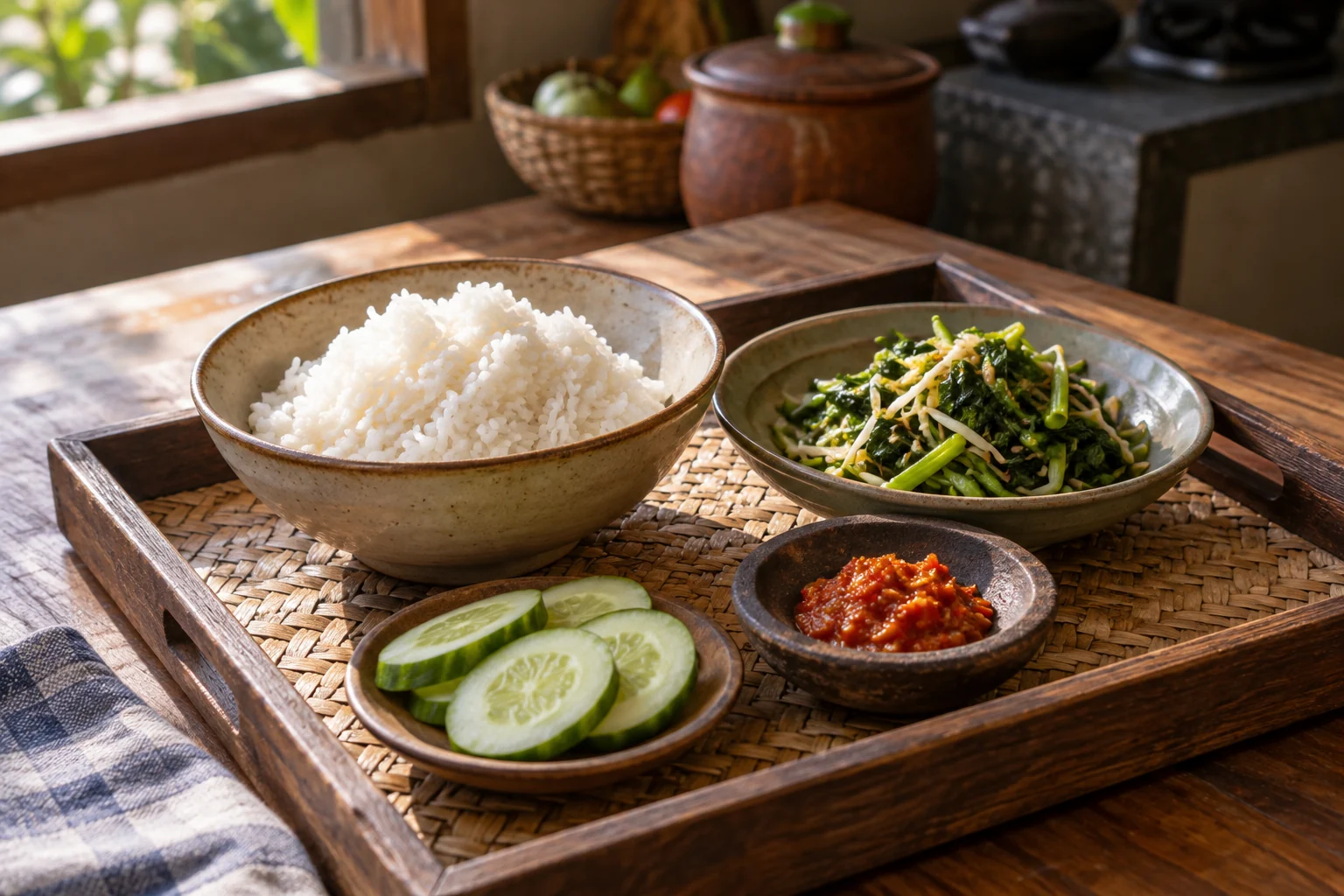
When narrowing your focus from balinese rice parcels and wrapped meals to the specific question of balinese rice meal for one, the primary distinction is context and practical application. A balinese rice meal for one can be satisfying without recreating a full ceremonial spread. Think in parts: a portion of rice, one vegetable, one savoury addition if you want it, and a sauce or sambal used with care. This is a flexible home-cooking template, not a claim that every Balinese meal follows the same plate. By keeping this specific scope distinct from neighbouring topics, you avoid applying a general rule where a precise ingredient check or timing adjustment is required.
In practice at the market or in the paon, Plain steamed rice is the easiest base for a quick meal. If you want a compact wrapped portion, take inspiration from Nasi Jinggo and add a few small sides. If you want the sweet potato integrated into the rice, read about Nasi Sela. For a soft, spoonable bowl, Nasi Tepeng is the closer reference; tipat works when you want rice in a firm, sliceable form. Whether you are comparing options before booking your private session or taking notes to cook at home after your trip, treating balinese rice meal for one as its own step ensures your preparation remains accurate and stress-free.
How to Apply These Notes When Planning Your Private Cooking Day at Wayan’s Paon
Bringing all ten facets of balinese rice parcels and wrapped meals together reveals a consistent lesson about Balinese culinary culture: clarity comes from asking specific questions before the cooking begins. In a private household setting in Ubud, your host does not rely on factory-made pastes or rigid group schedules. Instead, fresh roots (galangal, turmeric, ginger, and aromatic kencur), shallots, garlic, lemongrass, salam leaves, and kaffir lime are proportioned for the exact five dishes your group chooses to cook.
If you have dietary requirements—such as vegetarian or vegan preparation without fermented shrimp paste (terasi), gluten-free substitutions using pure rice flour and palm sugar (Gula Aren), dairy-free coconut milk infusions, or nut-free spice pastes omitting candlenut (kemiri)—discussing them when you select your menu allows the kitchen to prepare dedicated mortars, cutting boards, and filtered drinking-water washing stations in advance.
Finally, use this pillar overview on balinese rice parcels and wrapped meals alongside the ten focused cluster guides linked above whenever you want to verify a local Balinese term, compare morning market timing against afternoon kitchen sessions, or adapt a traditional Ubud technique for your own stove at home.