
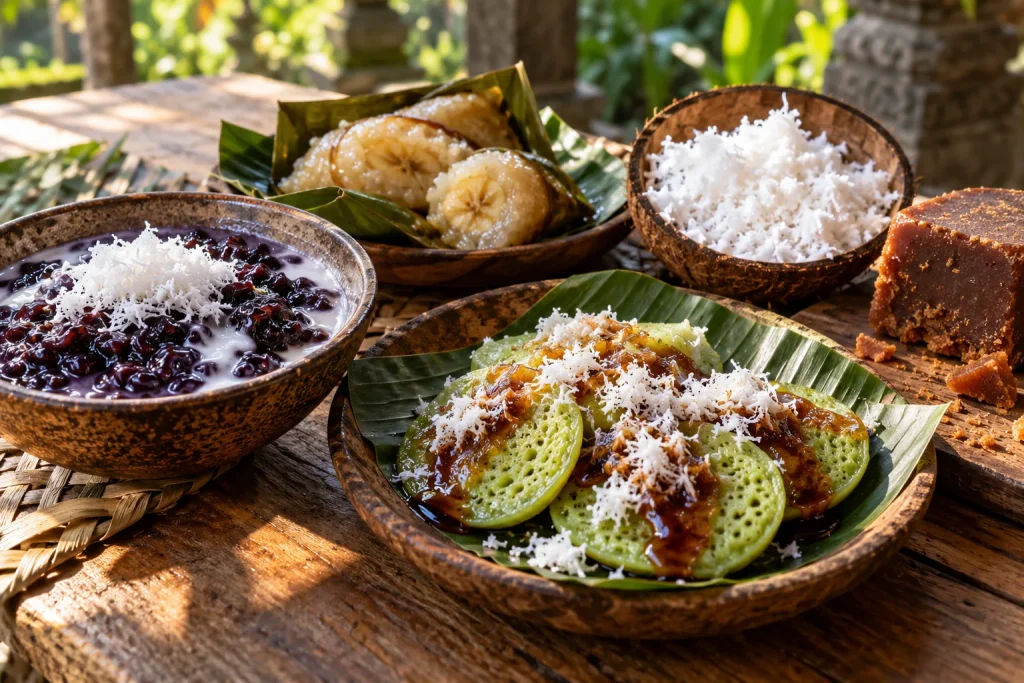
Balinese savoury snacks vs jaje is a useful comparison when a plate of small bites is unfamiliar. Jaje is commonly used for traditional cakes and snacks, many of which are sweet, but a name or display alone does not guarantee a particular flavour. Some foods combine a sweet note with coconut or salt, and local usage can vary. When examining balinese savoury snacks vs jaje in the context of everyday kitchen work and guest planning in Gianyar and Ubud, separating specific ingredient names, preparation timing, and household customs prevents common misunderstandings before you shop or cook.
Notice the first taste and the finish
The easiest approach is to look at ingredients and ask how the item is prepared. Palm sugar, rice flour and coconut may point towards a sweet bite; chilli, a savoury dressing or a fried filling suggests another direction. These are clues, not a rulebook for every market or kitchen.
Do not rely on colour alone
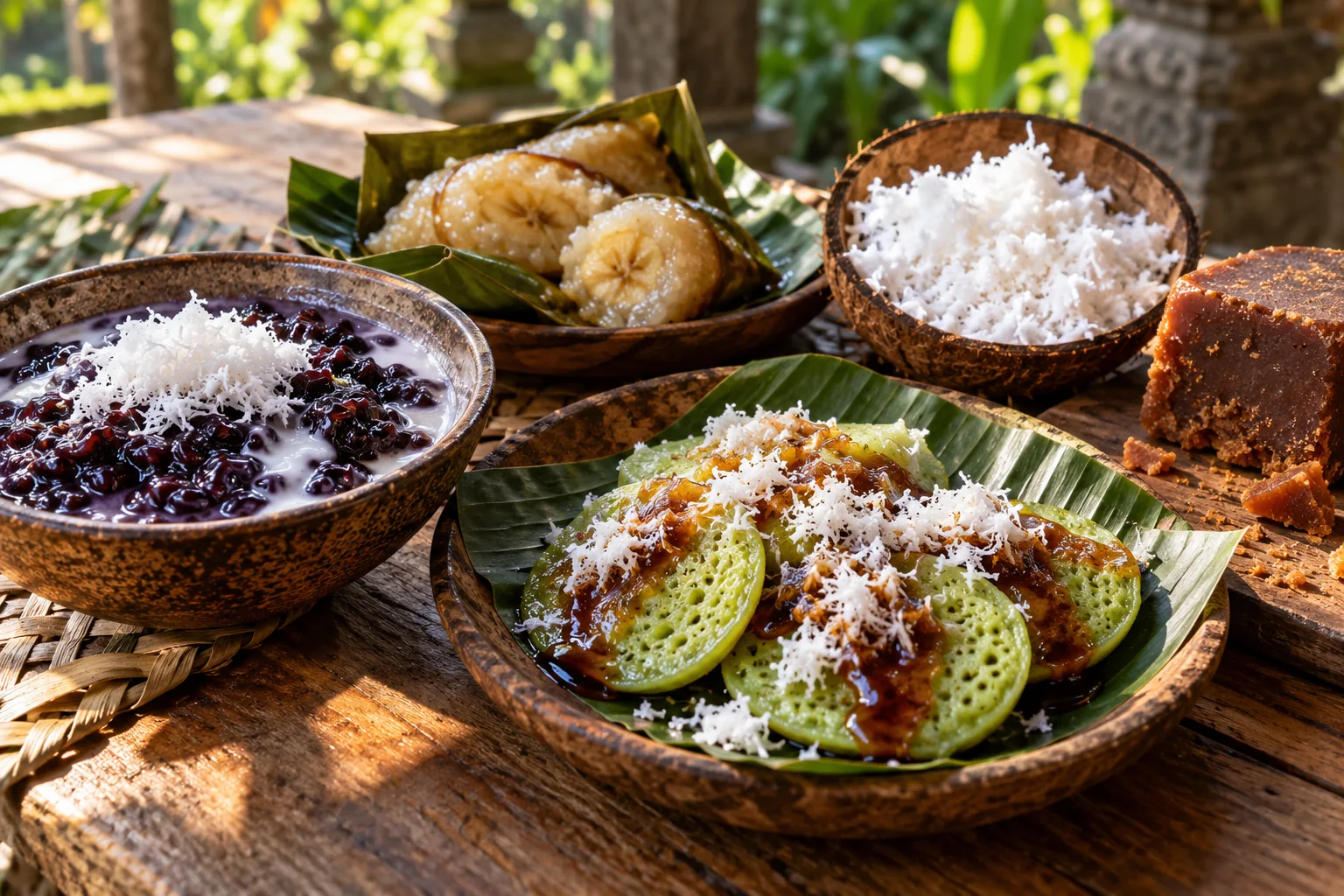
A sweet jaje may lean on palm sugar, syrup or a soft rice-flour texture. A savoury bite may bring salt, toasted aromatics, chilli or a sauce. Yet sweetness can still appear in a savoury dish, and a small fried piece is not necessarily mild. Taste a modest piece first if you are unsure.
Choose with context
Think about the finish as well as the first impression. Does the flavour stay sweet, become tangy, or finish with heat? Asking what is in the sauce can clarify more than asking only whether a dish is spicy. The wider balinese savoury snacks guide puts these cues into context.
Bright colours can come from ingredients, sauces or natural leaves; they do not reliably identify whether a snack is sweet. Nor does a leaf wrapper tell you how the filling tastes. If a dish is behind glass or already wrapped, ask the seller for its name and whether it is sweet, savoury or both.
At a shared table, keep sweet jaje on a separate plate from chilli dressings so the flavours do not mingle before anyone has chosen. That is a serving preference rather than a strict tradition. It also makes the selection easier for people who want to sample one category at a time.
Some small dishes sit between snack and meal. A rice parcel can be compact but satisfying; a fried bite plays a different role. A question about portion and accompaniment helps you understand what you are ordering without assuming that every small food is a dessert or appetizer.
Use the balinese savoury snacks guide to compare formats, then follow your curiosity one item at a time. If a hands-on introduction would help you recognise ingredients and seasonings, the Ubud Cooking Class page describes the current cooking class experience in Ubud.
How Sweet Jaje or Savoury Bite? How to Read a Balinese Snack Plate Connects Market Observation, Kitchen Technique, and Practical Planning in Ubud
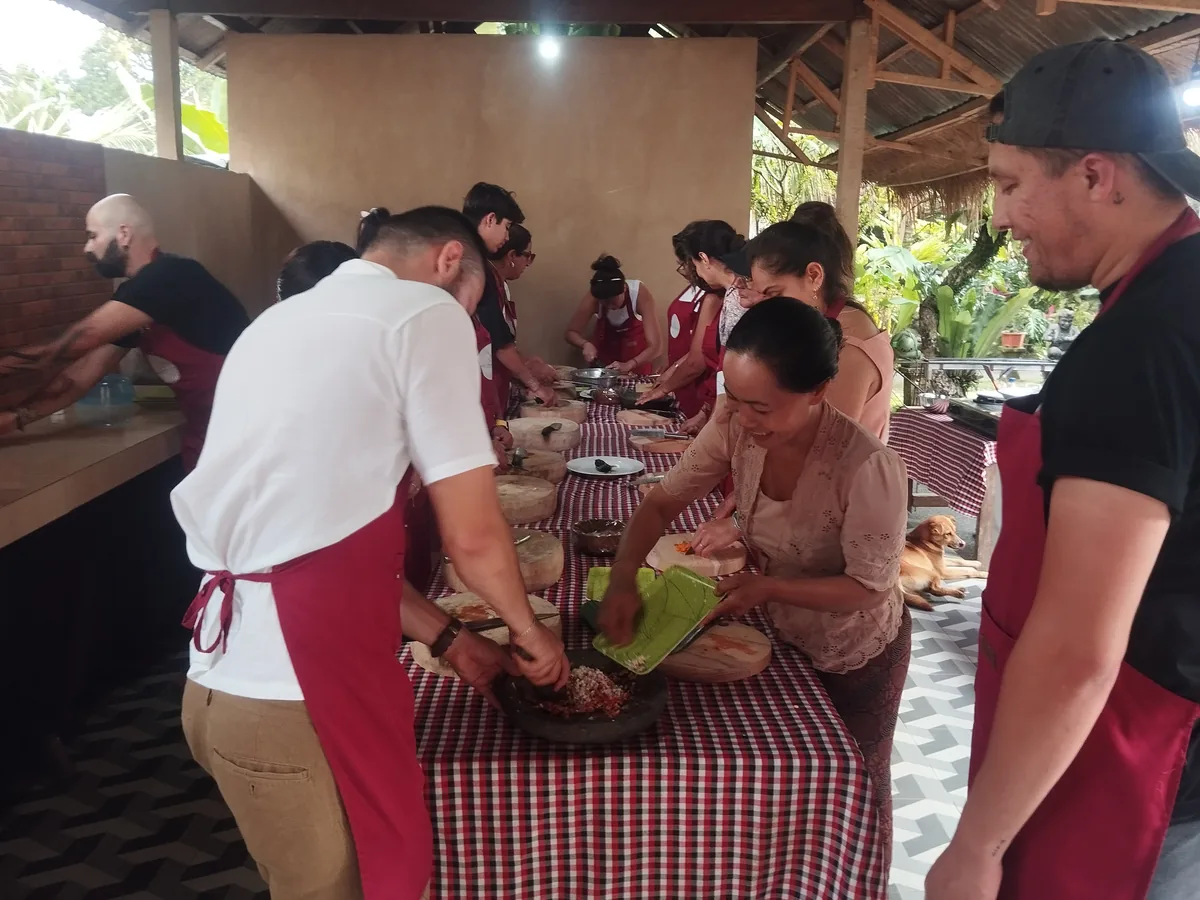
For travellers and home cooks researching balinese savoury snacks vs jaje, the biggest gap in general travel guides is that they treat Balinese food and daily life as a single uniform checklist rather than a living household system. In a traditional Balinese compound around Ubud, decisions about ingredients, prep sequence, and table pairing depend on whether a meal is prepared for a quiet family lunch, a morning market run, or a shared gathering. When you join an Ubud Cooking Class at Wayan’s Paon, every question around balinese savoury snacks vs jaje is answered through direct hands-on observation rather than abstract theory.
A second practical principle when evaluating balinese savoury snacks vs jaje is recognizing the boundary between what happens at the morning produce stalls, what happens at the stone mortar (ulekan), and how the final dishes are balanced on the plate. In our private sessions such as Balinese Sweet Cooking Class, your group works only with your own booking party and selects up to five dishes from the 53-dish menu (plus the foundational Base Genep spice paste), allowing you to test how each choice affects flavour, texture, and timing.
Comparative Reference Matrix: 10 Core Dimensions of Balinese Savoury Snacks Vs Jaje
Before diving into each specialized subtopic in this family of guides, the table below summarizes how the ten focused questions around balinese savoury snacks vs jaje differ in scope, practical kitchen impact, and what you should verify before buying ingredients or confirming a menu in Ubud:
| Focus Topic / Keyword Owner | Specific Question Addressed | Key Practical Distinction in Ubud |
|---|---|---|
| 1. prepare a balinese snack plate ahead | What Can You Prepare Ahead for a Balinese Snack Plate? | To prepare a Balinese snack plate ahead, separate the jobs that can wait from the ones that depend on texture. Washing and arranging serving… |
| 2. balinese savoury snacks | Balinese Savoury Snacks: A Guide to Small Bites and How to Serve Them | Balinese savoury snacks occupy the space between a quick bite and a full plate. Some are crisp, some are cool and dressed, and others arrive… |
| 3. balinese savoury snack plate | Build a Balinese Savoury Snack Plate at Home | A balinese savoury snack plate does not need a long menu. Begin with one item you want to eat while warm, add a fresh or cool contrast, and … |
| 4. balinese savoury snack flavours | Coconut, Chilli and Lime: The Flavours behind Balinese Savoury Snacks | Balinese savoury snack flavours are easier to understand when you notice one element at a time. A bite might be salty before the chilli arri… |
| 5. balinese snack textures | Crisp, Soft or Saucy? A Texture Guide to Balinese Snacks | Balinese snack textures tell you how a bite is likely to behave on the plate. A fritter with a crisp edge is best enjoyed before steam softe… |
| 6. balinese snack portions | Small, Shared or Filling? Choosing a Balinese Snack Portion | Balinese snack portions do not follow one fixed measure. A vendor may serve a small rice parcel that feels more substantial than its size su… |
| 7. vegetarian balinese snacks | Vegetarian Balinese Snacks: What to Ask before You Order | Finding vegetarian Balinese snacks is less about memorising a list and more about checking how each dish is prepared. A name may describe th… |
| 8. balinese snack spice level | Gentle to Hot: Managing Chilli on a Balinese Snack Plate | Balinese snack spice level can change from one cook to another, even when two dishes share a name. Chilli may be mixed into the food, served… |
| 9. balinese snack pairings | What to Serve with Balinese Savoury Snacks at Home | Balinese snack pairings are easiest to choose by contrast. If the main bite is fried, add something fresh or cool. If it is already dressed … |
| 10. balinese snack menu for sharing | A Small Balinese Snack Menu for Sharing at Home | A balinese snack menu for sharing does not need to recreate a restaurant spread. For a relaxed home table, choose a few dishes that differ i… |
Deep-Dive Guide to the 10 Specialized Subtopics Within Balinese Savoury Snacks Vs Jaje
Each of the ten companion articles in this topic family isolates one specific decision or ingredient question related to balinese savoury snacks vs jaje so that you never confuse a broad category label with a concrete culinary rule. Below is how each specialized guide fits into the wider picture:
1. What Can You Prepare Ahead for a Balinese Snack Plate?
When narrowing your focus from balinese savoury snacks vs jaje to the specific question of prepare a balinese snack plate ahead, the primary distinction is context and practical application. To prepare a Balinese snack plate ahead, separate the jobs that can wait from the ones that depend on texture. Washing and arranging serving bowls can happen earlier; a crisp item and a dressed salad are better finished close to the meal. Planning this way keeps the last stretch calm. By keeping this specific scope distinct from neighbouring topics, you avoid applying a general rule where a precise ingredient check or timing adjustment is required.
In practice at the market or in the paon, Start with a short list of dishes and check what each one needs. One warm bite, one fresh or chilled item and a condiment already create contrast. More dishes mean more pans, timing and leftovers, so add another only when it contributes a different flavour or texture. Whether you are comparing options before booking your private session or taking notes to cook at home after your trip, treating prepare a balinese snack plate ahead as its own step ensures your preparation remains accurate and stress-free.
2. Balinese Savoury Snacks: A Guide to Small Bites and How to Serve Them
When narrowing your focus from balinese savoury snacks vs jaje to the specific question of balinese savoury snacks, the primary distinction is context and practical application. Balinese savoury snacks occupy the space between a quick bite and a full plate. Some are crisp, some are cool and dressed, and others arrive with rice or a generous spoon of sauce. The word snack can describe size or occasion, so it does not always tell you what a dish contains or how filling it will be. By keeping this specific scope distinct from neighbouring topics, you avoid applying a general rule where a precise ingredient check or timing adjustment is required.
In practice at the market or in the paon, Rather than treating every small Balinese dish as the same kind of snack, look at its ingredients, texture and serving style. A fried bite, a rice parcel and a seaweed salad answer different appetites. Recipes and portions vary from cook to cook, which is part of the pleasure of exploring them. Whether you are comparing options before booking your private session or taking notes to cook at home after your trip, treating balinese savoury snacks as its own step ensures your preparation remains accurate and stress-free.
3. Build a Balinese Savoury Snack Plate at Home
When narrowing your focus from balinese savoury snacks vs jaje to the specific question of balinese savoury snack plate, the primary distinction is context and practical application. A balinese savoury snack plate does not need a long menu. Begin with one item you want to eat while warm, add a fresh or cool contrast, and decide whether rice belongs on the table. The aim is a plate that feels considered, not a miniature buffet that takes all afternoon. By keeping this specific scope distinct from neighbouring topics, you avoid applying a general rule where a precise ingredient check or timing adjustment is required.
In practice at the market or in the paon, Choose dishes with different jobs. A crisp-edged bite such as perkedel jagung bali can anchor the plate; a cool dressed item can brighten it; a sauce or sambal can provide the stronger accent. If you prefer a rice-based option, the compact format of nasi jinggo bali makes the plate more filling. Whether you are comparing options before booking your private session or taking notes to cook at home after your trip, treating balinese savoury snack plate as its own step ensures your preparation remains accurate and stress-free.
4. Coconut, Chilli and Lime: The Flavours behind Balinese Savoury Snacks
When narrowing your focus from balinese savoury snacks vs jaje to the specific question of balinese savoury snack flavours, the primary distinction is context and practical application. Balinese savoury snack flavours are easier to understand when you notice one element at a time. A bite might be salty before the chilli arrives, or tangy at the start and richer at the finish. Coconut can add body; citrus can lift a dressing; aromatics and chilli can bring warmth. The balance changes by recipe and cook. By keeping this specific scope distinct from neighbouring topics, you avoid applying a general rule where a precise ingredient check or timing adjustment is required.
In practice at the market or in the paon, Rather than describing every dish as spicy, ask what else you can taste. That answer is useful whether you are choosing a snack, adjusting a home recipe or deciding what should sit beside it. Whether you are comparing options before booking your private session or taking notes to cook at home after your trip, treating balinese savoury snack flavours as its own step ensures your preparation remains accurate and stress-free.
5. Crisp, Soft or Saucy? A Texture Guide to Balinese Snacks
When narrowing your focus from balinese savoury snacks vs jaje to the specific question of balinese snack textures, the primary distinction is context and practical application. Balinese snack textures tell you how a bite is likely to behave on the plate. A fritter with a crisp edge is best enjoyed before steam softens it; a tender parcel invites a slower bite; a dressed seaweed dish is cool and juicy. Thinking about texture helps you decide what to serve first and what to keep separate. By keeping this specific scope distinct from neighbouring topics, you avoid applying a general rule where a precise ingredient check or timing adjustment is required.
In practice at the market or in the paon, These are serving observations, not a ranking. A soft bite can be just as satisfying as a crunchy one, and a sauce may be central to the dish rather than an optional extra. Whether you are comparing options before booking your private session or taking notes to cook at home after your trip, treating balinese snack textures as its own step ensures your preparation remains accurate and stress-free.
6. Small, Shared or Filling? Choosing a Balinese Snack Portion
When narrowing your focus from balinese savoury snacks vs jaje to the specific question of balinese snack portions, the primary distinction is context and practical application. Balinese snack portions do not follow one fixed measure. A vendor may serve a small rice parcel that feels more substantial than its size suggests, while a fried bite may be only one part of a wider meal. The useful question is not whether a portion is authentic, but how much food you want now. By keeping this specific scope distinct from neighbouring topics, you avoid applying a general rule where a precise ingredient check or timing adjustment is required.
In practice at the market or in the paon, Look at the format first. Is the item mostly rice, a single cooked piece, a dressed salad or several small accompaniments? That tells you more about fullness than the word snack alone. Whether you are comparing options before booking your private session or taking notes to cook at home after your trip, treating balinese snack portions as its own step ensures your preparation remains accurate and stress-free.
7. Vegetarian Balinese Snacks: What to Ask before You Order
When narrowing your focus from balinese savoury snacks vs jaje to the specific question of vegetarian balinese snacks, the primary distinction is context and practical application. Finding vegetarian Balinese snacks is less about memorising a list and more about checking how each dish is prepared. A name may describe the main ingredient, while a dressing, broth, topping or cooking surface changes whether it suits your diet. Recipes can vary between cooks and stalls. By keeping this specific scope distinct from neighbouring topics, you avoid applying a general rule where a precise ingredient check or timing adjustment is required.
In practice at the market or in the paon, State your requirements clearly and ask about the complete dish, including the sauce. If you avoid fish, ask whether broth or shrimp paste is used. If you eat eggs but not meat, say so; the seller can answer more accurately when the boundary is specific. Whether you are comparing options before booking your private session or taking notes to cook at home after your trip, treating vegetarian balinese snacks as its own step ensures your preparation remains accurate and stress-free.
8. Gentle to Hot: Managing Chilli on a Balinese Snack Plate
When narrowing your focus from balinese savoury snacks vs jaje to the specific question of balinese snack spice level, the primary distinction is context and practical application. Balinese snack spice level can change from one cook to another, even when two dishes share a name. Chilli may be mixed into the food, served in a separate sambal or added as part of a dressing. A red sauce is not a reliable measure of heat, and a mild-looking sauce can still build. By keeping this specific scope distinct from neighbouring topics, you avoid applying a general rule where a precise ingredient check or timing adjustment is required.
In practice at the market or in the paon, If you are ordering, ask whether the chilli is already mixed in or served separately. If you are cooking for others, let each person add heat at the table. That keeps the main bite readable and gives everyone control over the last step. Whether you are comparing options before booking your private session or taking notes to cook at home after your trip, treating balinese snack spice level as its own step ensures your preparation remains accurate and stress-free.
9. What to Serve with Balinese Savoury Snacks at Home
When narrowing your focus from balinese savoury snacks vs jaje to the specific question of balinese snack pairings, the primary distinction is context and practical application. Balinese snack pairings are easiest to choose by contrast. If the main bite is fried, add something fresh or cool. If it is already dressed and tangy, a plain rice component can make the plate feel steadier. There is no one set of sides that belongs with every snack. When examining balinese snack pairings in the context of everyday kitchen work and guest planning in Gianyar and Ubud, separating specific ingredient names, preparation timing, and household customs prevents common misunderstandings before you shop or cook. By keeping this specific scope distinct from neighbouring topics, you avoid applying a general rule where a precise ingredient check or timing adjustment is required.
In practice at the market or in the paon, Begin with the food you already have, then ask what it lacks: substance, freshness, crunch or a mild counterpoint to chilli. That question keeps the table focused and makes it less likely that every item will taste alike. Whether you are comparing options before booking your private session or taking notes to cook at home after your trip, treating balinese snack pairings as its own step ensures your preparation remains accurate and stress-free.
10. A Small Balinese Snack Menu for Sharing at Home
When narrowing your focus from balinese savoury snacks vs jaje to the specific question of balinese snack menu for sharing, the primary distinction is context and practical application. A balinese snack menu for sharing does not need to recreate a restaurant spread. For a relaxed home table, choose a few dishes that differ in texture and seasoning, then leave room for people to decide what belongs together. A shorter menu is easier to time and gives each item more attention. By keeping this specific scope distinct from neighbouring topics, you avoid applying a general rule where a precise ingredient check or timing adjustment is required.
In practice at the market or in the paon, Think in roles rather than a long shopping list: one warm bite, one cool or fresh element, and a sauce or condiment served separately. Add a rice parcel or another filling option only if the group wants a more substantial meal. Whether you are comparing options before booking your private session or taking notes to cook at home after your trip, treating balinese snack menu for sharing as its own step ensures your preparation remains accurate and stress-free.
How to Apply These Notes When Planning Your Private Cooking Day at Wayan’s Paon
Bringing all ten facets of balinese savoury snacks vs jaje together reveals a consistent lesson about Balinese culinary culture: clarity comes from asking specific questions before the cooking begins. In a private household setting in Ubud, your host does not rely on factory-made pastes or rigid group schedules. Instead, fresh roots (galangal, turmeric, ginger, and aromatic kencur), shallots, garlic, lemongrass, salam leaves, and kaffir lime are proportioned for the exact five dishes your group chooses to cook.
If you have dietary requirements—such as vegetarian or vegan preparation without fermented shrimp paste (terasi), gluten-free substitutions using pure rice flour and palm sugar (Gula Aren), dairy-free coconut milk infusions, or nut-free spice pastes omitting candlenut (kemiri)—discussing them when you select your menu allows the kitchen to prepare dedicated mortars, cutting boards, and filtered drinking-water washing stations in advance.
Finally, use this pillar overview on balinese savoury snacks vs jaje alongside the ten focused cluster guides linked above whenever you want to verify a local Balinese term, compare morning market timing against afternoon kitchen sessions, or adapt a traditional Ubud technique for your own stove at home.