
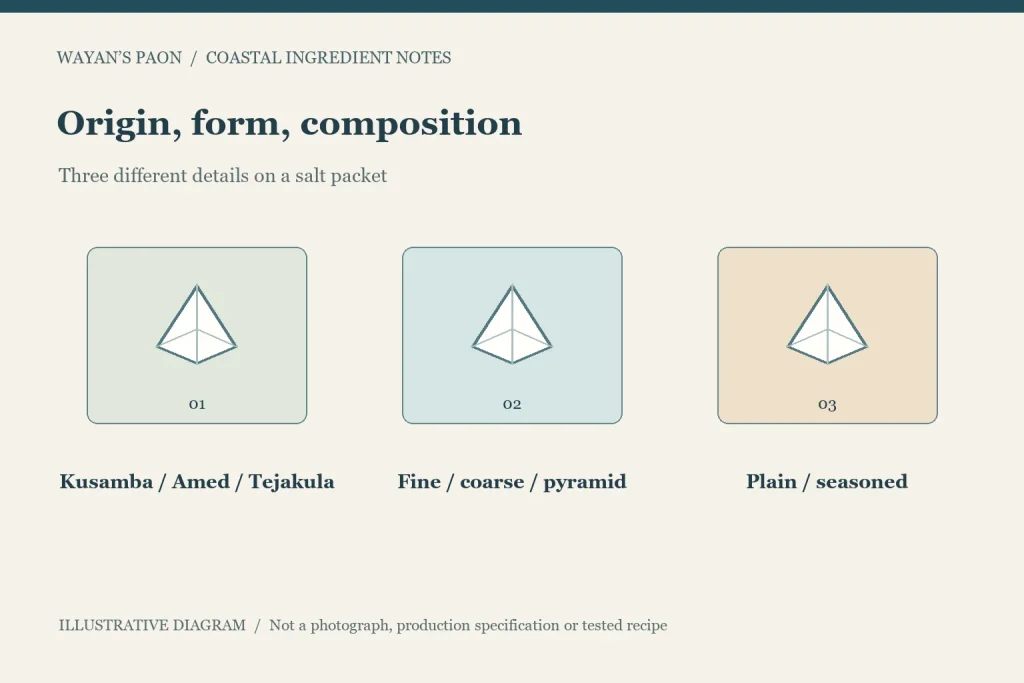
Balinese sea salt begins with seawater, but a bag of finished crystals can carry several different stories. Kusamba, Amed and Tejakula are names worth keeping separate. They point to coastal communities and production traditions, while words such as coarse, pyramid and flavoured describe other features of the product. When examining Balinese sea salt in the context of everyday kitchen work and guest planning in Gianyar and Ubud, separating specific ingredient names, preparation timing, and household customs prevents common misunderstandings before you shop or cook.
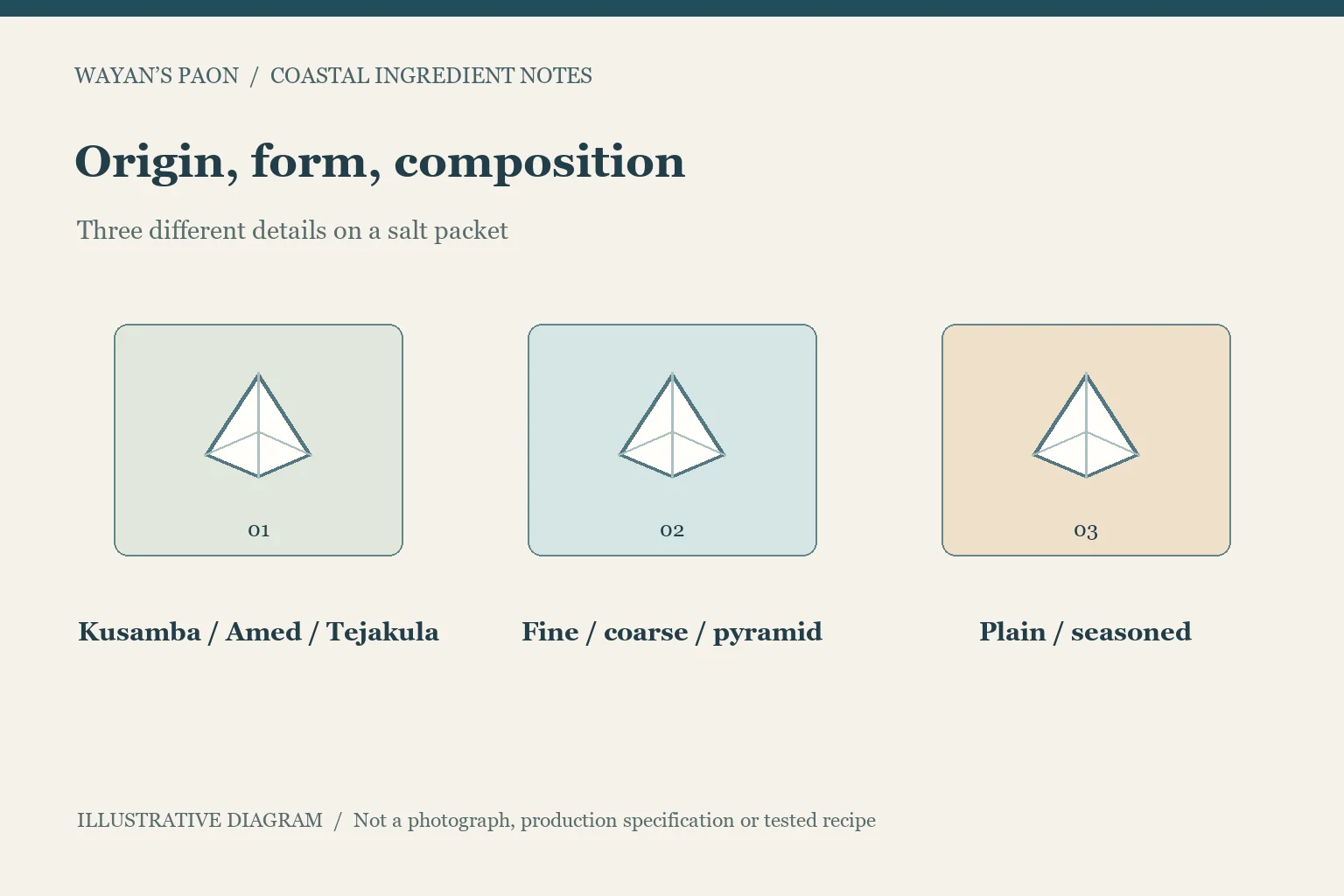
Three questions make the label easier to read
Start with origin: where was this salt produced? Then look at form: are the crystals fine, coarse or sold as a finishing salt? Finally, check composition: is the packet plain salt or a seasoning blend? A regional name cannot answer all three questions.
Follow the work from beach to crystal
Indonesia's geographical-indication register includes named Balinese salt products. That recognition is a reason to retain the full product name when learning about an ingredient. It is not a reason to treat every bag labelled Bali as a verified example of the same regional product.
Crystal form changes the kitchen question
Traditional production can involve more than leaving seawater in a shallow tray. The Klungkung investment office describes Kusamba's use of beach sand to capture salt, followed by collecting a concentrated liquid and drying it in coconut-wood troughs. Each stage has a different job.
Plain salt and seasoned salt are different ingredients
The vocabulary helps you follow a demonstration. A filter separates material as liquid passes through; a drying trough holds liquid while water evaporates. A photograph of either tool makes more sense when you know which stage you are looking at. The guides to tinjungan salt filter and palungan salt troughs explain those roles separately.
Bring the ingredient story back to the cooking
The Buleleng tourism office describes a hollow pyramid-shaped salt associated with Tejakula. A finishing crystal is interesting partly because it remains visible on food. Once salt has dissolved into a sauce, its original outline no longer provides that presentation.
Explore the coastal stories and kitchen questions
For a recipe, preserve the specified measurement. A teaspoon is a volume; grams measure mass. Different crystal arrangements can occupy the same spoon without supplying the same amount. The guide to measuring coarse salt explains how to keep a substitution traceable without inventing a conversion factor.
Klungkung's food and fisheries department documented plain, iodised and seasoned Uyah Kusamba products in 2022. Its examples included chilli and ginger varieties. Treat that as a record of product development, rather than a guarantee of what any shop stocks today.
Read the particular packet before adding it to a recipe. A flavoured blend may bring seasoning as well as salt. Adding the full original spice mixture on top can make an unintended change to the dish.
Learning about salt is most useful when you connect it with a preparation. In a Cooking Class Ubud session, ask which salt is used and how it is measured in the dish you are making. That question links coastal craftsmanship with an ordinary kitchen decision, without assuming the class includes a salt-farm visit or a particular brand.
How Balinese Sea Salt Has More Than One Coastal Story Connects Market Observation, Kitchen Technique, and Practical Planning in Ubud
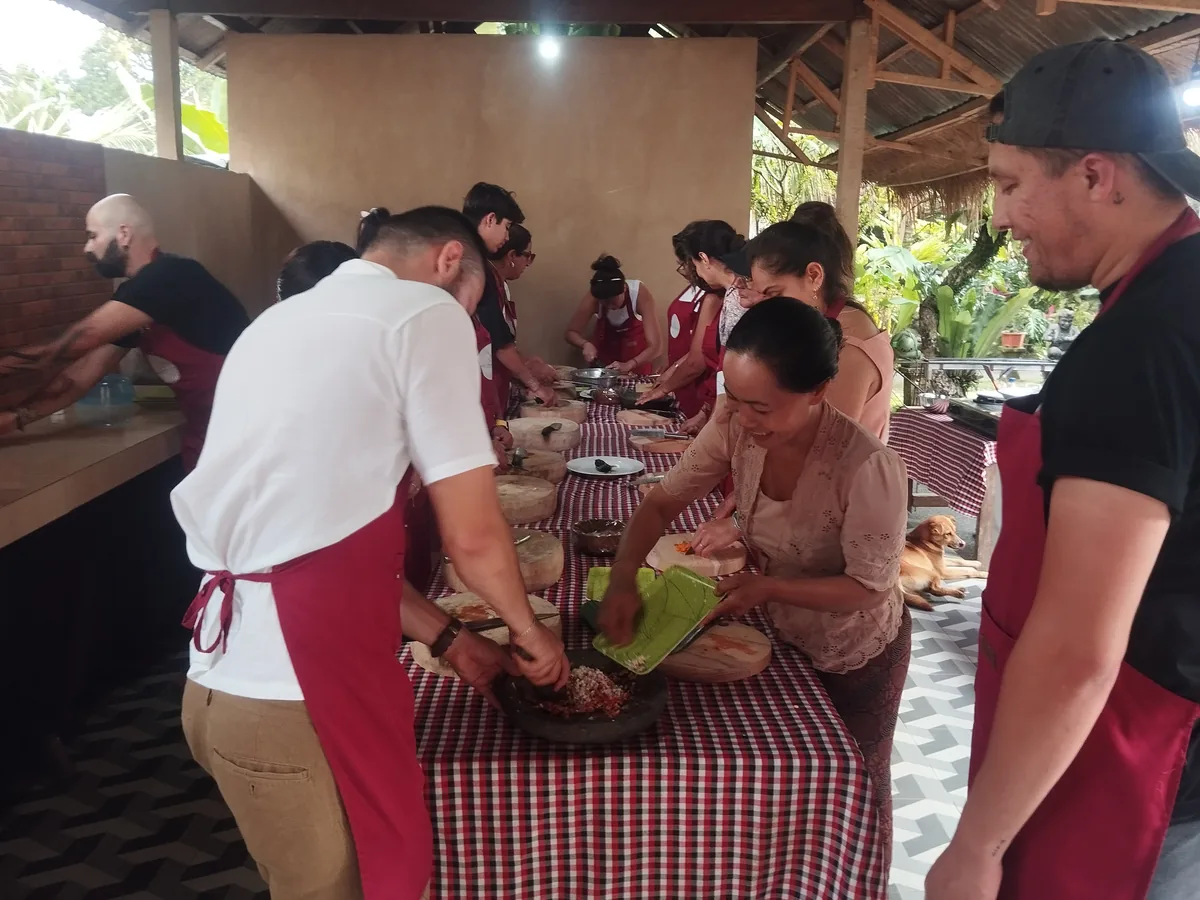
For travellers and home cooks researching Balinese sea salt, the biggest gap in general travel guides is that they treat Balinese food and daily life as a single uniform checklist rather than a living household system. In a traditional Balinese compound around Ubud, decisions about ingredients, prep sequence, and table pairing depend on whether a meal is prepared for a quiet family lunch, a morning market run, or a shared gathering. When you join an Ubud Cooking Class at Wayan’s Paon, every question around Balinese sea salt is answered through direct hands-on observation rather than abstract theory.
A second practical principle when evaluating Balinese sea salt is recognizing the boundary between what happens at the morning produce stalls, what happens at the stone mortar (ulekan), and how the final dishes are balanced on the plate. In our private sessions such as Market to Paon, your group works only with your own booking party and selects up to five dishes from the 53-dish menu (plus the foundational Base Genep spice paste), allowing you to test how each choice affects flavour, texture, and timing.
Comparative Reference Matrix: 10 Core Dimensions of Balinese Sea Salt
Before diving into each specialized subtopic in this family of guides, the table below summarizes how the ten focused questions around Balinese sea salt differ in scope, practical kitchen impact, and what you should verify before buying ingredients or confirming a menu in Ubud:
| Focus Topic / Keyword Owner | Specific Question Addressed | Key Practical Distinction in Ubud |
|---|---|---|
| 1. Kusamba salt | Kusamba Salt Begins with More Than a Drying Trough | Kusamba salt comes with a production story rooted in Klungkung. The local investment office locates the traditional industry in Kusamba vill… |
| 2. Amed salt | Amed Salt and the Place Behind Its Name | Amed salt is a place-linked ingredient, not a generic name for every sea salt sold in eastern Bali. Indonesia's intellectual-property o… |
| 3. Tejakula salt | Tejakula Salt Connects a Coastal Craft with the Kitchen | Tejakula salt belongs to a north-Bali production story in Buleleng. Local government accounts describe salt-making with coconut-wood troughs… |
| 4. Balinese pyramid salt | The Hollow Shape of Balinese Pyramid Salt | Balinese pyramid salt is easiest to understand by separating its shape from its origin. Buleleng's tourism office describes a Tejakula … |
| 5. tinjungan salt filter | What a Tinjungan Does in Amed Salt-Making | A tinjungan salt filter belongs to the production process, before the finished crystals reach a kitchen. Indonesia's intellectual-prope… |
| 6. palungan salt troughs | Palungan Troughs Give Salt Brine a Place to Dry | Palungan salt troughs are part of Bali's coastal salt-making vocabulary. Official descriptions from Klungkung and Buleleng identify tro… |
| 7. flavoured Balinese salt | Flavoured Balinese Salt Is Already a Seasoning Blend | Flavoured Balinese salt brings more than salt to a dish. Klungkung's food and fisheries department documented seasoned Uyah Kusamba pro… |
| 8. salt in Balinese sambal | Salt in Balinese Sambal Needs a Place in the Recipe | Salt in Balinese sambal is one part of a preparation, alongside ingredients that may already contribute seasoning. Start with the named samb… |
| 9. measuring coarse salt | Measuring Coarse Salt without Guessing a Spoon Conversion | Measuring coarse salt starts with the unit in the recipe. Grams describe mass; a teaspoon describes volume. Large crystals, small grains and… |
| 10. buying Balinese sea salt | Buying Balinese Sea Salt with the Origin Still Attached | Buying Balinese sea salt is easier when you keep three details together: the named product, who produced or packed it and the form you inten… |
Deep-Dive Guide to the 10 Specialized Subtopics Within Balinese Sea Salt
Each of the ten companion articles in this topic family isolates one specific decision or ingredient question related to Balinese sea salt so that you never confuse a broad category label with a concrete culinary rule. Below is how each specialized guide fits into the wider picture:
1. Kusamba Salt Begins with More Than a Drying Trough
When narrowing your focus from Balinese sea salt to the specific question of Kusamba salt, the primary distinction is context and practical application. Kusamba salt comes with a production story rooted in Klungkung. The local investment office locates the traditional industry in Kusamba village, in Dawan district, and describes a process that uses beach sand before the final drying stage. Understanding that sequence explains why the work is more involved than pouring seawater into a tray. By keeping this specific scope distinct from neighbouring topics, you avoid applying a general rule where a precise ingredient check or timing adjustment is required.
In practice at the market or in the paon, In the documented process, salt from seawater is captured on beach sand. The salt-bearing material is then washed, and the collected liquid goes forward for drying. The sand stage and the crystallisation stage therefore belong to the same sequence, but they do different work. Whether you are comparing options before booking your private session or taking notes to cook at home after your trip, treating Kusamba salt as its own step ensures your preparation remains accurate and stress-free.
2. Amed Salt and the Place Behind Its Name
When narrowing your focus from Balinese sea salt to the specific question of Amed salt, the primary distinction is context and practical application. Amed salt is a place-linked ingredient, not a generic name for every sea salt sold in eastern Bali. Indonesia's intellectual-property office records Garam Amed Bali as a geographical indication and reported its European recognition in October 2024. For a home cook, the immediate value is a clearer name to preserve when buying and recording the product. By keeping this specific scope distinct from neighbouring topics, you avoid applying a general rule where a precise ingredient check or timing adjustment is required.
In practice at the market or in the paon, If a packet says Garam Amed Bali, copy that wording into your ingredient notes rather than shortening it to white salt. Keep the producer or packer's details with it. That gives you a way to distinguish a repeat purchase from another product that happens to look similar. Whether you are comparing options before booking your private session or taking notes to cook at home after your trip, treating Amed salt as its own step ensures your preparation remains accurate and stress-free.
3. Tejakula Salt Connects a Coastal Craft with the Kitchen
When narrowing your focus from Balinese sea salt to the specific question of Tejakula salt, the primary distinction is context and practical application. Tejakula salt belongs to a north-Bali production story in Buleleng. Local government accounts describe salt-making with coconut-wood troughs and the development of pyramid-shaped products. The place name and the crystal shape are related in those accounts, but they are not interchangeable descriptions of every packet. By keeping this specific scope distinct from neighbouring topics, you avoid applying a general rule where a precise ingredient check or timing adjustment is required.
In practice at the market or in the paon, Use Tejakula for the origin and read the product description for the form. A packet may describe a particular crystal style or added flavour. That is more specific than assuming everything from one district has the same size, texture and intended use. Whether you are comparing options before booking your private session or taking notes to cook at home after your trip, treating Tejakula salt as its own step ensures your preparation remains accurate and stress-free.
4. The Hollow Shape of Balinese Pyramid Salt
When narrowing your focus from Balinese sea salt to the specific question of Balinese pyramid salt, the primary distinction is context and practical application. Balinese pyramid salt is easiest to understand by separating its shape from its origin. Buleleng's tourism office describes a Tejakula product with a small pyramid form and a hollow underside. That visible structure is part of its interest when used to finish a dish. By keeping this specific scope distinct from neighbouring topics, you avoid applying a general rule where a precise ingredient check or timing adjustment is required.
In practice at the market or in the paon, An intact finishing crystal can be seen on a plate. Crushing it changes that presentation; dissolving it removes the original outline altogether. Choose the form for the job you want it to do rather than paying attention only to the most striking photograph of the ingredient. Whether you are comparing options before booking your private session or taking notes to cook at home after your trip, treating Balinese pyramid salt as its own step ensures your preparation remains accurate and stress-free.
5. What a Tinjungan Does in Amed Salt-Making
When narrowing your focus from Balinese sea salt to the specific question of tinjungan salt filter, the primary distinction is context and practical application. A tinjungan salt filter belongs to the production process, before the finished crystals reach a kitchen. Indonesia's intellectual-property office describes tinjungan among the traditional tools used in Amed salt-making. Its role is filtering the liquid that proceeds to the drying stage. By keeping this specific scope distinct from neighbouring topics, you avoid applying a general rule where a precise ingredient check or timing adjustment is required.
In practice at the market or in the paon, A useful way to follow the work is to identify what enters the tool, what stays behind and what is collected. That keeps the explanation focused on a physical process instead of treating a traditional name as a decorative detail. Whether you are comparing options before booking your private session or taking notes to cook at home after your trip, treating tinjungan salt filter as its own step ensures your preparation remains accurate and stress-free.
6. Palungan Troughs Give Salt Brine a Place to Dry
When narrowing your focus from Balinese sea salt to the specific question of palungan salt troughs, the primary distinction is context and practical application. Palungan salt troughs are part of Bali's coastal salt-making vocabulary. Official descriptions from Klungkung and Buleleng identify troughs made from coconut trunks split lengthwise. Their job in the documented process is to hold salty liquid for drying. By keeping this specific scope distinct from neighbouring topics, you avoid applying a general rule where a precise ingredient check or timing adjustment is required.
In practice at the market or in the paon, The liquid arrives after earlier preparation. The trough then provides a place for water to evaporate and crystals to form. Keeping those stages in order prevents a wooden trough from becoming an all-purpose explanation for everything that happens between the sea and the finished bag. Whether you are comparing options before booking your private session or taking notes to cook at home after your trip, treating palungan salt troughs as its own step ensures your preparation remains accurate and stress-free.
7. Flavoured Balinese Salt Is Already a Seasoning Blend
When narrowing your focus from Balinese sea salt to the specific question of flavoured Balinese salt, the primary distinction is context and practical application. Flavoured Balinese salt brings more than salt to a dish. Klungkung's food and fisheries department documented seasoned Uyah Kusamba products in 2022, with examples including celery, chilli and ginger. That product history is useful context, but the ingredient list on the packet in front of you is what matters when cooking. By keeping this specific scope distinct from neighbouring topics, you avoid applying a general rule where a precise ingredient check or timing adjustment is required.
In practice at the market or in the paon, If a recipe calls for plain salt and fresh ginger, replacing the salt with a ginger-seasoned blend changes two parts of the preparation at once. You have changed the salt product and introduced an additional seasoning whose quantity may not be stated in the recipe. Whether you are comparing options before booking your private session or taking notes to cook at home after your trip, treating flavoured Balinese salt as its own step ensures your preparation remains accurate and stress-free.
8. Salt in Balinese Sambal Needs a Place in the Recipe
When narrowing your focus from Balinese sea salt to the specific question of salt in Balinese sambal, the primary distinction is context and practical application. Salt in Balinese sambal is one part of a preparation, alongside ingredients that may already contribute seasoning. Start with the named sambal recipe rather than adding an arbitrary pinch because the condiment looks similar to another version you have eaten. By keeping this specific scope distinct from neighbouring topics, you avoid applying a general rule where a precise ingredient check or timing adjustment is required.
In practice at the market or in the paon, A recipe may contain a prepared paste or another salted ingredient. Keep that ingredient in view when reading the separate salt amount. The recipe's instructions describe how the components work together; treating each line as unrelated can obscure the intended balance. Whether you are comparing options before booking your private session or taking notes to cook at home after your trip, treating salt in Balinese sambal as its own step ensures your preparation remains accurate and stress-free.
9. Measuring Coarse Salt without Guessing a Spoon Conversion
When narrowing your focus from Balinese sea salt to the specific question of measuring coarse salt, the primary distinction is context and practical application. Measuring coarse salt starts with the unit in the recipe. Grams describe mass; a teaspoon describes volume. Large crystals, small grains and broken flakes can occupy a spoon differently. There is no single conversion to invent from the words sea salt alone. When examining measuring coarse salt in the context of everyday kitchen work and guest planning in Gianyar and Ubud, separating specific ingredient names, preparation timing, and household customs prevents common misunderstandings before you shop or cook. By keeping this specific scope distinct from neighbouring topics, you avoid applying a general rule where a precise ingredient check or timing adjustment is required.
In practice at the market or in the paon, If the recipe gives grams, use a scale that can measure the required quantity meaningfully. Preserve the unit when changing the salt product. An instruction for 6 grams does not become a certain number of teaspoons merely because the replacement looks finer. Whether you are comparing options before booking your private session or taking notes to cook at home after your trip, treating measuring coarse salt as its own step ensures your preparation remains accurate and stress-free.
10. Buying Balinese Sea Salt with the Origin Still Attached
When narrowing your focus from Balinese sea salt to the specific question of buying Balinese sea salt, the primary distinction is context and practical application. Buying Balinese sea salt is easier when you keep three details together: the named product, who produced or packed it and the form you intend to cook with. An attractive bag can introduce an ingredient, but the useful information should remain available after the bag is opened. By keeping this specific scope distinct from neighbouring topics, you avoid applying a general rule where a precise ingredient check or timing adjustment is required.
In practice at the market or in the paon, Record where the salt was produced separately from where you bought it. A product purchased in Ubud may come from a coastal community. A shop receipt helps identify the purchase, while the packet may provide the origin and producer information. Whether you are comparing options before booking your private session or taking notes to cook at home after your trip, treating buying Balinese sea salt as its own step ensures your preparation remains accurate and stress-free.
How to Apply These Notes When Planning Your Private Cooking Day at Wayan’s Paon
Bringing all ten facets of Balinese sea salt together reveals a consistent lesson about Balinese culinary culture: clarity comes from asking specific questions before the cooking begins. In a private household setting in Ubud, your host does not rely on factory-made pastes or rigid group schedules. Instead, fresh roots (galangal, turmeric, ginger, and aromatic kencur), shallots, garlic, lemongrass, salam leaves, and kaffir lime are proportioned for the exact five dishes your group chooses to cook.
If you have dietary requirements—such as vegetarian or vegan preparation without fermented shrimp paste (terasi), gluten-free substitutions using pure rice flour and palm sugar (Gula Aren), dairy-free coconut milk infusions, or nut-free spice pastes omitting candlenut (kemiri)—discussing them when you select your menu allows the kitchen to prepare dedicated mortars, cutting boards, and filtered drinking-water washing stations in advance.
Finally, use this pillar overview on Balinese sea salt alongside the ten focused cluster guides linked above whenever you want to verify a local Balinese term, compare morning market timing against afternoon kitchen sessions, or adapt a traditional Ubud technique for your own stove at home.