
A Balinese Sweet Cooking Class Built around Texture and Timing. The current class is private, built around Balinese sweets and traditional drinks, and planned around dishes the host confirms for your date. This guide focuses on the decision or practical question in its title. When examining balinese sweet cooking class ubud in the context of everyday kitchen work and guest planning in Gianyar and Ubud, separating specific ingredient names, preparation timing, and household customs prevents common misunderstandings before you shop or cook.
Start with the menu, not a fixed set
The live class page describes a private session for the booking group, with up to five sweet or drink items chosen from a library of more than thirty options. That gives a group room to build a menu around a few things it is curious about. It does not mean every choice is ready on every date: Wayan confirms ingredients and preparation after receiving the request.
Texture is the useful thread
The confirmed menu may mix pancakes, banana sweets, black-rice dishes and traditional drinks. Those examples use different ingredients and methods, so a useful selection is one your group can actually cook in the time available. Choose favourites first, then ask the host which set works together.
Keep the group and logistics in view
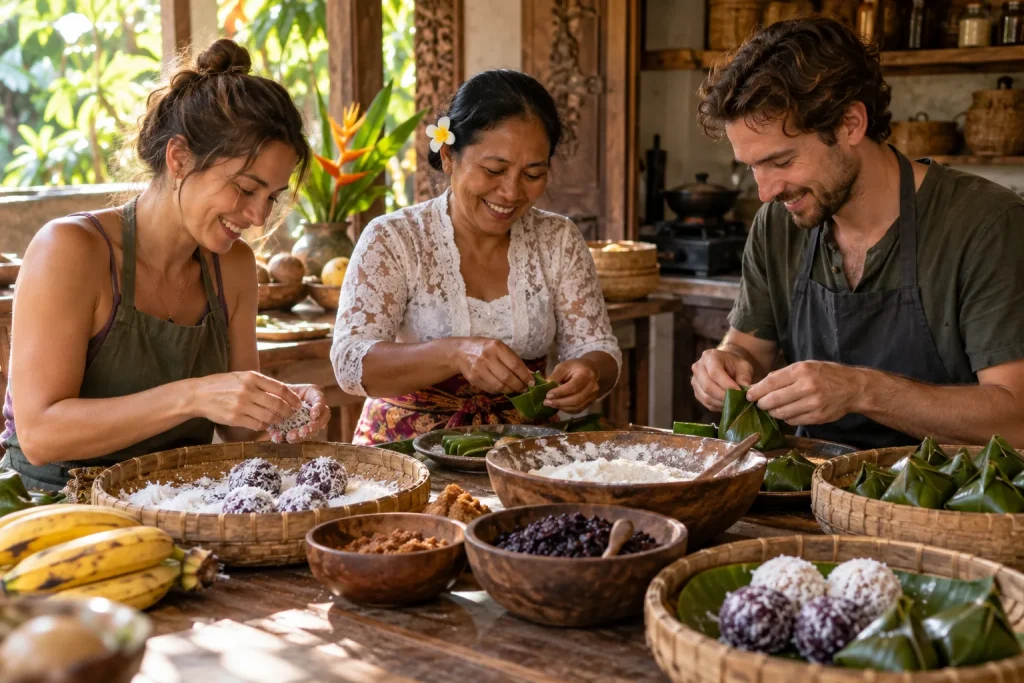
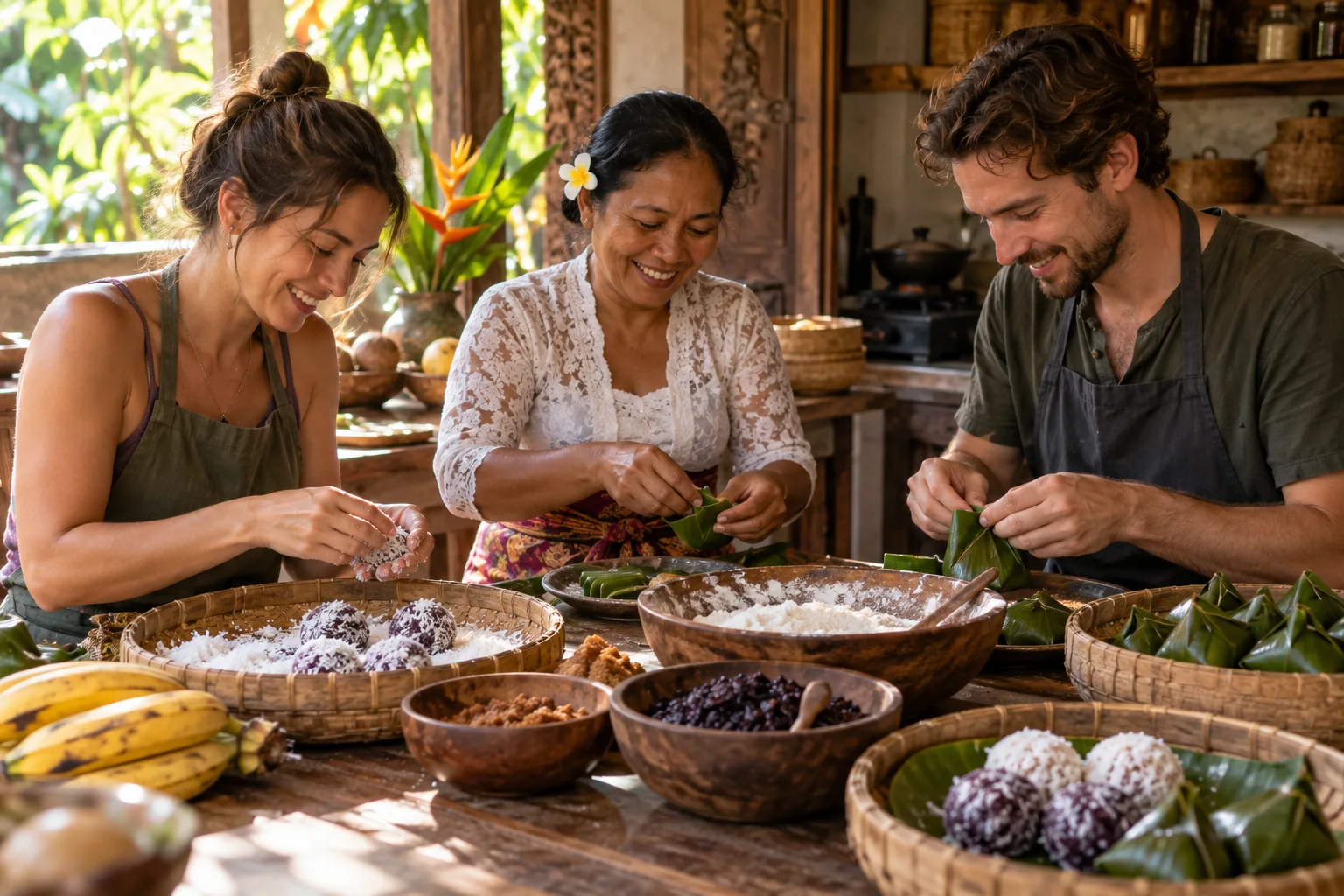
Balinese sweets are not one texture with different names. Rice-flour batter can be soft and tender, glutinous rice can keep a chewy bite, coconut can add a fresh or creamy finish, and palm sugar can arrive as a syrup or part of a filling. Banana and black rice bring other textures to the menu. The owner page describes the class around learning texture, heat and timing, without publishing a fixed lesson script.
Send one clear request
That makes the session easier to plan than a promise to master a particular recipe. Before the day, ask which confirmed dishes will be prepared, what the group will handle, and whether a sweet needs advance preparation. The answer can help set expectations without assuming that every dish follows the same recipe.
The class is private for your booking group; unrelated guests are not added. The page presents it as suitable for families and people who want a hands-on sweet-focused activity. It does not list a minimum child age or a separate supervision policy, so families should ask those questions with the guest count and ages before confirming.
The page lists lunch or afternoon timing. Ubud pickup and return are included, while transport from outside Ubud is quoted by location and paid by the guest. There is no fixed duration to rely on in the public description. If you have another booking later, give Wayan that constraint and ask for a realistic start and finish window.
Choose up to five preferred items, then include the date, group size, pickup area, dietary needs and any ingredient questions in one message. Tell the host whether the group prefers a hands-on focus or wants time to taste and compare the finished sweets. This gives Wayan the details needed to check ingredients and preparation rather than treating a sample menu as a guarantee.
For the current format and booking details, use the balinese dessert cooking class ubud owner page. The wider Cooking Class Ubud range can help if your group is still deciding between a sweets-focused session and another type of class.
How A Balinese Sweet Cooking Class Built around Texture and Timing Connects Market Observation, Kitchen Technique, and Practical Planning in Ubud
For travellers and home cooks researching balinese sweet cooking class ubud, the biggest gap in general travel guides is that they treat Balinese food and daily life as a single uniform checklist rather than a living household system. In a traditional Balinese compound around Ubud, decisions about ingredients, prep sequence, and table pairing depend on whether a meal is prepared for a quiet family lunch, a morning market run, or a shared gathering. When you join an Ubud Cooking Class at Wayan’s Paon, every question around balinese sweet cooking class ubud is answered through direct hands-on observation rather than abstract theory.
A second practical principle when evaluating balinese sweet cooking class ubud is recognizing the boundary between what happens at the morning produce stalls, what happens at the stone mortar (ulekan), and how the final dishes are balanced on the plate. In our private sessions such as Balinese Sweet Cooking Class, your group works only with your own booking party and selects up to five dishes from the 53-dish menu (plus the foundational Base Genep spice paste), allowing you to test how each choice affects flavour, texture, and timing.
Comparative Reference Matrix: 10 Core Dimensions of Balinese Sweet Cooking Class Ubud
Before diving into each specialized subtopic in this family of guides, the table below summarizes how the ten focused questions around balinese sweet cooking class ubud differ in scope, practical kitchen impact, and what you should verify before buying ingredients or confirming a menu in Ubud:
| Focus Topic / Keyword Owner | Specific Question Addressed | Key Practical Distinction in Ubud |
|---|---|---|
| 1. what to expect balinese sweets class | What to Expect in a Balinese Sweets Cooking Class | What to Expect in a Balinese Sweets Cooking Class. The current class is private, built around Balinese sweets and traditional drinks, and pl… |
| 2. balinese sweets cooking techniques class | Learn the Texture behind Jaje Laklak and Other Balinese Sweets | Learn the Texture behind Jaje Laklak and Other Balinese Sweets. The current class is private, built around Balinese sweets and traditional d… |
| 3. private balinese dessert cooking class ubud | A Private Class for Cooking Balinese Desserts in Ubud | A Private Class for Cooking Balinese Desserts in Ubud. The current class is private, built around Balinese sweets and traditional drinks, an… |
| 4. balinese sweets class ingredients | Rice, Coconut and Palm Sugar: Ingredients in a Balinese Sweets Class | Rice, Coconut and Palm Sugar: Ingredients in a Balinese Sweets Class. The current class is private, built around Balinese sweets and traditi… |
| 5. choose five balinese sweets cooking class | Choosing Five Sweets for a Hands-On Cooking Session | Choosing Five Sweets for a Hands-On Cooking Session. The current class is private, built around Balinese sweets and traditional drinks, and … |
| 6. balinese dessert cooking class for children ubud | Can Children Join a Balinese Sweet-Making Class? | Can Children Join a Balinese Sweet-Making Class?. The current class is private, built around Balinese sweets and traditional drinks, and pla… |
| 7. hands on balinese dessert class ubud | A Class for Travelers Who Want to Make the Sweets, Not Just Taste Them | A Class for Travelers Who Want to Make the Sweets, Not Just Taste Them. The current class is private, built around Balinese sweets and tradi… |
| 8. balinese sweets class menu choices | Jaje Laklak or Bubur Injin? Choosing a Sweet to Learn First | Jaje Laklak or Bubur Injin? Choosing a Sweet to Learn First. The current class is private, built around Balinese sweets and traditional drin… |
| 9. balinese sweet class vs regular cooking class | A Sweet-Focused Cooking Class versus a Full Balinese Menu | A Sweet-Focused Cooking Class versus a Full Balinese Menu. The current class is private, built around Balinese sweets and traditional drinks… |
| 10. plan balinese sweets cooking class | How to Build a Private Balinese Dessert Session in Ubud | How to Build a Private Balinese Dessert Session in Ubud. The current class is private, built around Balinese sweets and traditional drinks, … |
Deep-Dive Guide to the 10 Specialized Subtopics Within Balinese Sweet Cooking Class Ubud
Each of the ten companion articles in this topic family isolates one specific decision or ingredient question related to balinese sweet cooking class ubud so that you never confuse a broad category label with a concrete culinary rule. Below is how each specialized guide fits into the wider picture:
1. What to Expect in a Balinese Sweets Cooking Class
When narrowing your focus from balinese sweet cooking class ubud to the specific question of what to expect balinese sweets class, the primary distinction is context and practical application. What to Expect in a Balinese Sweets Cooking Class. The current class is private, built around Balinese sweets and traditional drinks, and planned around dishes the host confirms for your date. This guide focuses on the decision or practical question in its title. By keeping this specific scope distinct from neighbouring topics, you avoid applying a general rule where a precise ingredient check or timing adjustment is required.
In practice at the market or in the paon, The Balinese sweets class is private for the people on one booking. The page says unrelated tourists are not added, so your group can plan around its own interests and pace. If someone wants to observe rather than cook, or if your party includes children, mention that when you enquire instead of assuming the class has a separate activity for them. Whether you are comparing options before booking your private session or taking notes to cook at home after your trip, treating what to expect balinese sweets class as its own step ensures your preparation remains accurate and stress-free.
2. Learn the Texture behind Jaje Laklak and Other Balinese Sweets
When narrowing your focus from balinese sweet cooking class ubud to the specific question of balinese sweets cooking techniques class, the primary distinction is context and practical application. Learn the Texture behind Jaje Laklak and Other Balinese Sweets. The current class is private, built around Balinese sweets and traditional drinks, and planned around dishes the host confirms for your date. This guide focuses on the decision or practical question in its title. By keeping this specific scope distinct from neighbouring topics, you avoid applying a general rule where a precise ingredient check or timing adjustment is required.
In practice at the market or in the paon, A sweets class becomes more interesting when the group notices why two dishes feel different. The live owner page points to texture, heat and timing. Rice-flour batter, glutinous rice, banana, coconut and palm sugar each behave differently, so a hands-on menu can offer more than a row of similar desserts. The exact set still depends on what Wayan confirms for the date. Whether you are comparing options before booking your private session or taking notes to cook at home after your trip, treating balinese sweets cooking techniques class as its own step ensures your preparation remains accurate and stress-free.
3. A Private Class for Cooking Balinese Desserts in Ubud
When narrowing your focus from balinese sweet cooking class ubud to the specific question of private balinese dessert cooking class ubud, the primary distinction is context and practical application. A Private Class for Cooking Balinese Desserts in Ubud. The current class is private, built around Balinese sweets and traditional drinks, and planned around dishes the host confirms for your date. This guide focuses on the decision or practical question in its title. By keeping this specific scope distinct from neighbouring topics, you avoid applying a general rule where a precise ingredient check or timing adjustment is required.
In practice at the market or in the paon, The live page describes a sweets-focused cooking session for your booking group only. Unrelated travelers are not added, which can make it easier for friends or family to choose dishes around shared interests. It also means the menu and guest count should be settled together; one person’s favourite sweet may not be available for every date. Whether you are comparing options before booking your private session or taking notes to cook at home after your trip, treating private balinese dessert cooking class ubud as its own step ensures your preparation remains accurate and stress-free.
4. Rice, Coconut and Palm Sugar: Ingredients in a Balinese Sweets Class
When narrowing your focus from balinese sweet cooking class ubud to the specific question of balinese sweets class ingredients, the primary distinction is context and practical application. Rice, Coconut and Palm Sugar: Ingredients in a Balinese Sweets Class. The current class is private, built around Balinese sweets and traditional drinks, and planned around dishes the host confirms for your date. This guide focuses on the decision or practical question in its title. By keeping this specific scope distinct from neighbouring topics, you avoid applying a general rule where a precise ingredient check or timing adjustment is required.
In practice at the market or in the paon, The live class page describes a menu built around rice flour, coconut, banana, black rice, palm sugar and traditional drinks. It does not say every sweet uses all of them. A rice-flour pancake, a banana preparation and a black-rice porridge are different dishes, and the ingredients listed for one should not be transferred to the rest. Whether you are comparing options before booking your private session or taking notes to cook at home after your trip, treating balinese sweets class ingredients as its own step ensures your preparation remains accurate and stress-free.
5. Choosing Five Sweets for a Hands-On Cooking Session
When narrowing your focus from balinese sweet cooking class ubud to the specific question of choose five balinese sweets cooking class, the primary distinction is context and practical application. Choosing Five Sweets for a Hands-On Cooking Session. The current class is private, built around Balinese sweets and traditional drinks, and planned around dishes the host confirms for your date. This guide focuses on the decision or practical question in its title. By keeping this specific scope distinct from neighbouring topics, you avoid applying a general rule where a precise ingredient check or timing adjustment is required.
In practice at the market or in the paon, The current sweets page lets the booking group choose up to five items from a library of more than thirty. You do not need to fill every slot. A shorter list can leave room for the host to confirm ingredients and preparation, especially when one dish needs advance work. Whether you are comparing options before booking your private session or taking notes to cook at home after your trip, treating choose five balinese sweets cooking class as its own step ensures your preparation remains accurate and stress-free.
6. Can Children Join a Balinese Sweet-Making Class?
When narrowing your focus from balinese sweet cooking class ubud to the specific question of balinese dessert cooking class for children ubud, the primary distinction is context and practical application. Can Children Join a Balinese Sweet-Making Class?. The current class is private, built around Balinese sweets and traditional drinks, and planned around dishes the host confirms for your date. This guide focuses on the decision or practical question in its title. By keeping this specific scope distinct from neighbouring topics, you avoid applying a general rule where a precise ingredient check or timing adjustment is required.
In practice at the market or in the paon, The live Balinese sweets class page describes a family-friendly option, but it does not publish a minimum age or a detailed child supervision policy. That means the label is a useful starting point, not a complete answer for every family. Share the children’s ages and ask how the session can fit your group before choosing a date. Whether you are comparing options before booking your private session or taking notes to cook at home after your trip, treating balinese dessert cooking class for children ubud as its own step ensures your preparation remains accurate and stress-free.
7. A Class for Travelers Who Want to Make the Sweets, Not Just Taste Them
When narrowing your focus from balinese sweet cooking class ubud to the specific question of hands on balinese dessert class ubud, the primary distinction is context and practical application. A Class for Travelers Who Want to Make the Sweets, Not Just Taste Them. The current class is private, built around Balinese sweets and traditional drinks, and planned around dishes the host confirms for your date. This guide focuses on the decision or practical question in its title. By keeping this specific scope distinct from neighbouring topics, you avoid applying a general rule where a precise ingredient check or timing adjustment is required.
In practice at the market or in the paon, The live class page describes guests preparing ingredients and cooking together before sitting down to eat. That makes the session different from ordering a plate of sweets at a café: the group is there to participate in the process as well as taste the result. The page does not publish a detailed class syllabus, so ask which steps your selected menu will include. Whether you are comparing options before booking your private session or taking notes to cook at home after your trip, treating hands on balinese dessert class ubud as its own step ensures your preparation remains accurate and stress-free.
8. Jaje Laklak or Bubur Injin? Choosing a Sweet to Learn First
When narrowing your focus from balinese sweet cooking class ubud to the specific question of balinese sweets class menu choices, the primary distinction is context and practical application. Jaje Laklak or Bubur Injin? Choosing a Sweet to Learn First. The current class is private, built around Balinese sweets and traditional drinks, and planned around dishes the host confirms for your date. This guide focuses on the decision or practical question in its title. By keeping this specific scope distinct from neighbouring topics, you avoid applying a general rule where a precise ingredient check or timing adjustment is required.
In practice at the market or in the paon, The sweets class menu names both Jaje Laklak and Bubur Injin, but they are very different choices. The current Laklak description is a small rice-flour pancake finished with grated coconut and palm-sugar syrup. Bubur Injin is a spoonable black glutinous-rice porridge with coconut and palm sugar. One is made as small cakes; the other is served in a bowl. Whether you are comparing options before booking your private session or taking notes to cook at home after your trip, treating balinese sweets class menu choices as its own step ensures your preparation remains accurate and stress-free.
9. A Sweet-Focused Cooking Class versus a Full Balinese Menu
When narrowing your focus from balinese sweet cooking class ubud to the specific question of balinese sweet class vs regular cooking class, the primary distinction is context and practical application. A Sweet-Focused Cooking Class versus a Full Balinese Menu. The current class is private, built around Balinese sweets and traditional drinks, and planned around dishes the host confirms for your date. This guide focuses on the decision or practical question in its title. When examining balinese sweet class vs regular cooking class in the context of everyday kitchen work and guest planning in Gianyar and Ubud, separating specific ingredient names, preparation timing, and household customs prevents common misunderstandings before you shop or cook. By keeping this specific scope distinct from neighbouring topics, you avoid applying a general rule where a precise ingredient check or timing adjustment is required.
In practice at the market or in the paon, A sweets-focused class makes sense when the group wants to spend its cooking time on jaje, snack-style desserts and traditional drinks. The live page gives that experience its own menu, with more than thirty choices and up to five items selected. A broader Balinese cooking class may suit a group that wants to concentrate on savoury dishes instead. Whether you are comparing options before booking your private session or taking notes to cook at home after your trip, treating balinese sweet class vs regular cooking class as its own step ensures your preparation remains accurate and stress-free.
10. How to Build a Private Balinese Dessert Session in Ubud
When narrowing your focus from balinese sweet cooking class ubud to the specific question of plan balinese sweets cooking class, the primary distinction is context and practical application. How to Build a Private Balinese Dessert Session in Ubud. The current class is private, built around Balinese sweets and traditional drinks, and planned around dishes the host confirms for your date. This guide focuses on the decision or practical question in its title. By keeping this specific scope distinct from neighbouring topics, you avoid applying a general rule where a precise ingredient check or timing adjustment is required.
In practice at the market or in the paon, The Balinese sweets experience is a private class for the booking group. Start your enquiry with the date and number of guests, then say where the group will need pickup. This gives the host the practical shape of the request before you choose a long menu or make plans around a specific dish. Whether you are comparing options before booking your private session or taking notes to cook at home after your trip, treating plan balinese sweets cooking class as its own step ensures your preparation remains accurate and stress-free.
How to Apply These Notes When Planning Your Private Cooking Day at Wayan’s Paon
Bringing all ten facets of balinese sweet cooking class ubud together reveals a consistent lesson about Balinese culinary culture: clarity comes from asking specific questions before the cooking begins. In a private household setting in Ubud, your host does not rely on factory-made pastes or rigid group schedules. Instead, fresh roots (galangal, turmeric, ginger, and aromatic kencur), shallots, garlic, lemongrass, salam leaves, and kaffir lime are proportioned for the exact five dishes your group chooses to cook.
If you have dietary requirements—such as vegetarian or vegan preparation without fermented shrimp paste (terasi), gluten-free substitutions using pure rice flour and palm sugar (Gula Aren), dairy-free coconut milk infusions, or nut-free spice pastes omitting candlenut (kemiri)—discussing them when you select your menu allows the kitchen to prepare dedicated mortars, cutting boards, and filtered drinking-water washing stations in advance.
Finally, use this pillar overview on balinese sweet cooking class ubud alongside the ten focused cluster guides linked above whenever you want to verify a local Balinese term, compare morning market timing against afternoon kitchen sessions, or adapt a traditional Ubud technique for your own stove at home.