
Balinese vegetarian food is best approached dish by dish. A plate built around vegetables, coconut and rice may look meat-free, yet its seasoning can include shrimp paste, fish sauce or stock made with bones. Recipes also change between households and kitchens. If you avoid animal ingredients, ask how the whole dish is seasoned and cooked rather than relying on its name or appearance. When examining balinese vegetarian food in the context of everyday kitchen work and guest planning in Gianyar and Ubud, separating specific ingredient names, preparation timing, and household customs prevents common misunderstandings before you shop or cook. When examining balinese vegetarian food in the context of everyday kitchen work and guest planning in Gianyar and Ubud, separating specific ingredient names, preparation timing, and household customs prevents common misunderstandings before you shop or cook.
Start with the dish, then check its seasoning
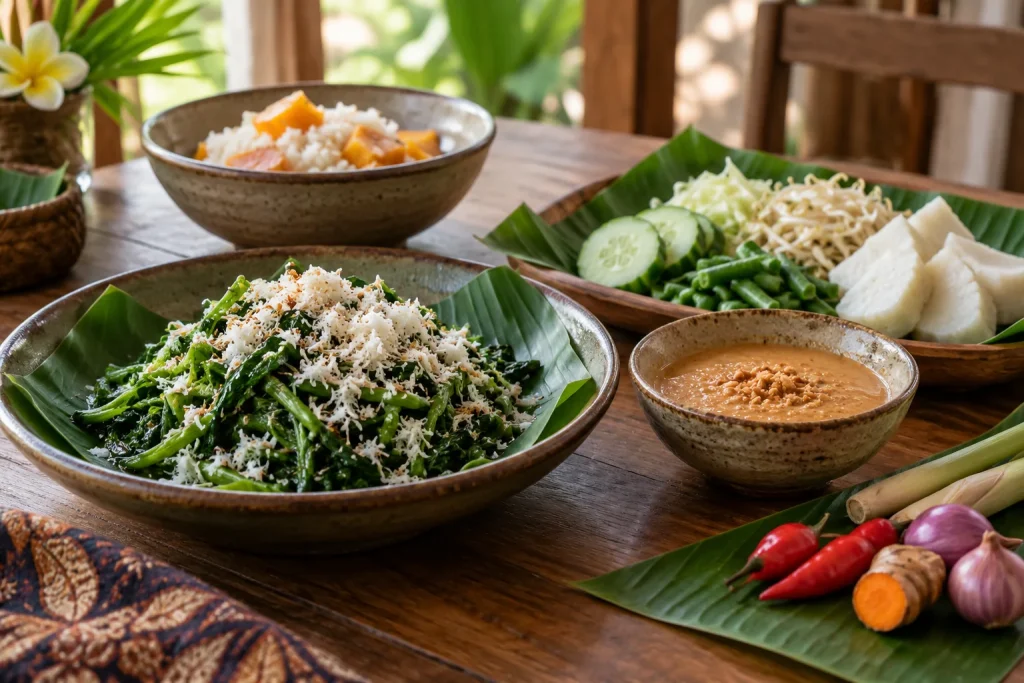
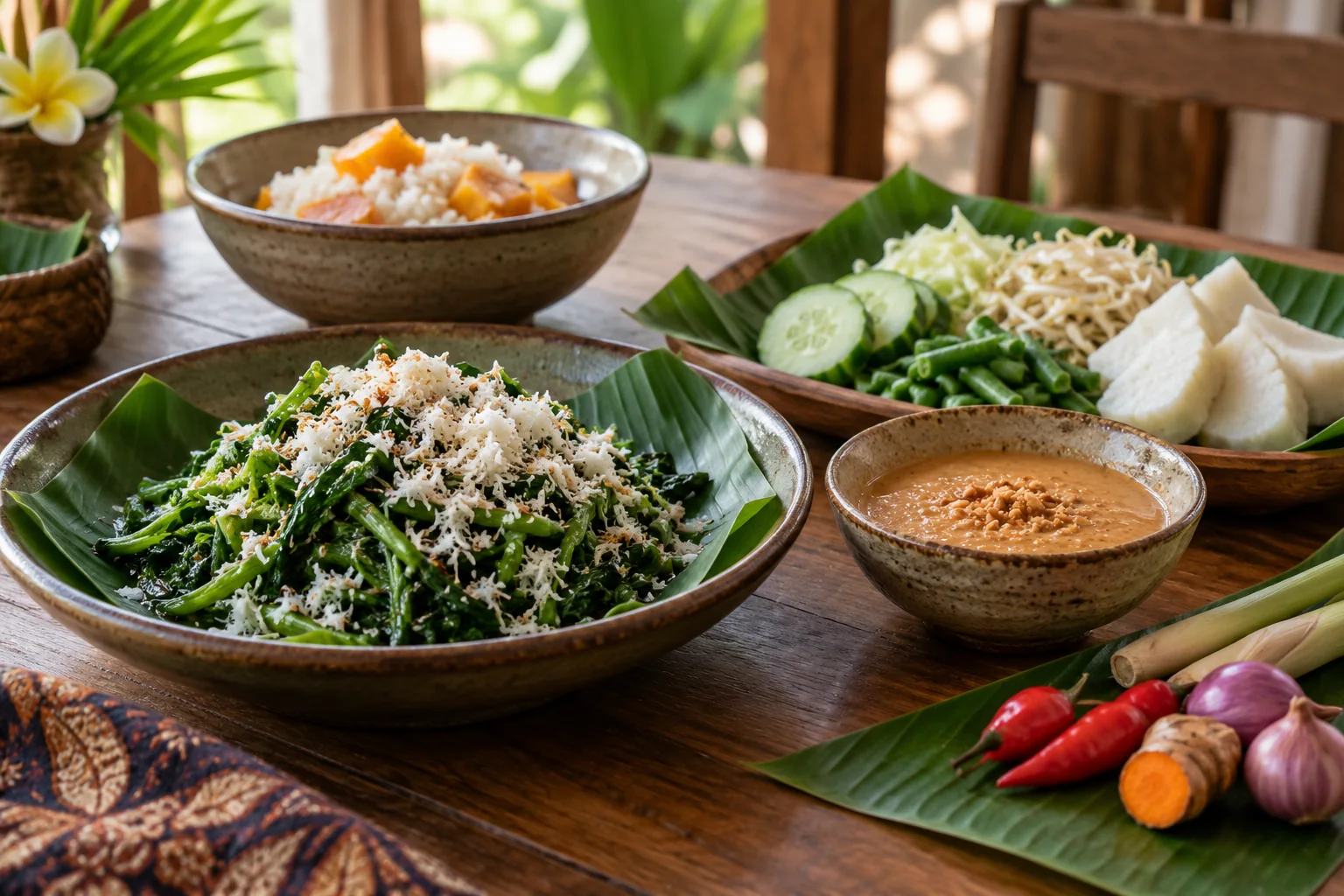
Several familiar Balinese dishes begin with vegetables or rice. Jukut urab combines cooked greens with seasoned grated coconut; serombotan brings vegetables together with coconut seasoning and peanut sauce; tipat cantok pairs rice cakes and vegetables with peanut sauce; and nasi sela cooks rice with pieces of sweet potato. Those descriptions tell you what is prominent, not everything in the pot.
Vegetable dishes worth asking about
Terasi is fermented shrimp paste and can appear in spice mixtures, sambal, coconut dressings or peanut sauces. Some cooks use fish-based seasonings or a meat broth in soups. A dish can therefore be mostly vegetables while still containing an ingredient a vegetarian avoids. Ask whether the paste, sauce and cooking liquid are made separately, and whether a topping or side dish contains egg, fish or meat.
Soups and stews need a broth check
Jukut urab: the greens and vegetables vary with availability. Coconut gives the dish its distinctive finish, but the seasoning may include terasi. Ask for a version without shrimp paste if that suits your diet, and check whether the coconut mixture is prepared in a shared batch.
Shared tools can matter too
Serombotan: this vegetable dish is served with its seasonings and peanut sauce, so ask about each component. In some preparations, terasi is used in the coconut seasoning or sauce. The vegetables may be suitable while one of the accompaniments is not.
Learn the vegetable names as well as the dishes
Tipat cantok: rice cakes and vegetables are dressed with peanut sauce. The sauce is the key question: recipes differ, and a cook may add shrimp paste or another local seasoning. Request the sauce ingredients and ask whether it can be prepared in a separate, clean mortar.
A simple way to order with confidence
Nasi sela: sweet potato is cooked with rice, but the rice dish is often part of a larger meal. Check the accompanying sambal, soup, fried side dishes and any broth rather than treating the rice alone as proof that the meal is vegetarian.
A green vegetable name does not guarantee a meat-free soup. Jukut ares, for example, is built around young banana stem, but many recipes use a meat-based broth. Other vegetable stews may be cooked with bones, fish seasoning or a mixed spice paste. If the cook says a dish is vegetarian, confirm whether that means no visible meat or no animal-derived ingredients in the stock and seasoning.
For a strict vegetarian meal, be specific about eggs, fish, shrimp paste and meat stock. For a vegan meal, also ask about dairy, eggs and honey where relevant. You can say: “I’m vegetarian. Does this use shrimp paste, fish sauce, or meat stock?” If the answer is uncertain, choosing a simpler dish and asking for the sauce separately makes the ingredients easier to check.
Mortars, cutting boards, woks, grills and frying oil may be used for several dishes. This is a separate question from the recipe itself. Let the cook know if shared equipment matters to you, then ask whether a clean pan, utensils and preparation area are available. Kitchens may not be able to prevent every trace of cross-contact, so explain whether your concern is a preference, a strict diet or an allergy.
A dish name and an ingredient name answer different questions. These ingredient guides help you recognise local vocabulary and keep the plant or plant part clear when learning a preparation. They complement the seasoning and broth checks above.
Balinese cooking offers plenty of vegetable-forward ingredients, but there is no single standard recipe that makes every dish vegetarian. A direct question about bumbu, broth and accompaniments is more useful than relying on a menu label. Guests who would like to ask about current menu options before choosing a hands-on session can visit the Cooking Class Ubud homepage.
How A Guide to Vegetarian Balinese Food and the Ingredients to Check Connects Market Observation, Kitchen Technique, and Practical Planning in Ubud
For travellers and home cooks researching balinese vegetarian food, the biggest gap in general travel guides is that they treat Balinese food and daily life as a single uniform checklist rather than a living household system. In a traditional Balinese compound around Ubud, decisions about ingredients, prep sequence, and table pairing depend on whether a meal is prepared for a quiet family lunch, a morning market run, or a shared gathering. When you join an Ubud Cooking Class at Wayan’s Paon, every question around balinese vegetarian food is answered through direct hands-on observation rather than abstract theory.
A second practical principle when evaluating balinese vegetarian food is recognizing the boundary between what happens at the morning produce stalls, what happens at the stone mortar (ulekan), and how the final dishes are balanced on the plate. In our private sessions such as Vegetarian & Vegan Cooking Class Ubud, your group works only with your own booking party and selects up to five dishes from the 53-dish menu (plus the foundational Base Genep spice paste), allowing you to test how each choice affects flavour, texture, and timing.
Comparative Reference Matrix: 10 Core Dimensions of Balinese Vegetarian Food
Before diving into each specialized subtopic in this family of guides, the table below summarizes how the ten focused questions around balinese vegetarian food differ in scope, practical kitchen impact, and what you should verify before buying ingredients or confirming a menu in Ubud:
| Focus Topic / Keyword Owner | Specific Question Addressed | Key Practical Distinction in Ubud |
|---|---|---|
| 1. gonda vegetable | Gonda Is One of Bali’s Lesser-Known Cooking Greens | Gonda is a vegetable name worth learning if your knowledge of Balinese greens stops at kangkung. Udayana researchers describe it among Bali’… |
| 2. kejompot leaves | Kejompot Leaves and the Sintrong Name | Kejompot leaves have a place in Balinese vegetable cooking even though the name rarely leads an English-language menu. A Udayana study ident… |
| 3. pumpkin shoots | Pumpkin Shoots Have a Place in the Balinese Vegetable Bowl | Pumpkin shoots bring a different part of the plant to the kitchen from the orange flesh most visitors recognise. In Bali, the tender growth … |
| 4. kangkung in Balinese food | Kangkung on a Balinese Menu Means Water Spinach | Kangkung is water spinach, a leafy vegetable you may meet in a mixed Balinese vegetable dish. Indonesia’s tourism ministry includes it among… |
| 5. bayam in Bali | Bayam Is Not Always the Spinach You Know | Bayam is often translated into English as spinach, but that shortcut can hide an important difference. A Denpasar market survey records baya… |
| 6. long beans in Balinese food | Long Beans Give a Balinese Vegetable Plate Its Shape | Long beans in Balinese food are an ingredient you can follow across more than one vegetable preparation. Kacang panjang is the name to keep … |
| 7. bean sprouts in Balinese food | Which Bean Sprouts Are in Your Balinese Vegetable Dish? | Bean sprouts in Balinese food may be named tauge or kecambah in a recipe or conversation. Indonesia’s tourism ministry lists tauge among the… |
| 8. moringa leaves in Bali | Moringa Leaves in Bali Belong in the Kitchen Conversation | Kelor is the Indonesian name to recognise when looking for moringa leaves in Bali. A Denpasar vegetable inventory records kelor as Moringa o… |
| 9. winged beans in Bali | Kecipir Is the Winged Bean at the Vegetable Stall | Kecipir is the winged bean, an ingredient recorded in a Denpasar vegetable survey. Indonesia’s agriculture ministry also lists kelongkang as… |
| 10. paku sayur in Bali | Paku Sayur Is an Edible Fern Ingredient, Not Every Fern | Paku sayur is a vegetable name you may encounter when learning about edible fern ingredients in Bali. A Denpasar market inventory records pa… |
Deep-Dive Guide to the 10 Specialized Subtopics Within Balinese Vegetarian Food
Each of the ten companion articles in this topic family isolates one specific decision or ingredient question related to balinese vegetarian food so that you never confuse a broad category label with a concrete culinary rule. Below is how each specialized guide fits into the wider picture:
1. Gonda Is One of Bali’s Lesser-Known Cooking Greens
When narrowing your focus from balinese vegetarian food to the specific question of gonda vegetable, the primary distinction is context and practical application. Gonda is a vegetable name worth learning if your knowledge of Balinese greens stops at kangkung. Udayana researchers describe it among Bali’s locally established vegetables and record its use in sautéed preparations and urap. It belongs in a conversation about everyday ingredients, rather than only in a list of famous finished dishes. By keeping this specific scope distinct from neighbouring topics, you avoid applying a general rule where a precise ingredient check or timing adjustment is required.
In practice at the market or in the paon, The plant recorded in the research is Sphenoclea zeylanica. Keeping gonda in your notes is useful because an English description such as “cooked greens” loses the ingredient’s identity. A menu can tell you the preparation while leaving the vegetable unnamed; a market label can do the opposite. Whether you are comparing options before booking your private session or taking notes to cook at home after your trip, treating gonda vegetable as its own step ensures your preparation remains accurate and stress-free.
2. Kejompot Leaves and the Sintrong Name
When narrowing your focus from balinese vegetarian food to the specific question of kejompot leaves, the primary distinction is context and practical application. Kejompot leaves have a place in Balinese vegetable cooking even though the name rarely leads an English-language menu. A Udayana study identifies the plant as Crassocephalum crepidioides and notes that Sundanese speakers know it as sintrong. Two names can therefore lead you to the same ingredient in different regional conversations. By keeping this specific scope distinct from neighbouring topics, you avoid applying a general rule where a precise ingredient check or timing adjustment is required.
In practice at the market or in the paon, Write kejompot first when recording the Balinese ingredient, with sintrong as an additional name. This preserves what the cook or seller actually called it. It also gives you a second term to recognise when discussing the vegetable elsewhere in Indonesia. Whether you are comparing options before booking your private session or taking notes to cook at home after your trip, treating kejompot leaves as its own step ensures your preparation remains accurate and stress-free.
3. Pumpkin Shoots Have a Place in the Balinese Vegetable Bowl
When narrowing your focus from balinese vegetarian food to the specific question of pumpkin shoots, the primary distinction is context and practical application. Pumpkin shoots bring a different part of the plant to the kitchen from the orange flesh most visitors recognise. In Bali, the tender growth has documented uses as a vegetable. Udayana researchers describe pucuk daun labu kuning in boiled, sautéed and urap preparations, including mixtures with other vegetables. By keeping this specific scope distinct from neighbouring topics, you avoid applying a general rule where a precise ingredient check or timing adjustment is required.
In practice at the market or in the paon, Pucuk points to young growth. A recipe that calls for shoots is making a different ingredient choice from one that calls for chunks of pumpkin. Keep that distinction in a translation: “pumpkin” on its own can send you shopping for the wrong part. Whether you are comparing options before booking your private session or taking notes to cook at home after your trip, treating pumpkin shoots as its own step ensures your preparation remains accurate and stress-free.
4. Kangkung on a Balinese Menu Means Water Spinach
When narrowing your focus from balinese vegetarian food to the specific question of kangkung in Balinese food, the primary distinction is context and practical application. Kangkung is water spinach, a leafy vegetable you may meet in a mixed Balinese vegetable dish. Indonesia’s tourism ministry includes it among the vegetables used in jukut urab, where cooked vegetables meet seasoned grated coconut. Seeing the name on a menu helps you recognise one component of the bowl. By keeping this specific scope distinct from neighbouring topics, you avoid applying a general rule where a precise ingredient check or timing adjustment is required.
In practice at the market or in the paon, Kangkung names the vegetable; jukut urab describes a preparation. A menu that mentions both gives you more information than either name alone. It tells you which green is used and gives a starting point for asking how it is served. Whether you are comparing options before booking your private session or taking notes to cook at home after your trip, treating kangkung in Balinese food as its own step ensures your preparation remains accurate and stress-free.
5. Bayam Is Not Always the Spinach You Know
When narrowing your focus from balinese vegetarian food to the specific question of bayam in Bali, the primary distinction is context and practical application. Bayam is often translated into English as spinach, but that shortcut can hide an important difference. A Denpasar market survey records bayam hijau as Amaranthus tricolor and bayam jepang, or horenso, as Spinacia oleracea. The names do not refer to the same plant in that inventory. By keeping this specific scope distinct from neighbouring topics, you avoid applying a general rule where a precise ingredient check or timing adjustment is required.
In practice at the market or in the paon, If a recipe is taught with bayam, ask the cook which vegetable is being used and retain the local name. Writing only “spinach” may make it hard to recognise the ingredient when you shop later. Bayam hijau and horenso give you more useful distinctions than the broad translation alone. Whether you are comparing options before booking your private session or taking notes to cook at home after your trip, treating bayam in Bali as its own step ensures your preparation remains accurate and stress-free.
6. Long Beans Give a Balinese Vegetable Plate Its Shape
When narrowing your focus from balinese vegetarian food to the specific question of long beans in Balinese food, the primary distinction is context and practical application. Long beans in Balinese food are an ingredient you can follow across more than one vegetable preparation. Kacang panjang is the name to keep beside the English translation. Learning it helps you connect what you see at a vegetable stall with the words a cook uses in the kitchen. By keeping this specific scope distinct from neighbouring topics, you avoid applying a general rule where a precise ingredient check or timing adjustment is required.
In practice at the market or in the paon, Indonesia’s tourism ministry includes long beans among the vegetables used in jukut urab. The beans are one component of a preparation with seasoned coconut; they do not name the whole dish. Our jukut urab bali guide explains that finished bowl. Whether you are comparing options before booking your private session or taking notes to cook at home after your trip, treating long beans in Balinese food as its own step ensures your preparation remains accurate and stress-free.
7. Which Bean Sprouts Are in Your Balinese Vegetable Dish?
When narrowing your focus from balinese vegetarian food to the specific question of bean sprouts in Balinese food, the primary distinction is context and practical application. Bean sprouts in Balinese food may be named tauge or kecambah in a recipe or conversation. Indonesia’s tourism ministry lists tauge among the vegetables used in jukut urab. They are one ingredient in the mixture, alongside the vegetables and seasoned coconut chosen for that version. By keeping this specific scope distinct from neighbouring topics, you avoid applying a general rule where a precise ingredient check or timing adjustment is required.
In practice at the market or in the paon, A Denpasar vegetable inventory records tauge kacang hijau and tauge kedelai separately: mung-bean sprouts and soybean sprouts. “Bean sprouts” alone loses that distinction. If you are learning a preparation, ask which ingredient is in the bowl before shortening its name in your notes. Whether you are comparing options before booking your private session or taking notes to cook at home after your trip, treating bean sprouts in Balinese food as its own step ensures your preparation remains accurate and stress-free.
8. Moringa Leaves in Bali Belong in the Kitchen Conversation
When narrowing your focus from balinese vegetarian food to the specific question of moringa leaves in Bali, the primary distinction is context and practical application. Kelor is the Indonesian name to recognise when looking for moringa leaves in Bali. A Denpasar vegetable inventory records kelor as Moringa oleifera. The ingredient belongs in the vegetable conversation, even if you first encountered moringa on a packet of powder or tea. By keeping this specific scope distinct from neighbouring topics, you avoid applying a general rule where a precise ingredient check or timing adjustment is required.
In practice at the market or in the paon, Write down the form of the ingredient as well as its name. Fresh leaves, dried leaves and powder are different things to buy and measure. A recipe taught with a bunch of fresh kelor does not become a powder recipe simply because both products carry the moringa name. Whether you are comparing options before booking your private session or taking notes to cook at home after your trip, treating moringa leaves in Bali as its own step ensures your preparation remains accurate and stress-free.
9. Kecipir Is the Winged Bean at the Vegetable Stall
When narrowing your focus from balinese vegetarian food to the specific question of winged beans in Bali, the primary distinction is context and practical application. Kecipir is the winged bean, an ingredient recorded in a Denpasar vegetable survey. Indonesia’s agriculture ministry also lists kelongkang as a Balinese name. Keeping both names beside “winged bean” gives you useful vocabulary for a conversation at the vegetable stall or in the kitchen. By keeping this specific scope distinct from neighbouring topics, you avoid applying a general rule where a precise ingredient check or timing adjustment is required.
In practice at the market or in the paon, The agriculture ministry distinguishes several food parts of the plant, including young pods, leaves, flowers and seeds. A recipe should identify its ingredient more precisely than the plant name alone. Young pods and dried seeds are not the same item on a shopping list. Whether you are comparing options before booking your private session or taking notes to cook at home after your trip, treating winged beans in Bali as its own step ensures your preparation remains accurate and stress-free.
10. Paku Sayur Is an Edible Fern Ingredient, Not Every Fern
When narrowing your focus from balinese vegetarian food to the specific question of paku sayur in Bali, the primary distinction is context and practical application. Paku sayur is a vegetable name you may encounter when learning about edible fern ingredients in Bali. A Denpasar market inventory records paku sayur, also labelled pakis, as Diplazium esculentum. That is a specific food ingredient in a market record, not a statement that any fern can be cooked. When examining paku sayur in Bali in the context of everyday kitchen work and guest planning in Gianyar and Ubud, separating specific ingredient names, preparation timing, and household customs prevents common misunderstandings before you shop or cook. By keeping this specific scope distinct from neighbouring topics, you avoid applying a general rule where a precise ingredient check or timing adjustment is required.
In practice at the market or in the paon, Learn about paku sayur through ingredients supplied as food by knowledgeable sellers and cooks. A curled tip or a resemblance to a photograph is not enough to identify a plant for eating. This guide is about culinary vocabulary, rather than collecting or identifying wild ferns. Whether you are comparing options before booking your private session or taking notes to cook at home after your trip, treating paku sayur in Bali as its own step ensures your preparation remains accurate and stress-free.
How to Apply These Notes When Planning Your Private Cooking Day at Wayan’s Paon
Bringing all ten facets of balinese vegetarian food together reveals a consistent lesson about Balinese culinary culture: clarity comes from asking specific questions before the cooking begins. In a private household setting in Ubud, your host does not rely on factory-made pastes or rigid group schedules. Instead, fresh roots (galangal, turmeric, ginger, and aromatic kencur), shallots, garlic, lemongrass, salam leaves, and kaffir lime are proportioned for the exact five dishes your group chooses to cook.
If you have dietary requirements—such as vegetarian or vegan preparation without fermented shrimp paste (terasi), gluten-free substitutions using pure rice flour and palm sugar (Gula Aren), dairy-free coconut milk infusions, or nut-free spice pastes omitting candlenut (kemiri)—discussing them when you select your menu allows the kitchen to prepare dedicated mortars, cutting boards, and filtered drinking-water washing stations in advance.
Finally, use this pillar overview on balinese vegetarian food alongside the ten focused cluster guides linked above whenever you want to verify a local Balinese term, compare morning market timing against afternoon kitchen sessions, or adapt a traditional Ubud technique for your own stove at home.