
The first Balinese meal you cook at home does not need a long shopping list or a special stove. Start with one dish, read its method all the way through, and decide which ingredients give it its main aroma. Balinese cooking changes from kitchen to kitchen, so the useful goal is to understand the work each ingredient does rather than chase one supposedly universal recipe. When examining how to cook balinese food in the context of everyday kitchen work and guest planning in Gianyar and Ubud, separating specific ingredient names, preparation timing, and household customs prevents common misunderstandings before you shop or cook.
Choose a dish before you shop
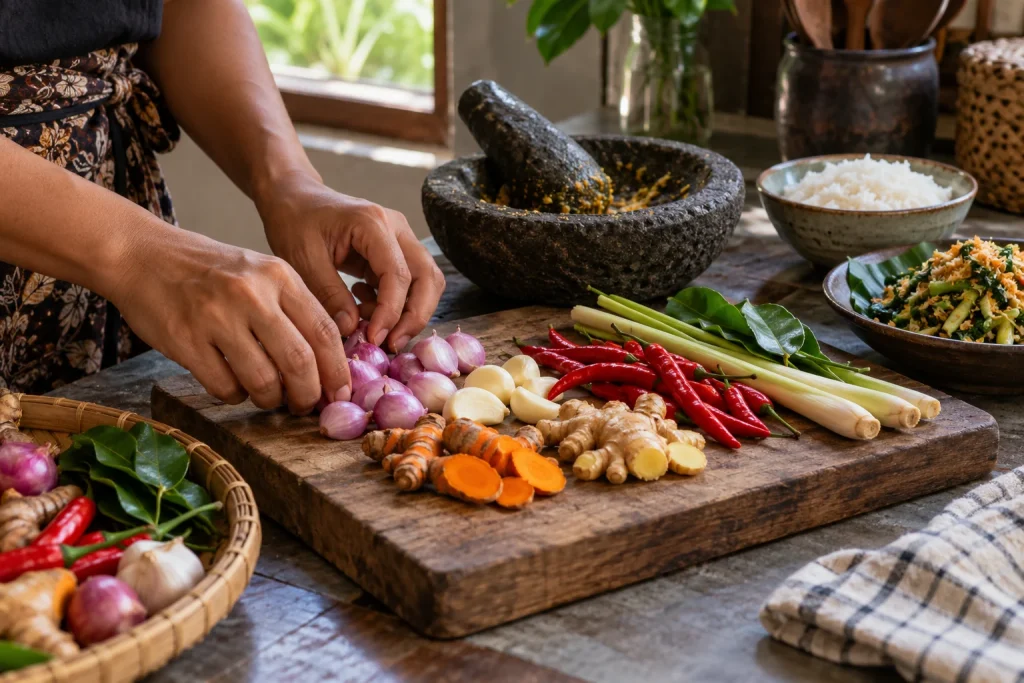
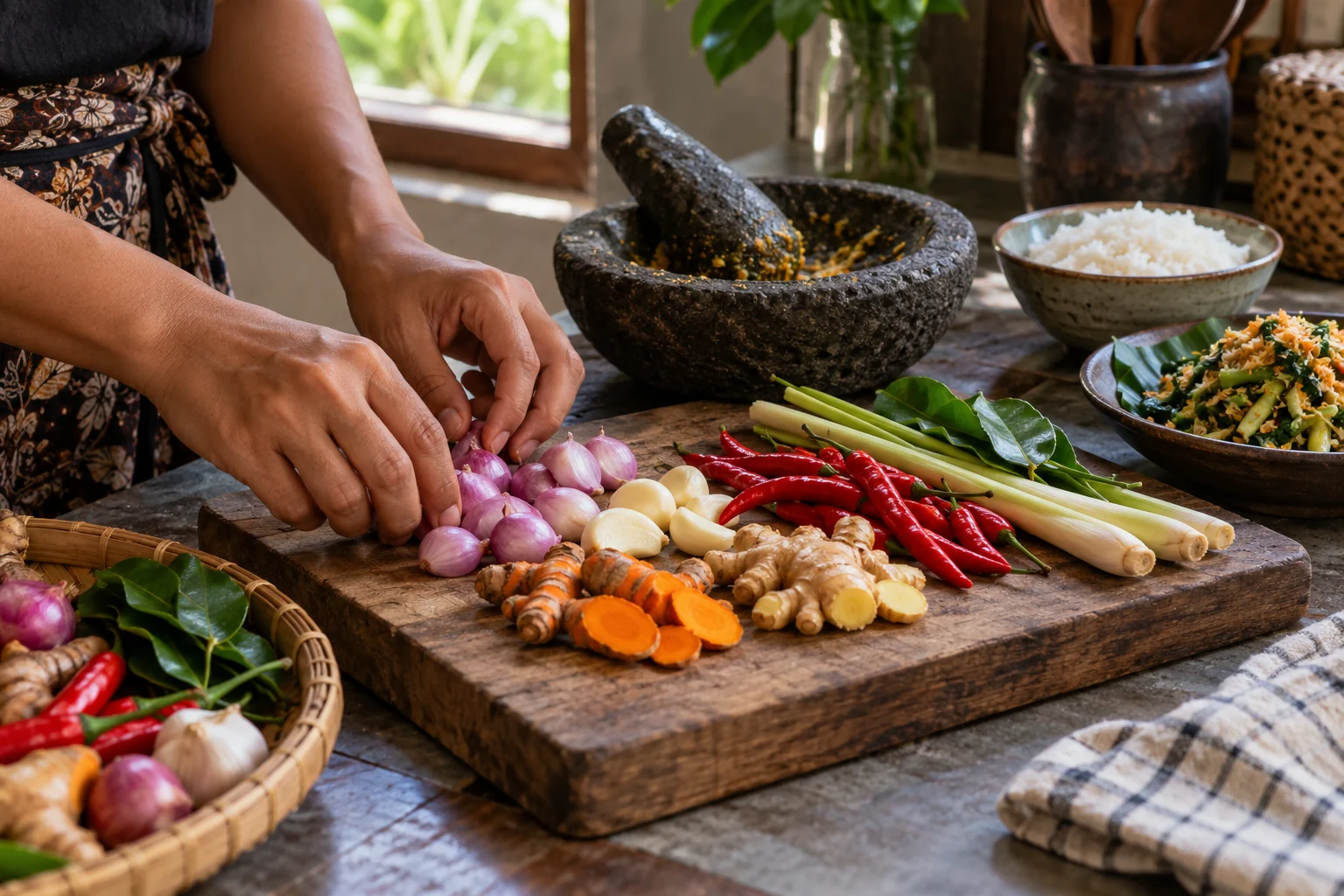
A rice plate, a vegetable preparation or a simple grilled main gives you a manageable first project. Pick a recipe with ingredients you can actually buy, then note the few items that define it. Shallots, garlic, chilli, turmeric, ginger, lemongrass and lime leaves appear in many Indonesian kitchens, but not every Balinese preparation uses them all. Base genep is one familiar spice paste, not a shortcut that belongs in every dish.
Set up the counter, then build flavor
Read the recipe for its sequence too. Some aromatics are ground together; others are bruised and cooked later. A leaf may hold a parcel and lend a gentle aroma. A sambal added at the table behaves differently from chilli cooked into a paste. Keep those jobs in mind when you adapt.
Make sensible substitutions
Wash and dry the fresh ingredients, chop them to a size your mortar or blender can handle, and measure the dry spices before the pan gets hot. Grind in small batches if needed. When cooking a paste, give it time to lose its raw edge without letting the shallots or spices scorch. Taste after it has cooked, then adjust salt, chilli, sweetness or acidity one at a time.
For a first plate, keep the structure simple: rice, one main dish, one vegetable and a small sambal. That makes it easier to notice whether the paste is too sharp, the chilli too strong or the seasoning too quiet. Scale a recipe down for two only after checking which parts can be adjusted by taste; halving every spice automatically can flatten a small batch.
Look for the ingredient under its Indonesian or regional name as well as its English label. If a specialty root or flower is unavailable, decide whether it supplies aroma, color, texture or heat. Replace only one thing at a time and be clear that the result is an adaptation. Parchment can hold a steamed parcel together, for example, but it does not reproduce the scent of a banana leaf.
Plan ahead without guessing at storage life. Measure dry ingredients in advance and follow the tested recipe for any fresh paste. Refrigerate perishable preparations promptly, keep them cold and freeze portions when the recipe’s handling guidance supports it.
If you want to learn the grinding and tasting steps alongside local cooks, explore a Cooking Class Ubud before your visit.
How How to Cook Balinese Food at Home with Ingredients You Can Find Connects Market Observation, Kitchen Technique, and Practical Planning in Ubud
For travellers and home cooks researching how to cook balinese food, the biggest gap in general travel guides is that they treat Balinese food and daily life as a single uniform checklist rather than a living household system. In a traditional Balinese compound around Ubud, decisions about ingredients, prep sequence, and table pairing depend on whether a meal is prepared for a quiet family lunch, a morning market run, or a shared gathering. When you join an Ubud Cooking Class at Wayan’s Paon, every question around how to cook balinese food is answered through direct hands-on observation rather than abstract theory.
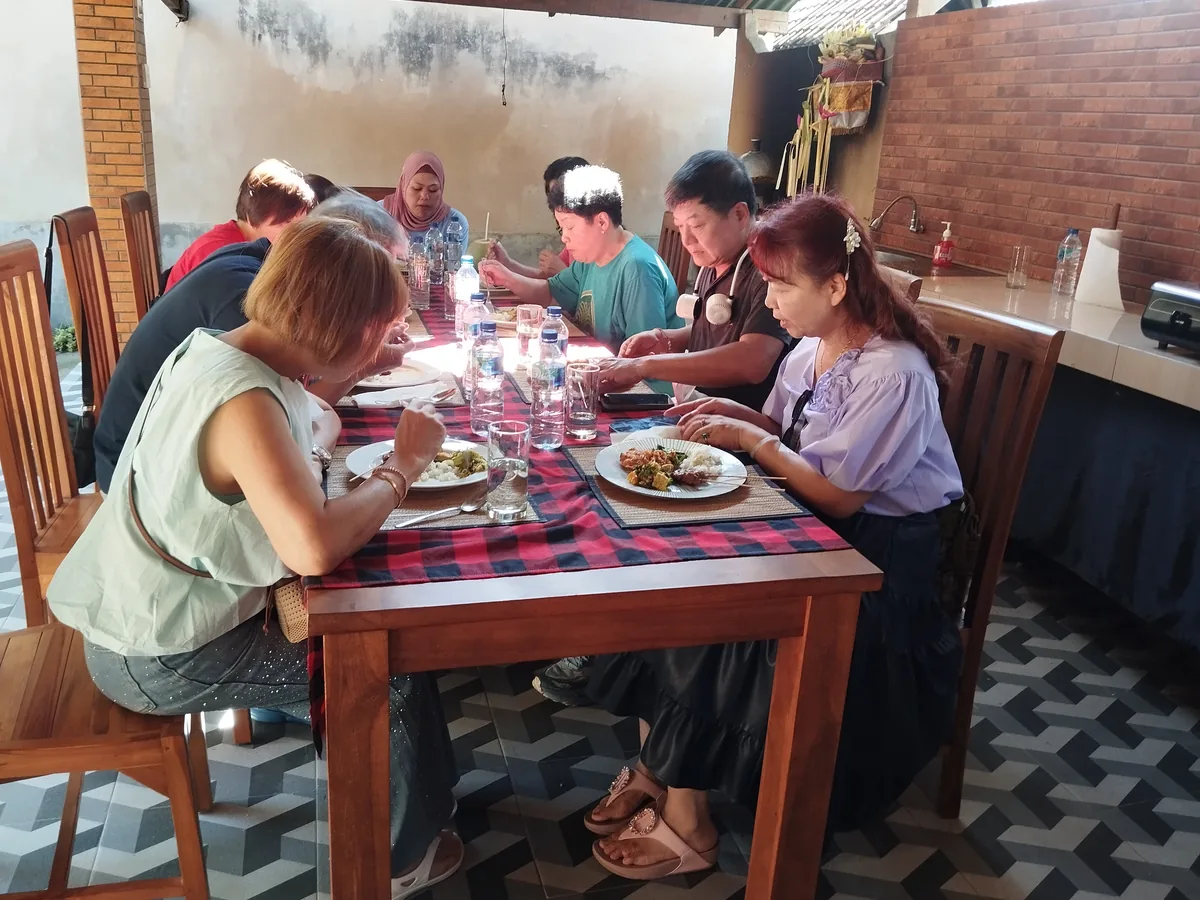
A second practical principle when evaluating how to cook balinese food is recognizing the boundary between what happens at the morning produce stalls, what happens at the stone mortar (ulekan), and how the final dishes are balanced on the plate. In our private sessions such as Private Paon Table, your group works only with your own booking party and selects up to five dishes from the 53-dish menu (plus the foundational Base Genep spice paste), allowing you to test how each choice affects flavour, texture, and timing.
Comparative Reference Matrix: 10 Core Dimensions of How To Cook Balinese Food
Before diving into each specialized subtopic in this family of guides, the table below summarizes how the ten focused questions around how to cook balinese food differ in scope, practical kitchen impact, and what you should verify before buying ingredients or confirming a menu in Ubud:
| Focus Topic / Keyword Owner | Specific Question Addressed | Key Practical Distinction in Ubud |
|---|---|---|
| 1. balinese spices abroad | Finding Balinese Spices outside Indonesia | Finding Balinese spices abroad is less about locating one perfect specialty shop and more about knowing what to ask for. A market may label … |
| 2. kencur substitute | What Can Replace Kencur in a Balinese Recipe? | A kencur substitute in Balinese cooking is a choice about what you can preserve, not a way to make two roots taste identical. Kencur has a d… |
| 3. torch ginger substitute | When Torch Ginger Is Hard to Find, What Changes in the Dish? | Torch ginger is not simply a hotter or milder version of ginger root. Its flower bud brings a fresh, floral aroma and a crisp bite to some S… |
| 4. banana leaf substitute | No Banana Leaves? Adapting a Balinese Wrap for a Home Kitchen | A banana leaf does two jobs in a wrapped dish: it holds the filling together and changes the aroma around it as it cooks. A substitute can h… |
| 5. balinese spice paste substitute | Balinese Spice Paste Substitutes That Keep the Dish Balanced | When a Balinese spice paste is missing an ingredient, ask what that ingredient contributes before choosing a replacement. One root may add w… |
| 6. balinese spice paste in a blender | Can a Small Blender Make a Good Balinese Spice Paste? | A small blender can make Balinese spice paste at home, but the result depends on preparation and batch size. A full jug of chunky roots may … |
| 7. balinese recipes for two | Cooking a Balinese Meal for Two without Losing the Balance of Flavors | Cooking Balinese food for two is not only a matter of halving every number in a recipe. Rice is easy to portion, but a small amount of spice… |
| 8. small kitchen balinese cooking setup | Balinese Cooking in a Small Kitchen: Set Up the Counter Before You Start | Balinese cooking can look like a lot of activity on a crowded counter: roots to chop, a paste to grind, a pan to watch and ingredients that … |
| 9. balinese pantry list | A Balinese Pantry Checklist for Home Cooks | A useful Balinese pantry list for home cooks is a short shopping plan, not a demand to stock every ingredient used across the island. Start … |
| 10. make-ahead balinese spice paste | Which Parts of a Balinese Spice Paste Can You Make Ahead? | Some of the work for Balinese spice paste can happen before dinner, but the safe storage time depends on the ingredients and how the paste w… |
Deep-Dive Guide to the 10 Specialized Subtopics Within How To Cook Balinese Food
Each of the ten companion articles in this topic family isolates one specific decision or ingredient question related to how to cook balinese food so that you never confuse a broad category label with a concrete culinary rule. Below is how each specialized guide fits into the wider picture:
1. Finding Balinese Spices outside Indonesia
When narrowing your focus from how to cook balinese food to the specific question of balinese spices abroad, the primary distinction is context and practical application. Finding Balinese spices abroad is less about locating one perfect specialty shop and more about knowing what to ask for. A market may label the same root by an Indonesian name, an English description or a regional name used by its supplier. Bring the ingredient list from the dish you plan to cook and shop for that recipe first. By keeping this specific scope distinct from neighbouring topics, you avoid applying a general rule where a precise ingredient check or timing adjustment is required.
In practice at the market or in the paon, Galangal may be labelled laos or lengkuas; turmeric may appear as kunyit; lemongrass as serai. Kencur is sometimes sold as aromatic ginger or sand ginger, while torch ginger may be listed as kecombrang, bunga kantan or ginger flower. These names help you search, but they do not make different roots interchangeable. Check the shape, freshness and label before buying. Whether you are comparing options before booking your private session or taking notes to cook at home after your trip, treating balinese spices abroad as its own step ensures your preparation remains accurate and stress-free.
2. What Can Replace Kencur in a Balinese Recipe?
When narrowing your focus from how to cook balinese food to the specific question of kencur substitute, the primary distinction is context and practical application. A kencur substitute in Balinese cooking is a choice about what you can preserve, not a way to make two roots taste identical. Kencur has a distinctive earthy, aromatic quality, and market labels can make it easy to confuse with ginger or galangal. If the recipe depends on that particular note, the most honest answer may be to find the root or choose another dish. By keeping this specific scope distinct from neighbouring topics, you avoid applying a general rule where a precise ingredient check or timing adjustment is required.
In practice at the market or in the paon, Look for kencur, aromatic ginger, sand ginger or the Indonesian spelling. Fresh kencur is a small rhizome and may be sold near other roots in an Asian grocery. Frozen or dried forms can be easier to find outside Southeast Asia, but they will not behave exactly like fresh root; follow the package or recipe directions for rehydration. Whether you are comparing options before booking your private session or taking notes to cook at home after your trip, treating kencur substitute as its own step ensures your preparation remains accurate and stress-free.
3. When Torch Ginger Is Hard to Find, What Changes in the Dish?
When narrowing your focus from how to cook balinese food to the specific question of torch ginger substitute, the primary distinction is context and practical application. Torch ginger is not simply a hotter or milder version of ginger root. Its flower bud brings a fresh, floral aroma and a crisp bite to some Southeast Asian preparations. In Bali, the name kecombrang is common; you may also see bunga kantan or ginger flower on a market label. If a recipe calls for the flower, replacing it changes the dish’s character. By keeping this specific scope distinct from neighbouring topics, you avoid applying a general rule where a precise ingredient check or timing adjustment is required.
In practice at the market or in the paon, Check the fresh herb case and freezer section at a Southeast Asian grocery. Frozen sliced kecombrang is still torch ginger, although its texture will soften after thawing. If you find dried flower, use the package directions because drying concentrates some aromas and removes the fresh crunch. Whether you are comparing options before booking your private session or taking notes to cook at home after your trip, treating torch ginger substitute as its own step ensures your preparation remains accurate and stress-free.
4. No Banana Leaves? Adapting a Balinese Wrap for a Home Kitchen
When narrowing your focus from how to cook balinese food to the specific question of banana leaf substitute, the primary distinction is context and practical application. A banana leaf does two jobs in a wrapped dish: it holds the filling together and changes the aroma around it as it cooks. A substitute can handle the first job without reproducing the second. Decide whether you need a parcel that steams neatly, a barrier for grilling or the gentle scent of the leaf before choosing what to use. By keeping this specific scope distinct from neighbouring topics, you avoid applying a general rule where a precise ingredient check or timing adjustment is required.
In practice at the market or in the paon, Food-grade cooking parchment can form a simple parcel for a steamer. Fold it tightly and secure the ends so the filling stays contained. It offers little of the leaf’s green aroma, so the dish will smell more like its seasoning than a traditional leaf wrap. If the parcel tends to open, set it seam-side down or use a tie suitable for the cooking method. Whether you are comparing options before booking your private session or taking notes to cook at home after your trip, treating banana leaf substitute as its own step ensures your preparation remains accurate and stress-free.
5. Balinese Spice Paste Substitutes That Keep the Dish Balanced
When narrowing your focus from how to cook balinese food to the specific question of balinese spice paste substitute, the primary distinction is context and practical application. When a Balinese spice paste is missing an ingredient, ask what that ingredient contributes before choosing a replacement. One root may add warmth, another may bring a sharper aroma, a nut can thicken the paste, and chilli sets the heat. Recipes vary, so a substitute that works in one paste may not suit another. By keeping this specific scope distinct from neighbouring topics, you avoid applying a general rule where a precise ingredient check or timing adjustment is required.
In practice at the market or in the paon, Terasi is a fermented seafood ingredient, not simply another source of salt. If you need a vegetarian paste, use a recipe designed for that purpose or omit it only when the recipe can still be balanced. Check packaged pastes for seafood, nuts and other ingredients before serving people with dietary restrictions. Whether you are comparing options before booking your private session or taking notes to cook at home after your trip, treating balinese spice paste substitute as its own step ensures your preparation remains accurate and stress-free.
6. Can a Small Blender Make a Good Balinese Spice Paste?
When narrowing your focus from how to cook balinese food to the specific question of balinese spice paste in a blender, the primary distinction is context and practical application. A small blender can make Balinese spice paste at home, but the result depends on preparation and batch size. A full jug of chunky roots may spin without catching the blades; too much liquid can turn the paste thin. A mortar gives you more control over texture, while a blender saves effort when you work in short pulses. By keeping this specific scope distinct from neighbouring topics, you avoid applying a general rule where a precise ingredient check or timing adjustment is required.
In practice at the market or in the paon, Peel or trim the roots as the recipe directs, remove tough lemongrass layers where needed and chop everything into similar small pieces. Put the hardest ingredients in first only if the appliance can handle them; otherwise follow its instructions for load order. Work in a small batch so the blades can pull the ingredients down instead of leaving pieces stuck around the sides. Whether you are comparing options before booking your private session or taking notes to cook at home after your trip, treating balinese spice paste in a blender as its own step ensures your preparation remains accurate and stress-free.
7. Cooking a Balinese Meal for Two without Losing the Balance of Flavors
When narrowing your focus from how to cook balinese food to the specific question of balinese recipes for two, the primary distinction is context and practical application. Cooking Balinese food for two is not only a matter of halving every number in a recipe. Rice is easy to portion, but a small amount of spice paste can become too strong or too faint if it is scaled mechanically. Keep the method, start with a conservative amount of seasoning and taste as the dish cooks. By keeping this specific scope distinct from neighbouring topics, you avoid applying a general rule where a precise ingredient check or timing adjustment is required.
In practice at the market or in the paon, Choose one main dish, one vegetable, rice and a small sambal. That is enough variety for two people without creating four separate pots. If the main dish already uses a rich paste, choose a vegetable preparation with a lighter seasoning. If the main is grilled or simply cooked, a more aromatic vegetable or sambal can carry the plate. Whether you are comparing options before booking your private session or taking notes to cook at home after your trip, treating balinese recipes for two as its own step ensures your preparation remains accurate and stress-free.
8. Balinese Cooking in a Small Kitchen: Set Up the Counter Before You Start
When narrowing your focus from how to cook balinese food to the specific question of small kitchen balinese cooking setup, the primary distinction is context and practical application. Balinese cooking can look like a lot of activity on a crowded counter: roots to chop, a paste to grind, a pan to watch and ingredients that need different treatment. A small kitchen still works well if you clear one prep zone and keep only the tools for the recipe within reach. By keeping this specific scope distinct from neighbouring topics, you avoid applying a general rule where a precise ingredient check or timing adjustment is required.
In practice at the market or in the paon, Set aside one surface for chopping and grinding, one tray or group of bowls for measured ingredients, and the stove area for cooking. Keep the cutting board close to the sink so scraps can be cleared without crossing the kitchen. Place the mortar, blender or spice grinder where it can sit securely, with enough room to operate safely. Whether you are comparing options before booking your private session or taking notes to cook at home after your trip, treating small kitchen balinese cooking setup as its own step ensures your preparation remains accurate and stress-free.
9. A Balinese Pantry Checklist for Home Cooks
When narrowing your focus from how to cook balinese food to the specific question of balinese pantry list, the primary distinction is context and practical application. A useful Balinese pantry list for home cooks is a short shopping plan, not a demand to stock every ingredient used across the island. Start with the dish you want to make, then buy the items that appear repeatedly in that recipe. Balinese food varies by cook and occasion; a pantry that works for one household may not be universal. When examining balinese pantry list in the context of everyday kitchen work and guest planning in Gianyar and Ubud, separating specific ingredient names, preparation timing, and household customs prevents common misunderstandings before you shop or cook. By keeping this specific scope distinct from neighbouring topics, you avoid applying a general rule where a precise ingredient check or timing adjustment is required.
In practice at the market or in the paon, These basics can support more than one dish, but they do not replace specialty ingredients automatically. Kencur, galangal, candlenut, torch ginger, terasi, palm sugar and banana leaves each bring a different quality. Add them when the recipe needs them, and check storage directions for anything sold fresh, frozen or packaged. Whether you are comparing options before booking your private session or taking notes to cook at home after your trip, treating balinese pantry list as its own step ensures your preparation remains accurate and stress-free.
10. Which Parts of a Balinese Spice Paste Can You Make Ahead?
When narrowing your focus from how to cook balinese food to the specific question of make-ahead balinese spice paste, the primary distinction is context and practical application. Some of the work for Balinese spice paste can happen before dinner, but the safe storage time depends on the ingredients and how the paste was prepared. A recipe from another kitchen is not a reliable shelf-life test for yours. Make-ahead planning should save chopping time while keeping the paste cold and the storage advice specific. By keeping this specific scope distinct from neighbouring topics, you avoid applying a general rule where a precise ingredient check or timing adjustment is required.
In practice at the market or in the paon, The lowest-effort option is to measure dry spices, wash the produce, set out the grinder and portion the ingredients before you cook. Keep washed fresh ingredients dry and follow their normal refrigeration needs. If the tested recipe lets you prepare the finished paste in advance, label the container with the date and follow that recipe’s storage instructions. Whether you are comparing options before booking your private session or taking notes to cook at home after your trip, treating make-ahead balinese spice paste as its own step ensures your preparation remains accurate and stress-free.
How to Apply These Notes When Planning Your Private Cooking Day at Wayan’s Paon
Bringing all ten facets of how to cook balinese food together reveals a consistent lesson about Balinese culinary culture: clarity comes from asking specific questions before the cooking begins. In a private household setting in Ubud, your host does not rely on factory-made pastes or rigid group schedules. Instead, fresh roots (galangal, turmeric, ginger, and aromatic kencur), shallots, garlic, lemongrass, salam leaves, and kaffir lime are proportioned for the exact five dishes your group chooses to cook.
If you have dietary requirements—such as vegetarian or vegan preparation without fermented shrimp paste (terasi), gluten-free substitutions using pure rice flour and palm sugar (Gula Aren), dairy-free coconut milk infusions, or nut-free spice pastes omitting candlenut (kemiri)—discussing them when you select your menu allows the kitchen to prepare dedicated mortars, cutting boards, and filtered drinking-water washing stations in advance.
Finally, use this pillar overview on how to cook balinese food alongside the ten focused cluster guides linked above whenever you want to verify a local Balinese term, compare morning market timing against afternoon kitchen sessions, or adapt a traditional Ubud technique for your own stove at home.