
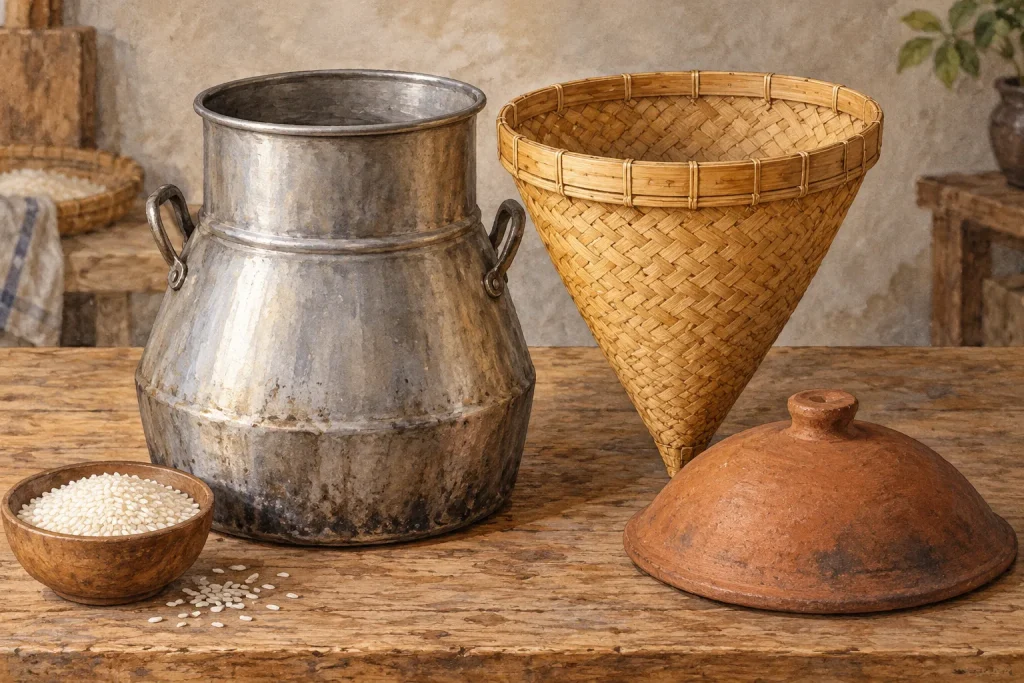
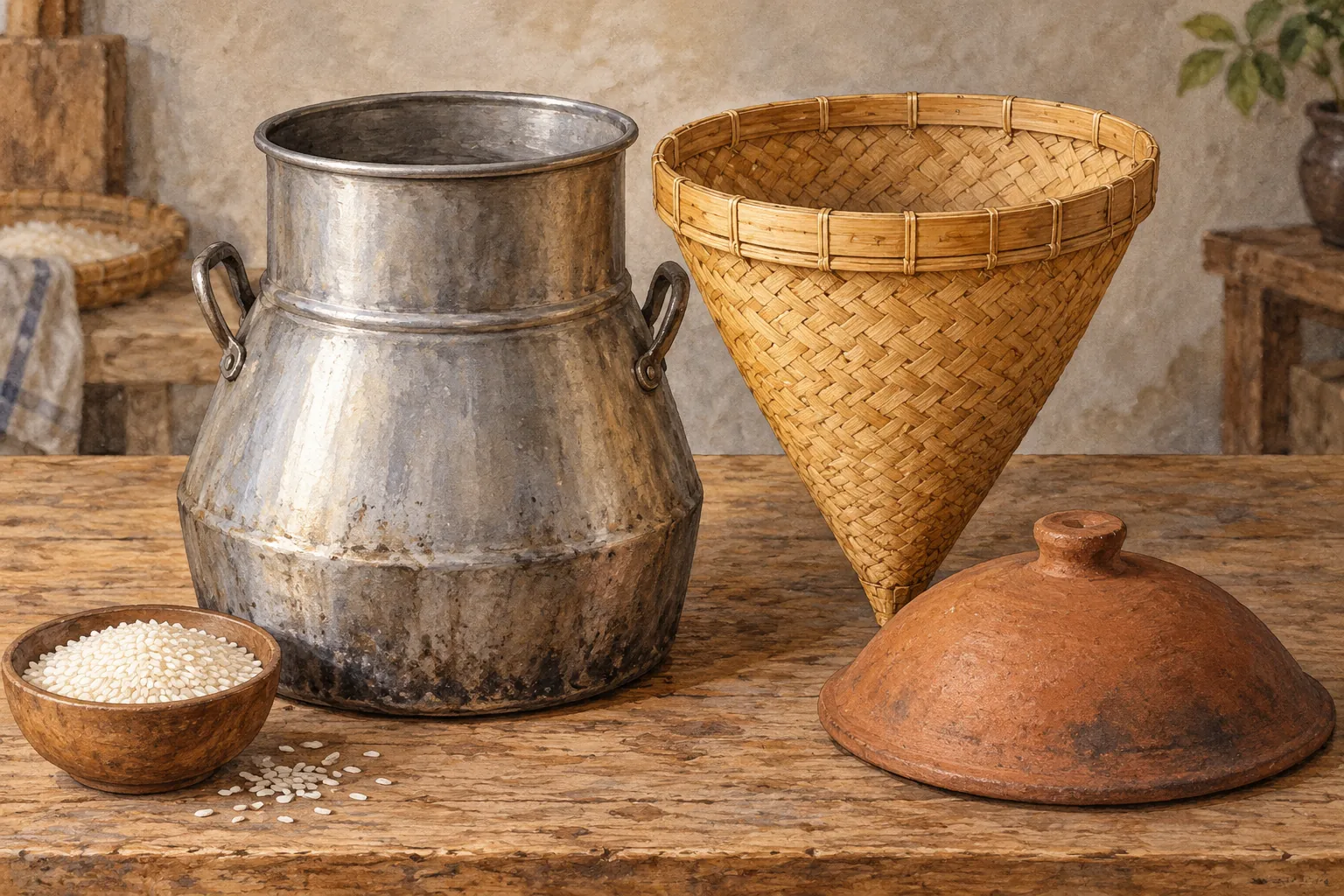
Kukusan and dandang are parts of a steaming arrangement, rather than two names for the same pot. The kukusan is the basket that holds the food; the dandang is the vessel below it. A cover completes the arrangement. Looking at those parts together makes the equipment easier to recognise. When examining kukusan and dandang in the context of everyday kitchen work and guest planning in Gianyar and Ubud, separating specific ingredient names, preparation timing, and household customs prevents common misunderstandings before you shop or cook.
Follow the parts from bottom to top
The conical basket is especially distinctive. Its point faces down into the vessel, while its open top allows access to the rice. A traditional cover may be called a kekeb. A rice utensil belongs beside this assembly too, but it has a separate job from containing the food or enclosing the steam.
A basket for cooking is different from one for serving
The lower vessel holds the water. As that water boils, steam rises through the basket to the food above. The basket holds the rice separately from the water, while the cover helps keep steam around it. This is the central distinction between the arrangement and a saucepan in which rice and water share the same space.
What to ask when you see one
Notice where the basket rests and how the cover meets it. These are useful details to record if you are trying to remember the equipment later. They also explain why a basket that looks similar on a market stall should not automatically be treated as a compatible replacement.
The word “rice basket” is ambiguous. A basket in a steaming arrangement performs a different task from a sokasi rice basket used in serving. Keeping those stages separate prevents an easy mistake when translating names or describing a kitchen photograph.
The same care applies to recipes. Recognising the apparatus does not establish a water quantity, cooking time or batch size. Those details belong to the cook’s method and the particular equipment. Use a recipe written for the steamer you have rather than borrowing a timing from an unfamiliar vessel.
A compact set of names is enough to follow the assembly: dandang below, kukusan inside, kekeb above. The basket’s fit matters as much as its name. A basket that sits too low, a loose cover or an unstable rim changes the arrangement, which is why the parts should be treated as a working set.
Find the rest of the equipment in traditional balinese kitchen utensils. If you would like to explore ingredients and preparation during a session, check the current Ubud Cooking Class options and ask which tools accompany your chosen dishes.
How Kukusan and Dandang Make a Rice Steamer Work Connects Market Observation, Kitchen Technique, and Practical Planning in Ubud
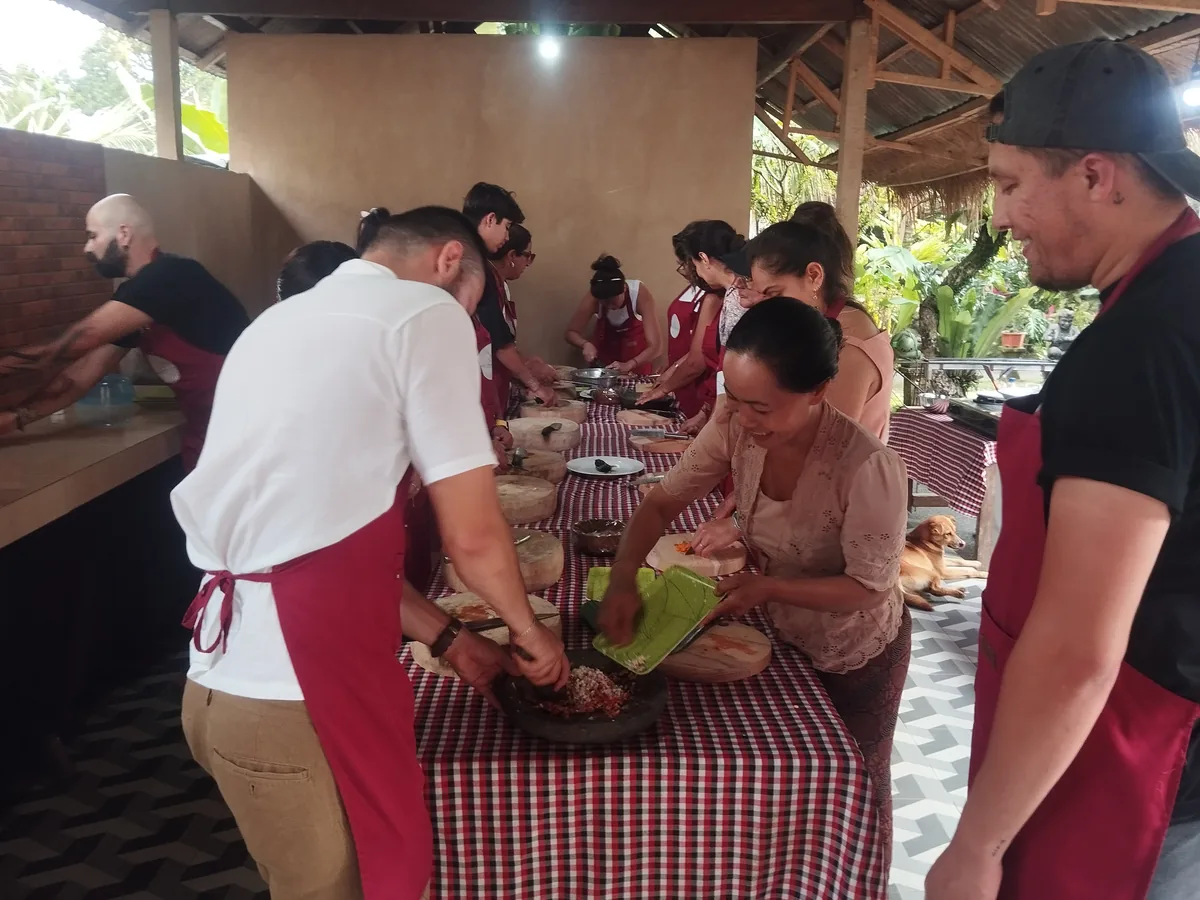
For travellers and home cooks researching kukusan and dandang, the biggest gap in general travel guides is that they treat Balinese food and daily life as a single uniform checklist rather than a living household system. In a traditional Balinese compound around Ubud, decisions about ingredients, prep sequence, and table pairing depend on whether a meal is prepared for a quiet family lunch, a morning market run, or a shared gathering. When you join an Ubud Cooking Class at Wayan’s Paon, every question around kukusan and dandang is answered through direct hands-on observation rather than abstract theory.
A second practical principle when evaluating kukusan and dandang is recognizing the boundary between what happens at the morning produce stalls, what happens at the stone mortar (ulekan), and how the final dishes are balanced on the plate. In our private sessions such as Private Paon Table, your group works only with your own booking party and selects up to five dishes from the 53-dish menu (plus the foundational Base Genep spice paste), allowing you to test how each choice affects flavour, texture, and timing.
Comparative Reference Matrix: 10 Core Dimensions of Kukusan And Dandang
Before diving into each specialized subtopic in this family of guides, the table below summarizes how the ten focused questions around kukusan and dandang differ in scope, practical kitchen impact, and what you should verify before buying ingredients or confirming a menu in Ubud:
| Focus Topic / Keyword Owner | Specific Question Addressed | Key Practical Distinction in Ubud |
|---|---|---|
| 1. ngiu winnowing tray | What a Ngiu Winnowing Tray Does Before Cooking | A ngiu winnowing tray is a broad, shallow woven object associated with sorting and preparing ingredients. You may also encounter the Indones… |
| 2. sokasi rice basket | A Sokasi Rice Basket on the Balinese Table | A sokasi rice basket belongs to the serving side of the kitchen vocabulary. The woven container is associated with cooked rice, and its form… |
| 3. penglaklakan pan | The Penglaklakan Pan behind Jaje Laklak | The penglaklakan pan is the cooking mould associated with jaje laklak, the small Balinese cakes often served with grated coconut and a sweet… |
| 4. siut and sinduk nasi | Siut and Sinduk Nasi beside the Rice Pot | Siut and sinduk nasi are names you may hear around rice preparation and serving in Bali. A siut is associated with working the rice; sinduk … |
| 5. ingke plates | Ingke Plates and Their Banana-Leaf Liners | Ingke plates combine a woven support with a liner used for serving food. Traditional examples use leaf ribs in the woven structure, with ban… |
| 6. traditional balinese kitchen utensils | Traditional Balinese Kitchen Utensils and What They Do | Traditional Balinese kitchen utensils are easier to understand when you follow the work around them. A basket above a pot belongs to a diffe… |
| 7. wajan in balinese cooking | How a Wajan Fits into Balinese Cooking | A wajan in Balinese cooking is a useful object to recognise because the curved pan can appear at several stages of a meal. You may also hear… |
| 8. kikihan coconut grater | Meet the Kikihan, Bali’s Coconut Grater | The kikihan coconut grater makes a familiar ingredient look different before it reaches the plate. A piece of coconut flesh becomes smaller … |
| 9. tiuk and blakas | Tiuk and Blakas Have Different Jobs at the Chopping Board | Tiuk and blakas are useful names to learn at a Balinese chopping board. Tiuk refers to a knife; blakas commonly identifies a larger chopping… |
| 10. cangkem paon | How a Cangkem Paon Holds the Cooking Fire | A cangkem paon is a traditional wood-fired cooking hearth. The name points to the hearth rather than to every object in the kitchen. Its ope… |
Deep-Dive Guide to the 10 Specialized Subtopics Within Kukusan And Dandang
Each of the ten companion articles in this topic family isolates one specific decision or ingredient question related to kukusan and dandang so that you never confuse a broad category label with a concrete culinary rule. Below is how each specialized guide fits into the wider picture:
1. What a Ngiu Winnowing Tray Does Before Cooking
When narrowing your focus from kukusan and dandang to the specific question of ngiu winnowing tray, the primary distinction is context and practical application. A ngiu winnowing tray is a broad, shallow woven object associated with sorting and preparing ingredients. You may also encounter the Indonesian words tampah or nyiru when asking about a similar tray. Its open surface makes it different from a deep storage basket. By keeping this specific scope distinct from neighbouring topics, you avoid applying a general rule where a precise ingredient check or timing adjustment is required.
In practice at the market or in the paon, “Winnowing tray” describes a familiar use, but do not assume that every tray you see is being used to winnow rice at that moment. It may be resting, holding ingredients or serving another preparation task. Ask about the object and the current job together. Whether you are comparing options before booking your private session or taking notes to cook at home after your trip, treating ngiu winnowing tray as its own step ensures your preparation remains accurate and stress-free.
2. A Sokasi Rice Basket on the Balinese Table
When narrowing your focus from kukusan and dandang to the specific question of sokasi rice basket, the primary distinction is context and practical application. A sokasi rice basket belongs to the serving side of the kitchen vocabulary. The woven container is associated with cooked rice, and its form makes a useful contrast with the equipment used to steam that rice. Seeing both prevents the word “basket” from blurring two different jobs. By keeping this specific scope distinct from neighbouring topics, you avoid applying a general rule where a precise ingredient check or timing adjustment is required.
In practice at the market or in the paon, Ask about the particular object before assuming its contents. A woven container may have another purpose, and a decorative version may resemble working kitchenware. The name a household or seller uses, together with the intended job, gives you a better answer than appearance alone. Whether you are comparing options before booking your private session or taking notes to cook at home after your trip, treating sokasi rice basket as its own step ensures your preparation remains accurate and stress-free.
3. The Penglaklakan Pan behind Jaje Laklak
When narrowing your focus from kukusan and dandang to the specific question of penglaklakan pan, the primary distinction is context and practical application. The penglaklakan pan is the cooking mould associated with jaje laklak, the small Balinese cakes often served with grated coconut and a sweet sauce. Instead of spreading the batter over one broad surface, the mould gives each cake its own place to cook. By keeping this specific scope distinct from neighbouring topics, you avoid applying a general rule where a precise ingredient check or timing adjustment is required.
In practice at the market or in the paon, Traditional examples are associated with earthenware, and documented laklak preparation uses a heated mould and a cover. The name tells you the job of the equipment; it does not establish the specifications of every pan sold under that description. Whether you are comparing options before booking your private session or taking notes to cook at home after your trip, treating penglaklakan pan as its own step ensures your preparation remains accurate and stress-free.
4. Siut and Sinduk Nasi beside the Rice Pot
When narrowing your focus from kukusan and dandang to the specific question of siut and sinduk nasi, the primary distinction is context and practical application. Siut and sinduk nasi are names you may hear around rice preparation and serving in Bali. A siut is associated with working the rice; sinduk nasi identifies a rice-serving utensil. The useful distinction is the job being done, because shapes and the names used for particular pieces can vary. By keeping this specific scope distinct from neighbouring topics, you avoid applying a general rule where a precise ingredient check or timing adjustment is required.
In practice at the market or in the paon, Look at the end that touches the rice. Is it broad and relatively flat, or does it form a small scoop? Then ask the cook to confirm the local name. That pairs a word with an actual object rather than relying on an English translation such as “spoon,” which may cover several utensils. Whether you are comparing options before booking your private session or taking notes to cook at home after your trip, treating siut and sinduk nasi as its own step ensures your preparation remains accurate and stress-free.
5. Ingke Plates and Their Banana-Leaf Liners
When narrowing your focus from kukusan and dandang to the specific question of ingke plates, the primary distinction is context and practical application. Ingke plates combine a woven support with a liner used for serving food. Traditional examples use leaf ribs in the woven structure, with banana leaf placed above it. The support and the liner have different jobs, which is the first thing to notice when a meal arrives on one. By keeping this specific scope distinct from neighbouring topics, you avoid applying a general rule where a precise ingredient check or timing adjustment is required.
In practice at the market or in the paon, A leafy surface can hide much of the structure underneath. Look at the rim and underside when the plate is empty, rather than lifting a served meal to inspect it. The woven object is not simply a folded banana leaf, even when the leaf is the most visible part. Whether you are comparing options before booking your private session or taking notes to cook at home after your trip, treating ingke plates as its own step ensures your preparation remains accurate and stress-free.
6. Traditional Balinese Kitchen Utensils and What They Do
When narrowing your focus from kukusan and dandang to the specific question of traditional balinese kitchen utensils, the primary distinction is context and practical application. Traditional Balinese kitchen utensils are easier to understand when you follow the work around them. A basket above a pot belongs to a different stage of a meal from a woven plate on the table. A broad blade, a grater and a rice paddle each answer a particular need. Learning those jobs gives the names something to attach to. By keeping this specific scope distinct from neighbouring topics, you avoid applying a general rule where a precise ingredient check or timing adjustment is required.
In practice at the market or in the paon, This guide introduces the objects rather than prescribing a single kitchen that every household must have. Names, materials and everyday choices vary. Older equipment can sit beside a gas hob, an electric rice cooker or a modern saucepan. Ask about the object in front of you before assuming that a familiar name describes exactly the same thing everywhere. Whether you are comparing options before booking your private session or taking notes to cook at home after your trip, treating traditional balinese kitchen utensils as its own step ensures your preparation remains accurate and stress-free.
7. How a Wajan Fits into Balinese Cooking
When narrowing your focus from kukusan and dandang to the specific question of wajan in balinese cooking, the primary distinction is context and practical application. A wajan in Balinese cooking is a useful object to recognise because the curved pan can appear at several stages of a meal. You may also hear penggorengan or a local spelling of that name. The word identifies equipment; the food inside tells you what the cook is doing with it. By keeping this specific scope distinct from neighbouring topics, you avoid applying a general rule where a precise ingredient check or timing adjustment is required.
In practice at the market or in the paon, Look at the profile before looking at the colour. The curved base and sides distinguish the pan from a straight-sided saucepan. Handles, material and proportions vary, so a name alone will not tell you how heavy a particular pan is or whether it suits your stove. Whether you are comparing options before booking your private session or taking notes to cook at home after your trip, treating wajan in balinese cooking as its own step ensures your preparation remains accurate and stress-free.
8. Meet the Kikihan, Bali’s Coconut Grater
When narrowing your focus from kukusan and dandang to the specific question of kikihan coconut grater, the primary distinction is context and practical application. The kikihan coconut grater makes a familiar ingredient look different before it reaches the plate. A piece of coconut flesh becomes smaller shreds against the grating surface. Recognising that stage helps you distinguish grated coconut from coconut milk, coconut oil or a sliced coconut topping. By keeping this specific scope distinct from neighbouring topics, you avoid applying a general rule where a precise ingredient check or timing adjustment is required.
In practice at the market or in the paon, Kikihan is one name recorded for a grater in Balinese kitchen vocabulary. Spellings and related tool names vary, so point to the object when asking about it. A translation on its own is less useful than seeing the surface, the way the tool rests and the ingredient being worked against it. Whether you are comparing options before booking your private session or taking notes to cook at home after your trip, treating kikihan coconut grater as its own step ensures your preparation remains accurate and stress-free.
9. Tiuk and Blakas Have Different Jobs at the Chopping Board
When narrowing your focus from kukusan and dandang to the specific question of tiuk and blakas, the primary distinction is context and practical application. Tiuk and blakas are useful names to learn at a Balinese chopping board. Tiuk refers to a knife; blakas commonly identifies a larger chopping blade. Size and form matter, but the cook’s chosen task matters too. Two blades lying together are an invitation to ask why each is there. When examining tiuk and blakas in the context of everyday kitchen work and guest planning in Gianyar and Ubud, separating specific ingredient names, preparation timing, and household customs prevents common misunderstandings before you shop or cook. By keeping this specific scope distinct from neighbouring topics, you avoid applying a general rule where a precise ingredient check or timing adjustment is required.
In practice at the market or in the paon, Start by looking, rather than by picking one up. Compare the blade profiles and handles while the tools are resting. Ask the cook which name they use for each object. Local usage and the particular piece in front of you are more informative than trying to fit every knife into an English category. Whether you are comparing options before booking your private session or taking notes to cook at home after your trip, treating tiuk and blakas as its own step ensures your preparation remains accurate and stress-free.
10. How a Cangkem Paon Holds the Cooking Fire
When narrowing your focus from kukusan and dandang to the specific question of cangkem paon, the primary distinction is context and practical application. A cangkem paon is a traditional wood-fired cooking hearth. The name points to the hearth rather than to every object in the kitchen. Its openings show where the fuel enters and where cooking vessels sit above the fire. By keeping this specific scope distinct from neighbouring topics, you avoid applying a general rule where a precise ingredient check or timing adjustment is required.
In practice at the market or in the paon, Documented examples are built from clay or brick, with the structure containing the cooking fire. Layouts vary. A hearth with several vessel positions should be understood as one particular design, rather than a floor plan that every Balinese kitchen follows. Whether you are comparing options before booking your private session or taking notes to cook at home after your trip, treating cangkem paon as its own step ensures your preparation remains accurate and stress-free.
How to Apply These Notes When Planning Your Private Cooking Day at Wayan’s Paon
Bringing all ten facets of kukusan and dandang together reveals a consistent lesson about Balinese culinary culture: clarity comes from asking specific questions before the cooking begins. In a private household setting in Ubud, your host does not rely on factory-made pastes or rigid group schedules. Instead, fresh roots (galangal, turmeric, ginger, and aromatic kencur), shallots, garlic, lemongrass, salam leaves, and kaffir lime are proportioned for the exact five dishes your group chooses to cook.
If you have dietary requirements—such as vegetarian or vegan preparation without fermented shrimp paste (terasi), gluten-free substitutions using pure rice flour and palm sugar (Gula Aren), dairy-free coconut milk infusions, or nut-free spice pastes omitting candlenut (kemiri)—discussing them when you select your menu allows the kitchen to prepare dedicated mortars, cutting boards, and filtered drinking-water washing stations in advance.
Finally, use this pillar overview on kukusan and dandang alongside the ten focused cluster guides linked above whenever you want to verify a local Balinese term, compare morning market timing against afternoon kitchen sessions, or adapt a traditional Ubud technique for your own stove at home.