
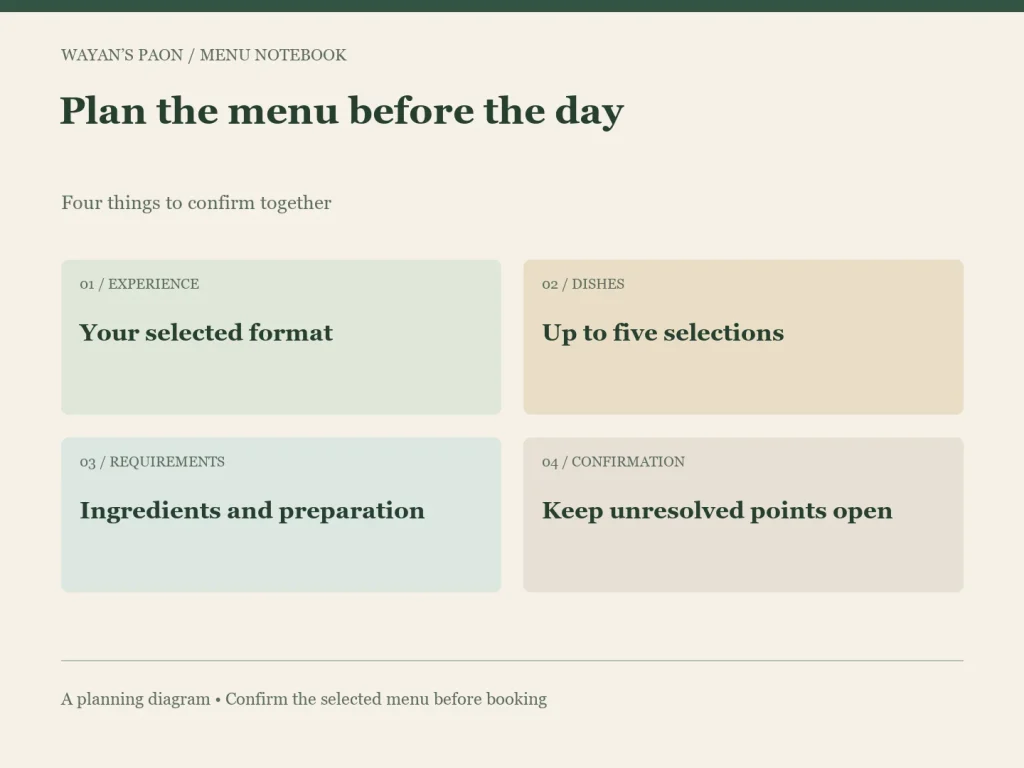

A halal-friendly cooking menu in Ubud needs more than a list of dishes without pork. Before choosing a class, establish what the kitchen can confirm about the selected ingredients, drinks and preparation. Wayan’s Paon describes a private, pork-free and alcohol-free menu planning option, and explicitly states that its kitchen is not halal-certified. If certification is essential to your booking, that distinction belongs at the beginning of the conversation. When examining halal-friendly cooking menu in Ubud in the context of everyday kitchen work and guest planning in Gianyar and Ubud, separating specific ingredient names, preparation timing, and household customs prevents common misunderstandings before you shop or cook. When examining halal-friendly cooking menu in Ubud in the context of everyday kitchen work and guest planning in Gianyar and Ubud, separating specific ingredient names, preparation timing, and household customs prevents common misunderstandings before you shop or cook.
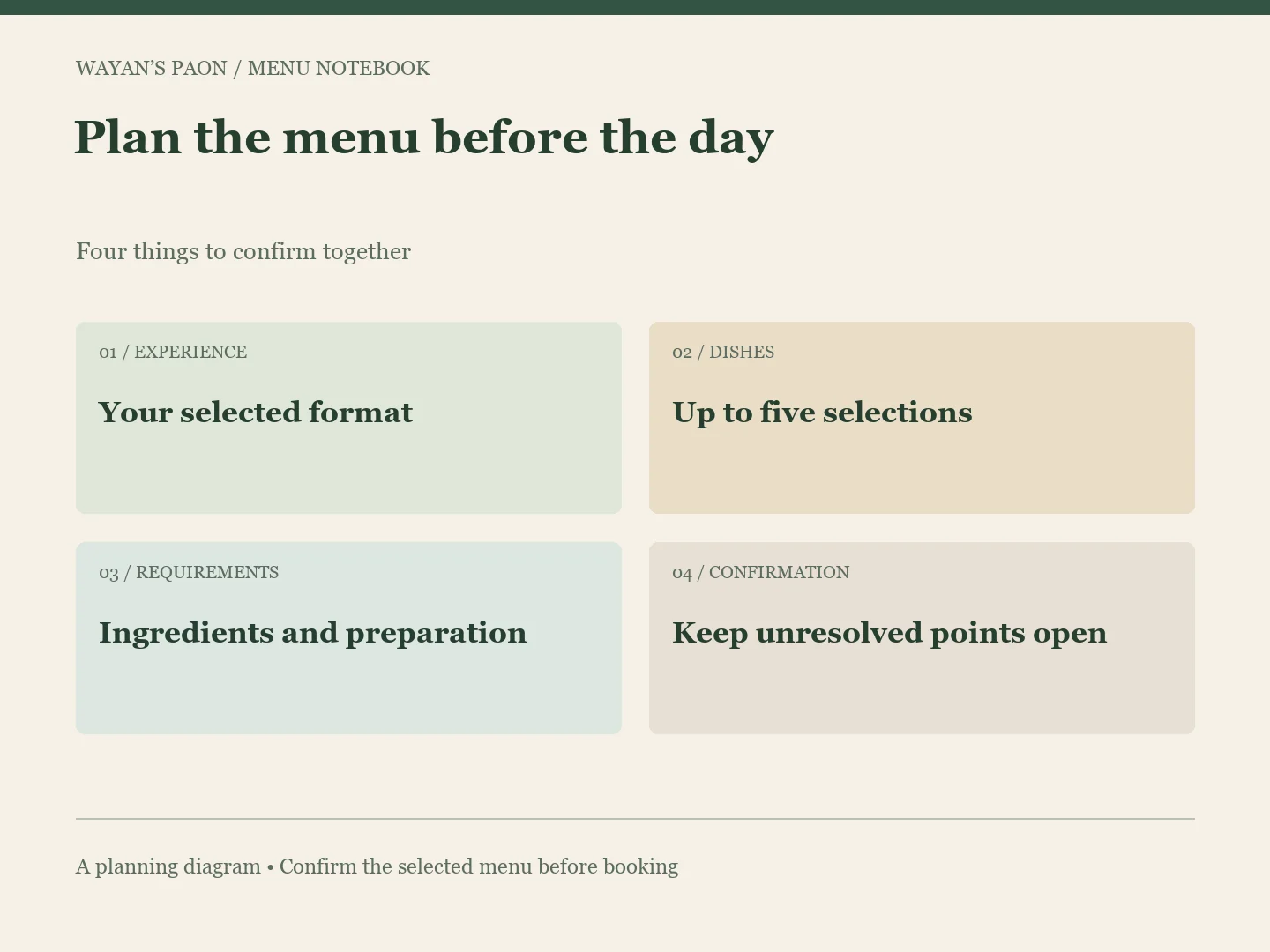
Start with the requirement, then choose the dishes
It is easier to assess a proposed menu when the operator knows what you need to verify. Say whether you require certified ingredients, whether meat sourcing matters, and which questions you have about preparation in a shared kitchen. Do not assume that choosing a vegetable dish settles every question about its seasoning.
Compare dishes by their place in the meal
The current halal-friendly private cooking class ubud page explains the service and its limits. Use that page for the booking offer. This guide helps you organise the menu discussion before you request confirmation.
Ask about the whole recipe
Rather than choosing five dishes that all do the same job, think about what your group wants to learn and eat. You might want a main preparation, vegetables, rice and a sweet finish. The operator’s menu builder currently allows up to five selections, subject to confirmation.
Include drinks in the request
The dietary page lists fish preparations, vegetable dishes, rice and desserts as ideas to discuss. A listing is a starting point for a request. It does not replace confirmation of the ingredients used for your session.
Keep the experience separate from the dietary plan
A dish card normally names the main ingredients and cooking method. Your requirements may depend on details that a short description cannot cover: a packaged sauce, the stock, a condiment added at the end, or the source of an ingredient. Send questions about those details with your shortlist so the answer refers to the actual proposed menu.
Explore the menu questions in more detail
A useful question is specific: “For these selected dishes, can you confirm the ingredients in the sauces and seasonings, the ingredient sourcing and any shared-kitchen constraints?” That gives the operator something concrete to review. Avoid treating a general menu label as an answer to every ingredient question.
Send one clear menu request
The dietary FAQ says beer is not served to the booking group for a halal-friendly booking and is replaced by a non-alcoholic option. Confirm that arrangement with the final menu. This matters because the general hospitality section elsewhere on the same page still lists complimentary beer among the standard inclusions.
If you have a particular drink preference, include it in the request rather than assuming which replacement will be provided.
A market visit and a cooking-only session offer different ways to spend the day. Choose the experience for the activities your group wants, then ask how the selected menu fits it. A market visit does not by itself establish ingredient certification or answer questions about kitchen preparation.
For the available private formats, start with Cooking Class Ubud. Confirm the date, format and menu together before booking, especially if an ingredient or sourcing requirement determines whether you can take part.
Compare the cooking tasks and place each selection in the meal.
Keep product checks, sourcing, facilities and certification claims separate.
Bring the activity, group requirements and final confirmation into the same request.
Include your date, group size, chosen experience, up to five proposed dishes and the exact requirements you need answered. Ask for confirmation of the complete selection, including seasonings, drinks and preparation. Keep the reply with your booking details so your group can refer to the agreed menu.
If the response leaves an essential requirement unresolved, ask about that point before committing. A shorter, clearly confirmed menu is more useful than a longer list built on assumptions.
How Plan a Halal-Friendly Cooking Menu in Ubud Before You Book Connects Market Observation, Kitchen Technique, and Practical Planning in Ubud
For travellers and home cooks researching halal-friendly cooking menu in Ubud, the biggest gap in general travel guides is that they treat Balinese food and daily life as a single uniform checklist rather than a living household system. In a traditional Balinese compound around Ubud, decisions about ingredients, prep sequence, and table pairing depend on whether a meal is prepared for a quiet family lunch, a morning market run, or a shared gathering. When you join an Ubud Cooking Class at Wayan’s Paon, every question around halal-friendly cooking menu in Ubud is answered through direct hands-on observation rather than abstract theory.
A second practical principle when evaluating halal-friendly cooking menu in Ubud is recognizing the boundary between what happens at the morning produce stalls, what happens at the stone mortar (ulekan), and how the final dishes are balanced on the plate. In our private sessions such as Private Paon Table, your group works only with your own booking party and selects up to five dishes from the 53-dish menu (plus the foundational Base Genep spice paste), allowing you to test how each choice affects flavour, texture, and timing.
Comparative Reference Matrix: 10 Core Dimensions of Halal-Friendly Cooking Menu In Ubud
Before diving into each specialized subtopic in this family of guides, the table below summarizes how the ten focused questions around halal-friendly cooking menu in Ubud differ in scope, practical kitchen impact, and what you should verify before buying ingredients or confirming a menu in Ubud:
| Focus Topic / Keyword Owner | Specific Question Addressed | Key Practical Distinction in Ubud |
|---|---|---|
| 1. fish dishes for a halal-friendly cooking class | Fish Skewers or Leaf Parcels for Your Private Cooking Menu? | Choosing fish dishes for a halal-friendly cooking class starts with two separate questions: which preparation would you enjoy learning, and … |
| 2. checking sauces for a halal-friendly menu | Check the Sauce Bottle as Well as the Main Ingredient | Checking sauces for a halal-friendly menu means identifying the actual products and preparations in the selected recipes. “Soy sauce” or “se… |
| 3. halal-friendly and halal-certified cooking classes | Halal-Friendly or Halal-Certified? Check What the Class Offers | Halal-friendly and halal-certified cooking classes should not be treated as interchangeable offers. For Wayan’s Paon, “halal-friendly” descr… |
| 4. shared kitchen questions for a halal-friendly class | A Private Class Does Not Answer Every Kitchen Question | Shared kitchen questions for a halal-friendly class concern the preparation environment as well as the menu. Ask about storage, utensils, co… |
| 5. halal meat sourcing for a cooking class | Confirm the Meat Source Before Choosing the Dish | Halal meat sourcing for a cooking class needs a specific answer about the ingredient proposed for your booking. “We can cook without pork” d… |
| 6. non-alcoholic drinks for a halal-friendly cooking class | Confirm the Drink Replacement with Your Dietary Menu | Non-alcoholic drinks for a halal-friendly cooking class belong in the booking request alongside the food. At Wayan’s Paon, the dietary FAQ s… |
| 7. vegetable dishes for a halal-friendly menu | Choose Vegetable Dishes by What You Want to Learn | Vegetable dishes for a halal-friendly menu can bring variety to a cooking session, but the main vegetable does not establish the status of t… |
| 8. halal-friendly market visit and cooking class | What to Confirm Before Adding a Market Visit | A halal-friendly market visit and cooking class involves two settings to discuss: the public market and the kitchen where your selected dish… |
| 9. checking halal product certification in Indonesia | Match the Product Before Relying on a Halal Certificate | Checking halal product certification in Indonesia starts with identifying the exact product. For an ingredient proposed in your cooking-clas… |
| 10. halal-friendly menu confirmation record | Keep a Clear Record of the Menu You Confirmed | A halal-friendly menu confirmation record keeps the agreed dishes and the answers to your ingredient questions in one place. It is a practic… |
Deep-Dive Guide to the 10 Specialized Subtopics Within Halal-Friendly Cooking Menu In Ubud
Each of the ten companion articles in this topic family isolates one specific decision or ingredient question related to halal-friendly cooking menu in Ubud so that you never confuse a broad category label with a concrete culinary rule. Below is how each specialized guide fits into the wider picture:
1. Fish Skewers or Leaf Parcels for Your Private Cooking Menu?
When narrowing your focus from halal-friendly cooking menu in Ubud to the specific question of fish dishes for a halal-friendly cooking class, the primary distinction is context and practical application. Choosing fish dishes for a halal-friendly cooking class starts with two separate questions: which preparation would you enjoy learning, and can the operator confirm the ingredients and handling you require? A fish-based main ingredient does not answer the second question. At Wayan’s Paon, the dietary service is described as menu planning in a kitchen that is not halal-certified. By keeping this specific scope distinct from neighbouring topics, you avoid applying a general rule where a precise ingredient check or timing adjustment is required.
In practice at the market or in the paon, The current dietary menu includes two useful starting points. sate lilit ikan bali uses fish blended with coconut and Balinese seasoning, shaped around a skewer and grilled. pesan be pasih / pepes ikan bali places seasoned fish inside a banana-leaf wrapper. They share fish and aromatics, but offer different hands-on tasks. Whether you are comparing options before booking your private session or taking notes to cook at home after your trip, treating fish dishes for a halal-friendly cooking class as its own step ensures your preparation remains accurate and stress-free.
2. Check the Sauce Bottle as Well as the Main Ingredient
When narrowing your focus from halal-friendly cooking menu in Ubud to the specific question of checking sauces for a halal-friendly menu, the primary distinction is context and practical application. Checking sauces for a halal-friendly menu means identifying the actual products and preparations in the selected recipes. “Soy sauce” or “seasoning” is a category, not a complete ingredient record. Ask which product the cook will use and whether it has the certification you require. The same question applies to a sauce offered at the table as to one mixed into the dish. By keeping this specific scope distinct from neighbouring topics, you avoid applying a general rule where a precise ingredient check or timing adjustment is required.
In practice at the market or in the paon, A useful menu discussion follows the ingredients through the preparation. Ask about the marinade, spice mixture, stock, cooking sauce and finishing condiment. Some dishes may use only freshly prepared seasoning; others may include a packaged product. Let the operator identify what applies to your selected dishes instead of sending a list of assumptions. Whether you are comparing options before booking your private session or taking notes to cook at home after your trip, treating checking sauces for a halal-friendly menu as its own step ensures your preparation remains accurate and stress-free.
3. Halal-Friendly or Halal-Certified? Check What the Class Offers
When narrowing your focus from halal-friendly cooking menu in Ubud to the specific question of halal-friendly and halal-certified cooking classes, the primary distinction is context and practical application. Halal-friendly and halal-certified cooking classes should not be treated as interchangeable offers. For Wayan’s Paon, “halal-friendly” describes a conversation about a pork-free, alcohol-free selected menu and ingredient sourcing. The service page explicitly says the kitchen is not halal-certified. If you require a certified experience, establish that requirement before comparing dishes or prices. By keeping this specific scope distinct from neighbouring topics, you avoid applying a general rule where a precise ingredient check or timing adjustment is required.
In practice at the market or in the paon, A dietary menu description tells you what the operator proposes to discuss or adapt. Certification is a separate claim requiring evidence. Do not turn “we can discuss ingredient sourcing” into “all ingredients are certified,” or “pork-free selected menu” into “certified kitchen.” Those statements answer different questions. Whether you are comparing options before booking your private session or taking notes to cook at home after your trip, treating halal-friendly and halal-certified cooking classes as its own step ensures your preparation remains accurate and stress-free.
4. A Private Class Does Not Answer Every Kitchen Question
When narrowing your focus from halal-friendly cooking menu in Ubud to the specific question of shared kitchen questions for a halal-friendly class, the primary distinction is context and practical application. Shared kitchen questions for a halal-friendly class concern the preparation environment as well as the menu. Ask about storage, utensils, cooking equipment and any components prepared before you arrive. A private session describes who joins the class; it does not by itself establish that the kitchen or equipment is dedicated to halal preparation. By keeping this specific scope distinct from neighbouring topics, you avoid applying a general rule where a precise ingredient check or timing adjustment is required.
In practice at the market or in the paon, Start with a practical sequence: where the ingredients are stored, where they are prepared, which tools are used, and how the finished food is served. Ask the operator which arrangements apply to your chosen dishes. This is more specific than asking whether the kitchen is “clean,” a word that may not communicate your religious requirements. Whether you are comparing options before booking your private session or taking notes to cook at home after your trip, treating shared kitchen questions for a halal-friendly class as its own step ensures your preparation remains accurate and stress-free.
5. Confirm the Meat Source Before Choosing the Dish
When narrowing your focus from halal-friendly cooking menu in Ubud to the specific question of halal meat sourcing for a cooking class, the primary distinction is context and practical application. Halal meat sourcing for a cooking class needs a specific answer about the ingredient proposed for your booking. “We can cook without pork” does not identify the source of chicken or beef. If certified meat is essential, say so before choosing a meat dish and ask what the operator can verify. By keeping this specific scope distinct from neighbouring topics, you avoid applying a general rule where a precise ingredient check or timing adjustment is required.
In practice at the market or in the paon, Send the dish name, the meat it uses and the evidence you require. A request such as “We would like a chicken dish, but only if its certified source can be confirmed before booking” is easier to assess than “Is your menu suitable?” It makes the sourcing condition explicit. Whether you are comparing options before booking your private session or taking notes to cook at home after your trip, treating halal meat sourcing for a cooking class as its own step ensures your preparation remains accurate and stress-free.
6. Confirm the Drink Replacement with Your Dietary Menu
When narrowing your focus from halal-friendly cooking menu in Ubud to the specific question of non-alcoholic drinks for a halal-friendly cooking class, the primary distinction is context and practical application. Non-alcoholic drinks for a halal-friendly cooking class belong in the booking request alongside the food. At Wayan’s Paon, the dietary FAQ says beer is not served to the booking group for a halal-friendly booking and is replaced with a non-alcoholic option. Confirm that arrangement for your session rather than relying only on the general inclusions list. By keeping this specific scope distinct from neighbouring topics, you avoid applying a general rule where a precise ingredient check or timing adjustment is required.
In practice at the market or in the paon, The same service page includes a standard hospitality section listing complimentary beer for adults. The dietary FAQ explains the exception for this booking type. Read both sections together: the general list describes the standard hospitality, while the dietary answer describes the proposed adjustment. Whether you are comparing options before booking your private session or taking notes to cook at home after your trip, treating non-alcoholic drinks for a halal-friendly cooking class as its own step ensures your preparation remains accurate and stress-free.
7. Choose Vegetable Dishes by What You Want to Learn
When narrowing your focus from halal-friendly cooking menu in Ubud to the specific question of vegetable dishes for a halal-friendly menu, the primary distinction is context and practical application. Vegetable dishes for a halal-friendly menu can bring variety to a cooking session, but the main vegetable does not establish the status of the finished recipe. Choose the cooking tasks you want to learn, then ask about the seasoning, sauce and other ingredients used for those dishes. By keeping this specific scope distinct from neighbouring topics, you avoid applying a general rule where a precise ingredient check or timing adjustment is required.
In practice at the market or in the paon, Wayan’s Paon’s current dietary page lists seasoned greens, young jackfruit, banana blossom, pigeon-pea soup, rice cake with peanut sauce and corn fritters among the ideas to discuss. These offer different tasks and meal roles. Selecting several names is less useful if they all repeat the same part of the lesson. Whether you are comparing options before booking your private session or taking notes to cook at home after your trip, treating vegetable dishes for a halal-friendly menu as its own step ensures your preparation remains accurate and stress-free.
8. What to Confirm Before Adding a Market Visit
When narrowing your focus from halal-friendly cooking menu in Ubud to the specific question of halal-friendly market visit and cooking class, the primary distinction is context and practical application. A halal-friendly market visit and cooking class involves two settings to discuss: the public market and the kitchen where your selected dishes will be prepared. Choosing a market format does not by itself confirm the sourcing or preparation standards you require. Ask which activities, purchases and any tastings are proposed for the actual experience. By keeping this specific scope distinct from neighbouring topics, you avoid applying a general rule where a precise ingredient check or timing adjustment is required.
In practice at the market or in the paon, You might want to recognise fresh ingredients, learn local names or see how a shopping trip fits the recipes. Explain that interest when choosing the format. If your main priority is the hands-on cooking, a cooking-only session may be worth discussing instead. Whether you are comparing options before booking your private session or taking notes to cook at home after your trip, treating halal-friendly market visit and cooking class as its own step ensures your preparation remains accurate and stress-free.
9. Match the Product Before Relying on a Halal Certificate
When narrowing your focus from halal-friendly cooking menu in Ubud to the specific question of checking halal product certification in Indonesia, the primary distinction is context and practical application. Checking halal product certification in Indonesia starts with identifying the exact product. For an ingredient proposed in your cooking-class menu, ask for the name on the package and the business or certificate details available. Use those details to review the relevant record rather than searching only for a broad category such as “soy sauce.” By keeping this specific scope distinct from neighbouring topics, you avoid applying a general rule where a precise ingredient check or timing adjustment is required.
In practice at the market or in the paon, BPJPH’s website provides a “Cek Produk Halal” search. Its fields allow a product name, business name or certificate number. You can enter one or several fields to narrow the results. The results show product and producer information alongside certificate details. Whether you are comparing options before booking your private session or taking notes to cook at home after your trip, treating checking halal product certification in Indonesia as its own step ensures your preparation remains accurate and stress-free.
10. Keep a Clear Record of the Menu You Confirmed
When narrowing your focus from halal-friendly cooking menu in Ubud to the specific question of halal-friendly menu confirmation record, the primary distinction is context and practical application. A halal-friendly menu confirmation record keeps the agreed dishes and the answers to your ingredient questions in one place. It is a practical booking note, not a certificate. Use it to distinguish what the operator has confirmed from what your group has proposed or still needs answered. By keeping this specific scope distinct from neighbouring topics, you avoid applying a general rule where a precise ingredient check or timing adjustment is required.
In practice at the market or in the paon, Write the date, experience format, group size and exact dish names at the top. Then note the ingredients or preparation conditions that matter to the booking. Avoid a heading such as “all suitable” if the reply only answers one specific question. Whether you are comparing options before booking your private session or taking notes to cook at home after your trip, treating halal-friendly menu confirmation record as its own step ensures your preparation remains accurate and stress-free.
How to Apply These Notes When Planning Your Private Cooking Day at Wayan’s Paon
Bringing all ten facets of halal-friendly cooking menu in Ubud together reveals a consistent lesson about Balinese culinary culture: clarity comes from asking specific questions before the cooking begins. In a private household setting in Ubud, your host does not rely on factory-made pastes or rigid group schedules. Instead, fresh roots (galangal, turmeric, ginger, and aromatic kencur), shallots, garlic, lemongrass, salam leaves, and kaffir lime are proportioned for the exact five dishes your group chooses to cook.
If you have dietary requirements—such as vegetarian or vegan preparation without fermented shrimp paste (terasi), gluten-free substitutions using pure rice flour and palm sugar (Gula Aren), dairy-free coconut milk infusions, or nut-free spice pastes omitting candlenut (kemiri)—discussing them when you select your menu allows the kitchen to prepare dedicated mortars, cutting boards, and filtered drinking-water washing stations in advance.
Finally, use this pillar overview on halal-friendly cooking menu in Ubud alongside the ten focused cluster guides linked above whenever you want to verify a local Balinese term, compare morning market timing against afternoon kitchen sessions, or adapt a traditional Ubud technique for your own stove at home.