
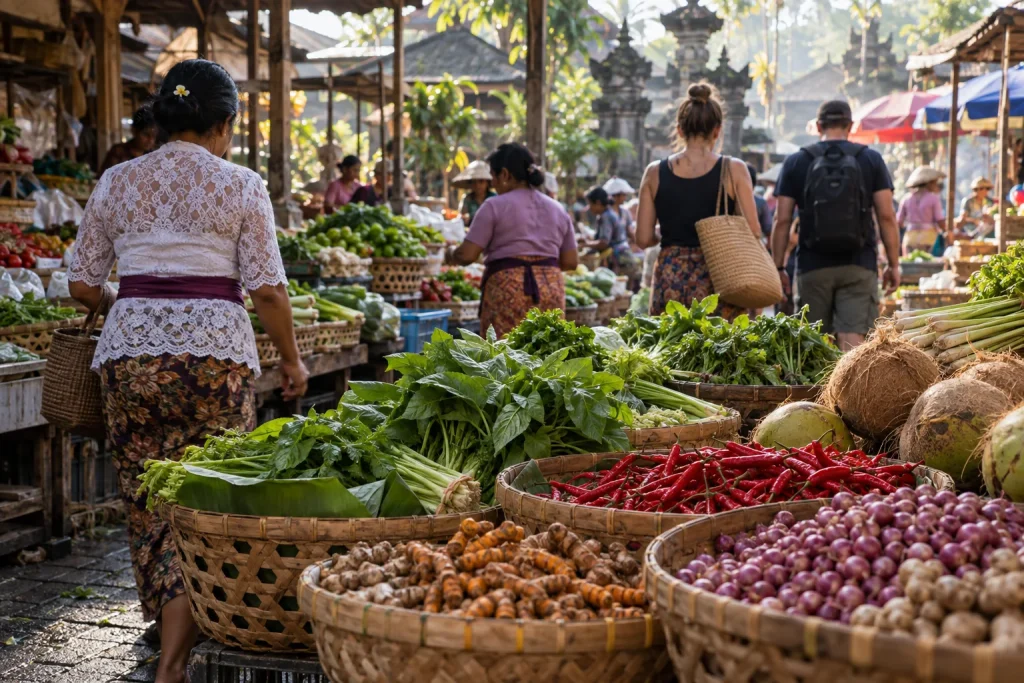
In Ubud, the word “market” can point to very different places. One visitor may mean the souvenir stalls near the palace; another may be looking for the produce and everyday ingredients used in local cooking. Food markets are easiest to understand when you start with that distinction. This guide follows the food side: what you might find, how to choose a useful stop and where a market fits into a day spent learning about Balinese food. When examining ubud food market in the context of everyday kitchen work and guest planning in Gianyar and Ubud, separating specific ingredient names, preparation timing, and household customs prevents common misunderstandings before you shop or cook.
Start by deciding what kind of market you mean
A morning market is usually about daily needs: vegetables, herbs, fruit, rice, eggs, spices and prepared breakfast, with the exact mix changing by place and day. A farmers market has a different rhythm, bringing smaller producers together on a scheduled day. At an evening food market, the focus shifts toward ready-to-eat meals and snacks. These settings can all be called markets, but they answer different questions for a visitor.
Follow the ingredient, not a fixed shopping list
The central Ubud market area also attracts people looking for clothing, crafts and souvenirs. If you want produce rather than shopping for gifts, check the purpose of the stop before you set out. The quick guide to the ubud morning market focuses on food and ingredients; our notes on a bali traditional market explain the broader pasar setting without treating every market as identical.
When the day turns toward cooked food
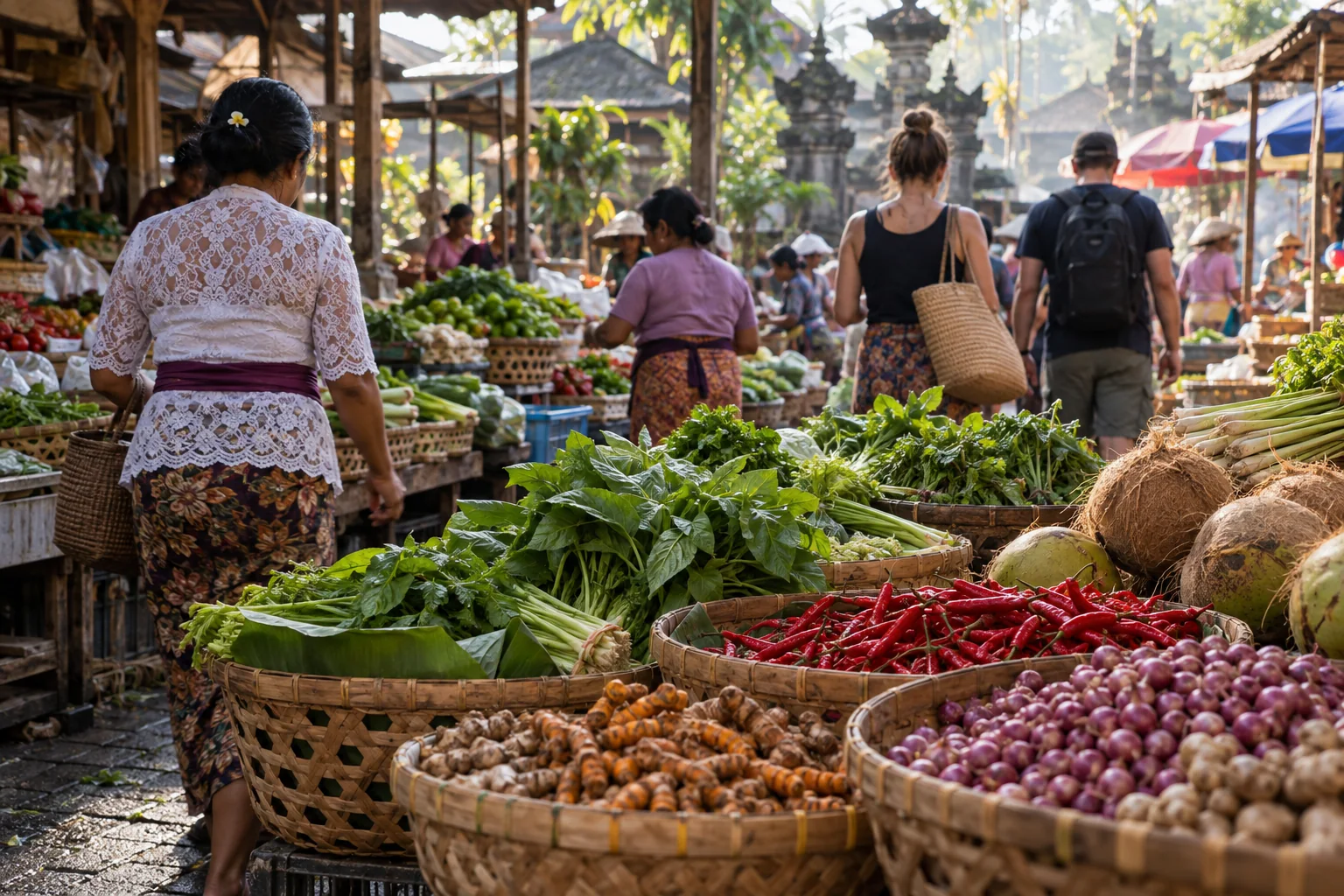
A useful market visit starts with one dish in mind. For a fresh sambal, look for chillies, shallots, citrus and aromatic herbs; for a vegetable side, ask what greens are in season and how they are usually cooked. The ingredient names and varieties may be unfamiliar, so it helps to point, listen and repeat the name back. You do not need to buy a large amount to learn what a local ingredient looks like.
Make the market part of a food-learning day
For a wider comparison of shopping options around the island, see the guide to a bali food market and the profile of a bali farmers market. The latter is a scheduled producer gathering, while a public market may serve people buying everyday household needs. A list of ingredients is less useful than knowing which setting can answer the question you have.
Markets are not only places to buy ingredients. Some become lively food stops later in the day, with grills, rice dishes, snacks and drinks sold by individual stalls. The island-wide guide to a bali street food market compares that evening experience with morning produce shopping. If your plan stays near Ubud, the article about the ubud night market explains the names and locations that often get mixed together online.
Other stops have their own character: the city’s working badung market, the separate gianyar street night market, and sanur food market at Pasar Sindhu. Each cluster has a narrower guide so this page can stay focused on how to choose a food-market visit. For basic courtesy in any setting, read balinese market etiquette before taking photographs or handling unfamiliar goods.
A market visit can make cooking terms concrete. You can see the size of a shallot, smell fresh turmeric and notice how a cook chooses produce. It is also fine to visit without buying anything; leave a stall clear if someone is serving a customer and ask before photographing people. When you are comparing a market visit with a class, the existing guide to ubud market before a cooking class owns that itinerary question.
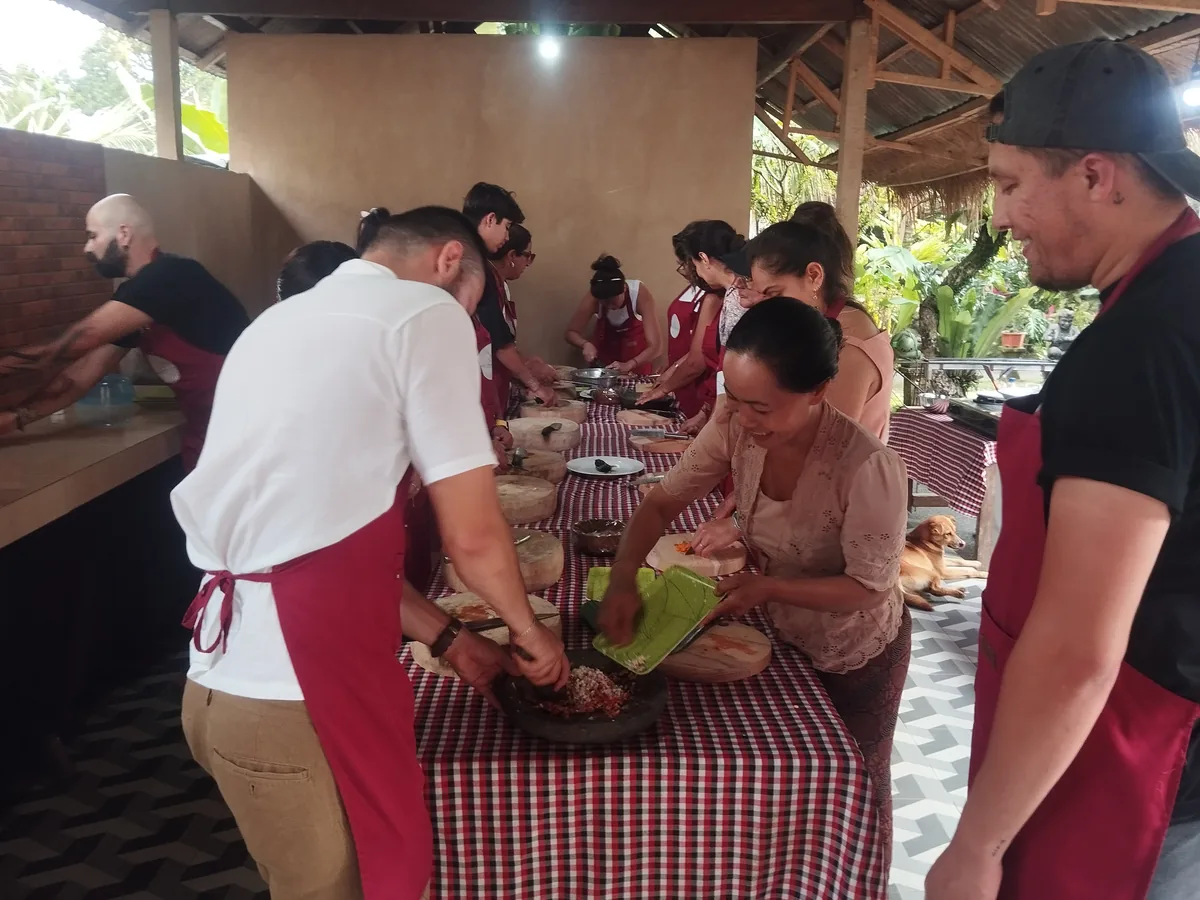
A guided kitchen session can then turn ingredient names into preparation steps. Check the current Cooking Class Ubud details before planning around a particular menu, and ask what is available on your date rather than assuming every class follows the same market route. A market is part of a living food system, not a display created for visitors; the more specific your question, the more useful the visit is likely to be.
How Ubud Food Markets and the Ingredients That Bring Balinese Cooking to Life Connects Market Observation, Kitchen Technique, and Practical Planning in Ubud
For travellers and home cooks researching ubud food market, the biggest gap in general travel guides is that they treat Balinese food and daily life as a single uniform checklist rather than a living household system. In a traditional Balinese compound around Ubud, decisions about ingredients, prep sequence, and table pairing depend on whether a meal is prepared for a quiet family lunch, a morning market run, or a shared gathering. When you join an Ubud Cooking Class at Wayan’s Paon, every question around ubud food market is answered through direct hands-on observation rather than abstract theory.
A second practical principle when evaluating ubud food market is recognizing the boundary between what happens at the morning produce stalls, what happens at the stone mortar (ulekan), and how the final dishes are balanced on the plate. In our private sessions such as Market to Paon, your group works only with your own booking party and selects up to five dishes from the 53-dish menu (plus the foundational Base Genep spice paste), allowing you to test how each choice affects flavour, texture, and timing.
Comparative Reference Matrix: 10 Core Dimensions of Ubud Food Market
Before diving into each specialized subtopic in this family of guides, the table below summarizes how the ten focused questions around ubud food market differ in scope, practical kitchen impact, and what you should verify before buying ingredients or confirming a menu in Ubud:
| Focus Topic / Keyword Owner | Specific Question Addressed | Key Practical Distinction in Ubud |
|---|---|---|
| 1. ubud morning market | At Ubud’s Morning Market, Fresh Ingredients Come First | The Ubud morning market makes more sense when you arrive with one question: what are people buying for the kitchen today? The market’s food … |
| 2. ubud night market | An Evening at Ubud’s Night Markets, Starting in Sayan | “Ubud night market” is not always a single map pin. Search results and travel guides use the phrase for more than one nearby evening stop, w… |
| 3. bali street food market | Bali’s Street-Food Markets, from Sanur to Gianyar | A Bali street-food market is less a single attraction than a set of local places with different rhythms. Some are traditional markets that a… |
| 4. bali food market | Where to Shop for Food at a Bali Market | The phrase “Bali food market” can mean a place to shop for ingredients or a place to buy dinner. Those are useful but different visits. If y… |
| 5. bali farmers market | Bali Farmers Market in Ubud Is a Weekly Gathering of Producers | A farmers market in Ubud has a different feel from a large public market. The draw is a smaller group of producers and food makers meeting v… |
| 6. badung market | Inside Badung Market, Denpasar’s Working Food Market | Badung Market is in central Denpasar, not in Badung Regency, despite the name. It is one of Bali’s major traditional markets, associated wit… |
| 7. gianyar street night market | Gianyar Street Night Market Is a Separate Stop from Ubud | The phrase “Gianyar street night market” most often points visitors toward Pasar Senggol in Gianyar town. It is not the same place as the ev… |
| 8. sanur food market | Sanur Food Market after Sunset at Pasar Sindhu | Sanur food market searches often lead to Pasar Sindhu, the neighborhood’s central market. It serves more than one purpose across the day, wh… |
| 9. bali traditional market | Bali Traditional Markets, from Morning Produce to Evening Meals | A Bali traditional market is not one uniform attraction. A local pasar may sell produce, household goods, ceremonial supplies and ready-to-e… |
| 10. balinese market etiquette | How to Browse a Balinese Market with Care | A market is a place to buy food and daily goods, not a stage set for visitors. A little care makes it easier to ask questions, take in the d… |
Deep-Dive Guide to the 10 Specialized Subtopics Within Ubud Food Market
Each of the ten companion articles in this topic family isolates one specific decision or ingredient question related to ubud food market so that you never confuse a broad category label with a concrete culinary rule. Below is how each specialized guide fits into the wider picture:
1. At Ubud’s Morning Market, Fresh Ingredients Come First
When narrowing your focus from ubud food market to the specific question of ubud morning market, the primary distinction is context and practical application. The Ubud morning market makes more sense when you arrive with one question: what are people buying for the kitchen today? The market’s food side is easy to miss if you expect a polished visitor attraction, because it is first a place for everyday shopping. Produce, breakfast and household goods may share the same stretch of stalls, and the mix can change from one visit to the next. By keeping this specific scope distinct from neighbouring topics, you avoid applying a general rule where a precise ingredient check or timing adjustment is required.
In practice at the market or in the paon, Search results for Ubud Market often blend the local food market with the souvenir and craft stalls visitors know from central Ubud. The easiest clue is what is being sold: fresh vegetables, herbs, fruit, rice and kitchen staples belong to a food-shopping visit; sarongs, bags and carvings belong to a different errand. Some areas change character through the day, so use current local directions rather than relying on a photo from years ago. Whether you are comparing options before booking your private session or taking notes to cook at home after your trip, treating ubud morning market as its own step ensures your preparation remains accurate and stress-free.
2. An Evening at Ubud’s Night Markets, Starting in Sayan
When narrowing your focus from ubud food market to the specific question of ubud night market, the primary distinction is context and practical application. “Ubud night market” is not always a single map pin. Search results and travel guides use the phrase for more than one nearby evening stop, while Sayan and Peliatan can appear as separate names. Gianyar town is another destination altogether. Before setting out, choose the market you mean, check the latest map listing and make sure your driver is taking you to the same place you have in mind. By keeping this specific scope distinct from neighbouring topics, you avoid applying a general rule where a precise ingredient check or timing adjustment is required.
In practice at the market or in the paon, Sayan Night Market is commonly used in visitor guides as a name for an evening food-market stop in the Ubud area. Current map results also show a separate Peliatan Night Market. Those listings can make a search for a single “Ubud Night Market” feel more certain than it is. The label is useful for discovery, but it is not a substitute for confirming the address or pin on the day you travel. Whether you are comparing options before booking your private session or taking notes to cook at home after your trip, treating ubud night market as its own step ensures your preparation remains accurate and stress-free.
3. Bali’s Street-Food Markets, from Sanur to Gianyar
When narrowing your focus from ubud food market to the specific question of bali street food market, the primary distinction is context and practical application. A Bali street-food market is less a single attraction than a set of local places with different rhythms. Some are traditional markets that add evening food stalls; others are neighborhood stops known for prepared meals. The useful question is not which one is “the best,” but what kind of visit you want: a quick dinner, a first look at local snacks, or a more food-focused walk through a market area. By keeping this specific scope distinct from neighbouring topics, you avoid applying a general rule where a precise ingredient check or timing adjustment is required.
In practice at the market or in the paon, For a meal near Ubud, searches often point toward the Sayan or Peliatan night-market names. They are not the same pin as Pasar Senggol in Gianyar town. Read the guide to the ubud night market for the naming issue and the separate gianyar street night market page before choosing a route. Whether you are comparing options before booking your private session or taking notes to cook at home after your trip, treating bali street food market as its own step ensures your preparation remains accurate and stress-free.
4. Where to Shop for Food at a Bali Market
When narrowing your focus from ubud food market to the specific question of bali food market, the primary distinction is context and practical application. The phrase “Bali food market” can mean a place to shop for ingredients or a place to buy dinner. Those are useful but different visits. If you are planning to cook, begin with produce, aromatics and pantry staples; if you want a meal, look for a market with active food stalls. Once you make that distinction, it is easier to choose a stop and avoid treating every market as a tourist attraction. By keeping this specific scope distinct from neighbouring topics, you avoid applying a general rule where a precise ingredient check or timing adjustment is required.
In practice at the market or in the paon, A public neighborhood market can combine vegetables, fruit, herbs, eggs, rice, household goods and ceremonial supplies. A farmers market tends to bring local producers together at a set time. A night food market emphasizes prepared dishes and snacks. The names overlap in casual travel writing, but a produce buyer and a dinner-seeker will have different expectations. Check what the market sells before you build a route around it. Whether you are comparing options before booking your private session or taking notes to cook at home after your trip, treating bali food market as its own step ensures your preparation remains accurate and stress-free.
5. Bali Farmers Market in Ubud Is a Weekly Gathering of Producers
When narrowing your focus from ubud food market to the specific question of bali farmers market, the primary distinction is context and practical application. A farmers market in Ubud has a different feel from a large public market. The draw is a smaller group of producers and food makers meeting visitors on a regular day, with produce and prepared goods that can tell you something about what is grown or made nearby. Bali Earth Market is the clearest current example found for this guide, but its hours are a live detail, so check the listing before you travel. By keeping this specific scope distinct from neighbouring topics, you avoid applying a general rule where a precise ingredient check or timing adjustment is required.
In practice at the market or in the paon, The Slow Food Foundation’s listing describes Bali Earth Market in the Ubud area as a weekly gathering, with small-scale producers offering fruits, vegetables, tofu, tempeh, coffee, herbal teas, baked goods, homemade foods and Balinese specialties. It also notes cooking demonstrations and seed exchanges. That combination makes the stop more than a row of produce tables: it can be a place to hear how local food is grown, prepared and shared. Whether you are comparing options before booking your private session or taking notes to cook at home after your trip, treating bali farmers market as its own step ensures your preparation remains accurate and stress-free.
6. Inside Badung Market, Denpasar’s Working Food Market
When narrowing your focus from ubud food market to the specific question of badung market, the primary distinction is context and practical application. Badung Market is in central Denpasar, not in Badung Regency, despite the name. It is one of Bali’s major traditional markets, associated with everyday shopping and a broad mix of food and household goods. The nearby Kumbasari Art Market is a separate stop across the river. Knowing that distinction before you arrive helps you choose the right side of the area for produce, daily ingredients or handicrafts. By keeping this specific scope distinct from neighbouring topics, you avoid applying a general rule where a precise ingredient check or timing adjustment is required.
In practice at the market or in the paon, The Denpasar tourism office describes Badung as a traditional market for daily needs, while the city’s market company continues to publish market information and updates. Local food shopping, fresh produce and household goods sit alongside other market categories. The scale is different from a small neighborhood produce stall, so give yourself time to orient before walking through the aisles. Whether you are comparing options before booking your private session or taking notes to cook at home after your trip, treating badung market as its own step ensures your preparation remains accurate and stress-free.
7. Gianyar Street Night Market Is a Separate Stop from Ubud
When narrowing your focus from ubud food market to the specific question of gianyar street night market, the primary distinction is context and practical application. The phrase “Gianyar street night market” most often points visitors toward Pasar Senggol in Gianyar town. It is not the same place as the evening markets commonly labelled Sayan or Peliatan in Ubud searches. The distinction matters because travellers sometimes hear “night market near Ubud” and assume every result is a short walk from the center. Check the destination’s current map pin before leaving. By keeping this specific scope distinct from neighbouring topics, you avoid applying a general rule where a precise ingredient check or timing adjustment is required.
In practice at the market or in the paon, Pasar Senggol is the name used for Gianyar’s evening food-market area. Government descriptions connect the market with Gianyar’s public market, while records of redevelopment show that traders have been moved temporarily during construction. That history is why an older blog’s address or turn-by-turn directions may no longer be dependable. Use the place name and a live map, then check whether the pin is current before you book transport. Whether you are comparing options before booking your private session or taking notes to cook at home after your trip, treating gianyar street night market as its own step ensures your preparation remains accurate and stress-free.
8. Sanur Food Market after Sunset at Pasar Sindhu
When narrowing your focus from ubud food market to the specific question of sanur food market, the primary distinction is context and practical application. Sanur food market searches often lead to Pasar Sindhu, the neighborhood’s central market. It serves more than one purpose across the day, while its evening food stalls are what many visitors have in mind when they ask where to eat casually. Keep those two ideas separate: the market’s operating window is not necessarily the same as the hours of every food stall. By keeping this specific scope distinct from neighbouring topics, you avoid applying a general rule where a precise ingredient check or timing adjustment is required.
In practice at the market or in the paon, The national tourism attraction registry identifies Pasar Sindhu at Jl. Ps. Sindu No. 5 in Sanur, Denpasar Selatan. The registry lists daily operating hours for the market, while the city’s visitor information describes Sindhu as a place for affordable snacks and street food. That gives travellers a dependable name and general location, but not a promise that a particular stall will be open at every hour listed for the wider market. Whether you are comparing options before booking your private session or taking notes to cook at home after your trip, treating sanur food market as its own step ensures your preparation remains accurate and stress-free.
9. Bali Traditional Markets, from Morning Produce to Evening Meals
When narrowing your focus from ubud food market to the specific question of bali traditional market, the primary distinction is context and practical application. A Bali traditional market is not one uniform attraction. A local pasar may sell produce, household goods, ceremonial supplies and ready-to-eat food, with different activity at different times of day. Some visitor guides use the word “market” for craft and souvenir shopping too. Before you go, decide whether you want ingredients, a meal or handicrafts; the name alone may not tell you which side of the market you will find. When examining bali traditional market in the context of everyday kitchen work and guest planning in Gianyar and Ubud, separating specific ingredient names, preparation timing, and household customs prevents common misunderstandings before you shop or cook. By keeping this specific scope distinct from neighbouring topics, you avoid applying a general rule where a precise ingredient check or timing adjustment is required.
In practice at the market or in the paon, Traditional markets are part of everyday shopping, but each serves its own community and assortment. A larger city market can bring together produce, spices, clothing and household supplies, while a smaller market may be known for one group of goods or a particular time of day. Bali’s official 2024 market directory records active public markets across the island, which is a reminder that a market is infrastructure as well as a visitor stop. Whether you are comparing options before booking your private session or taking notes to cook at home after your trip, treating bali traditional market as its own step ensures your preparation remains accurate and stress-free.
10. How to Browse a Balinese Market with Care
When narrowing your focus from ubud food market to the specific question of balinese market etiquette, the primary distinction is context and practical application. A market is a place to buy food and daily goods, not a stage set for visitors. A little care makes it easier to ask questions, take in the details and avoid interrupting someone’s work. These suggestions are practical, not a rulebook for every village or family. If a seller or local guide gives a specific instruction, follow that instead of assuming one general article can explain every custom. By keeping this specific scope distinct from neighbouring topics, you avoid applying a general rule where a precise ingredient check or timing adjustment is required.
In practice at the market or in the paon, A wide scene of a busy aisle may still capture people who did not expect to become the subject of a travel photo. Before taking a close picture of a vendor, a person preparing food or a stall’s goods, ask first. If the answer is no or unclear, put the camera away. Do not photograph a private exchange, a payment or a person’s religious practice without permission. Whether you are comparing options before booking your private session or taking notes to cook at home after your trip, treating balinese market etiquette as its own step ensures your preparation remains accurate and stress-free.
How to Apply These Notes When Planning Your Private Cooking Day at Wayan’s Paon
Bringing all ten facets of ubud food market together reveals a consistent lesson about Balinese culinary culture: clarity comes from asking specific questions before the cooking begins. In a private household setting in Ubud, your host does not rely on factory-made pastes or rigid group schedules. Instead, fresh roots (galangal, turmeric, ginger, and aromatic kencur), shallots, garlic, lemongrass, salam leaves, and kaffir lime are proportioned for the exact five dishes your group chooses to cook.
If you have dietary requirements—such as vegetarian or vegan preparation without fermented shrimp paste (terasi), gluten-free substitutions using pure rice flour and palm sugar (Gula Aren), dairy-free coconut milk infusions, or nut-free spice pastes omitting candlenut (kemiri)—discussing them when you select your menu allows the kitchen to prepare dedicated mortars, cutting boards, and filtered drinking-water washing stations in advance.
Finally, use this pillar overview on ubud food market alongside the ten focused cluster guides linked above whenever you want to verify a local Balinese term, compare morning market timing against afternoon kitchen sessions, or adapt a traditional Ubud technique for your own stove at home.