
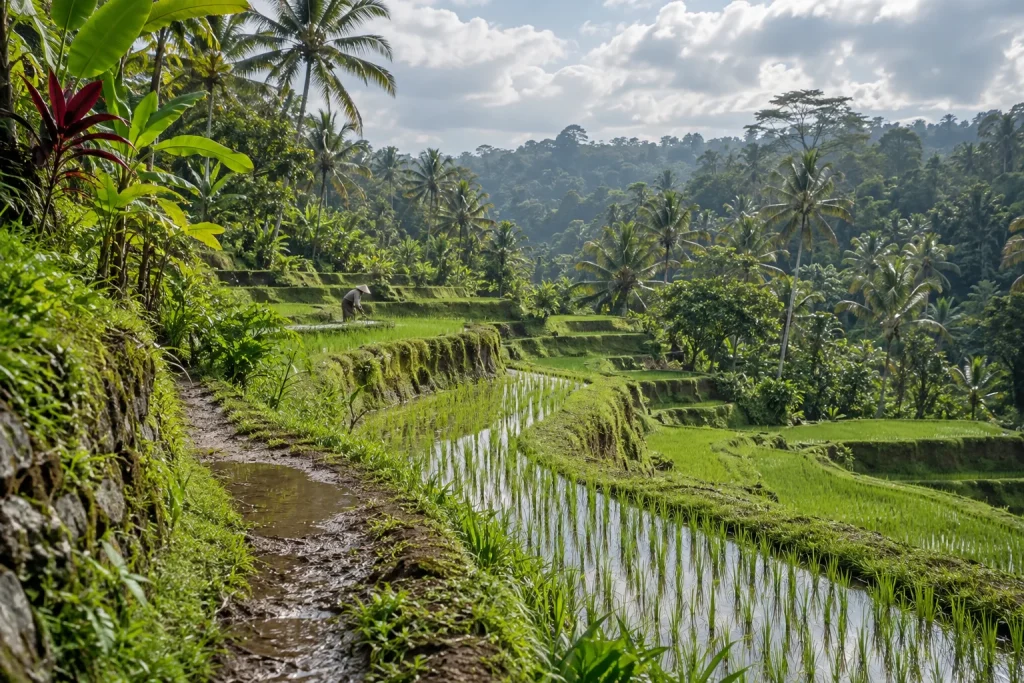
“Rice terrace” can mean a famous lookout, a marked walking route or a working field where people are tending the crop. Around Ubud, those are different visits. Tegallalang is the best-known terrace landscape north of town, while the wider region also includes rice-growing areas around Pejeng and Campuhan. A photo from one viewpoint cannot tell you what the paths, water or crops will be like on the day you arrive. When examining ubud rice terrace in the context of everyday kitchen work and guest planning in Gianyar and Ubud, separating specific ingredient names, preparation timing, and household customs prevents common misunderstandings before you shop or cook.
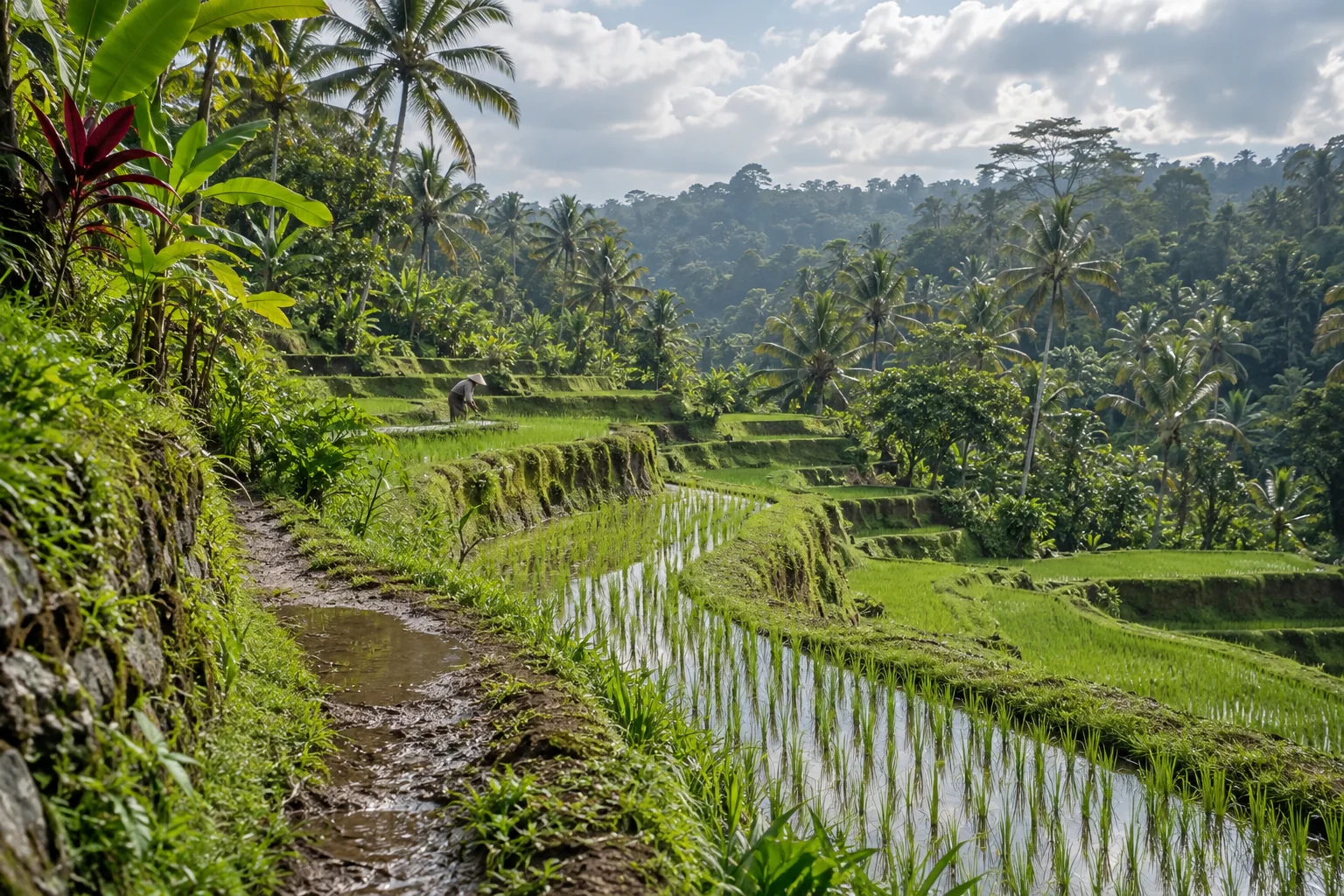
A living landscape, not a theme park
The most useful plan starts with the kind of outing you want. If a broad view is enough, allow time to stop, look and leave without descending into the fields. If you hope to walk, check where visitors are currently allowed and whether the path is suitable for your footwear and pace.
Choose the stop that fits your day
Bali’s terraces are part of a working agricultural landscape. Water is shared through local Subak arrangements, and the shape of a field reflects both the land and the people who farm it. The wider heritage story is important, but it does not turn every bund, irrigation channel or footpath into a public attraction. A path that appears on a map may cross private land or be closed while work is underway.
Bring the landscape back to the table
For a visitor, that distinction is practical. Stay on a path that is clearly open, follow local signs and instructions, and turn back if a route becomes muddy, narrow or uncertain. Do not step onto planting rows to get a better photograph.
Tegallalang suits a visit built around a recognised viewpoint and a shorter journey from Ubud. Other rice-field areas can feel more like village countryside, but access and facilities vary. Decide whether you value an easy look, a longer walk or a quiet rural setting before you choose a location. Then check current transport, opening arrangements and any local charges directly, because these details can change.
Morning or late afternoon may make walking more comfortable than the hottest part of the day. That is a comfort choice, not a promise of a particular colour or an empty path. Recent rain, irrigation and the crop stage all affect what you see. Some plots may hold water while nearby ones are green or recently harvested.
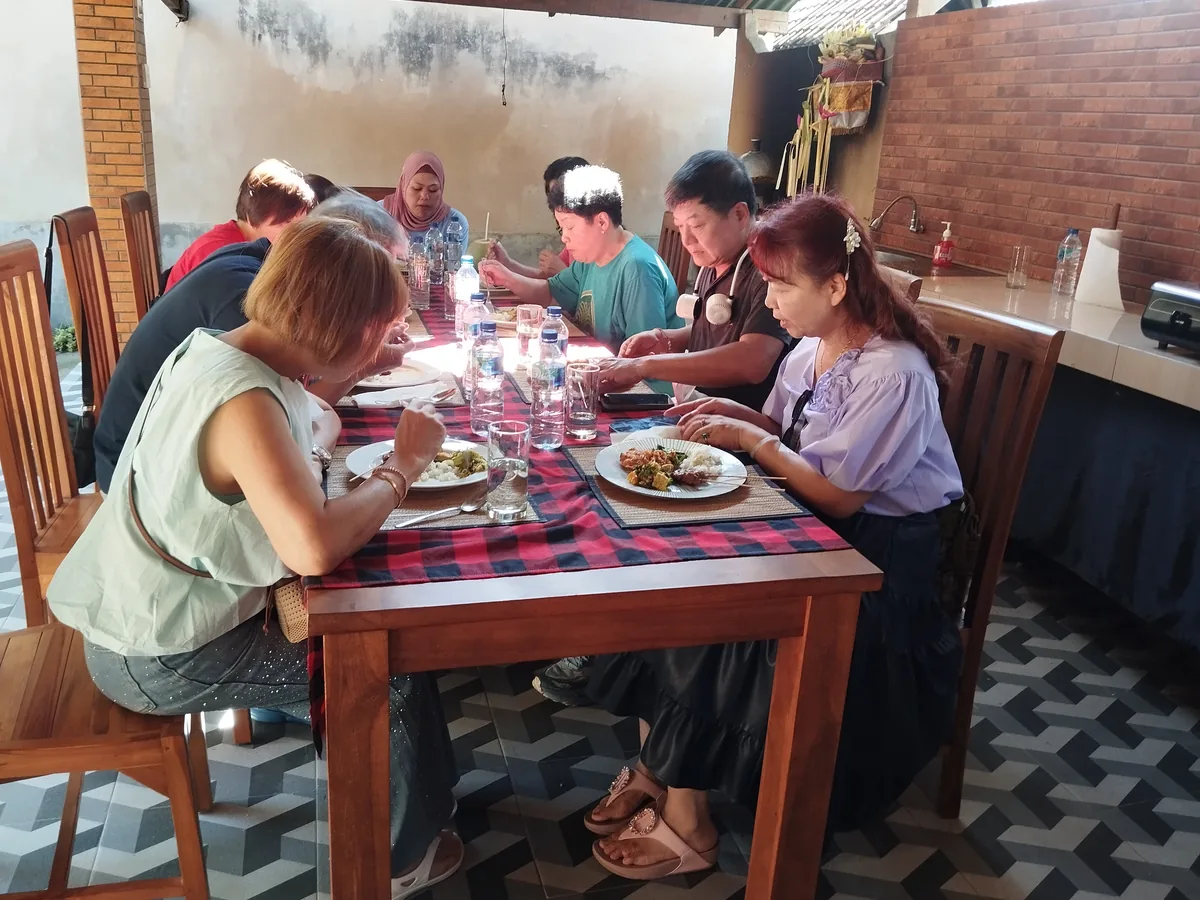
Rice is also an everyday part of Balinese meals, not just a view from a hillside. Notice how fields and food sit together, then choose an activity that genuinely explores the cooking side of Ubud. A cooking session is separate from a terrace visit, so confirm its own location and timing. For that food experience, see Cooking Class Ubud.
A good rice-terrace visit leaves the fields as you found them: no damaged crops, blocked channels or assumptions about access. The best route is the one that is open, manageable and respectful on the day, even if it is shorter than the plan you made at home.
How Ubud Rice Terraces and the Food Landscape Around Them Connects Market Observation, Kitchen Technique, and Practical Planning in Ubud
For travellers and home cooks researching ubud rice terrace, the biggest gap in general travel guides is that they treat Balinese food and daily life as a single uniform checklist rather than a living household system. In a traditional Balinese compound around Ubud, decisions about ingredients, prep sequence, and table pairing depend on whether a meal is prepared for a quiet family lunch, a morning market run, or a shared gathering. When you join an Ubud Cooking Class at Wayan’s Paon, every question around ubud rice terrace is answered through direct hands-on observation rather than abstract theory.
A second practical principle when evaluating ubud rice terrace is recognizing the boundary between what happens at the morning produce stalls, what happens at the stone mortar (ulekan), and how the final dishes are balanced on the plate. In our private sessions such as Private Paon Table, your group works only with your own booking party and selects up to five dishes from the 53-dish menu (plus the foundational Base Genep spice paste), allowing you to test how each choice affects flavour, texture, and timing.
Comparative Reference Matrix: 10 Core Dimensions of Ubud Rice Terrace
Before diving into each specialized subtopic in this family of guides, the table below summarizes how the ten focused questions around ubud rice terrace differ in scope, practical kitchen impact, and what you should verify before buying ingredients or confirming a menu in Ubud:
| Focus Topic / Keyword Owner | Specific Question Addressed | Key Practical Distinction in Ubud |
|---|---|---|
| 1. ubud to tegallalang rice terrace | Tegallalang from Ubud: How to Plan the Visit | Tegallalang sits north of Ubud and is an easy name to add to a day plan. The part that needs thought is not the map pin but the shape of the… |
| 2. rice field walk ubud | Rice Field Walks in Ubud, from Paved Paths to Muddy Lanes | A rice field walk in Ubud can start on a paved village lane and turn into a narrow earth track within a few minutes. That change is part of … |
| 3. ubud kajeng rice field walk | A Short Walk through Kajeng’s Rice Fields | Some Ubud walks move from a lane of houses to a quieter edge of rice fields without ever feeling like a formal attraction. Kajeng is often m… |
| 4. best time to visit bali rice terraces | When Is the Best Time to Visit a Bali Rice Terrace? | There is no month when every Bali rice terrace is guaranteed to look bright green. A field is part of a crop cycle, not a permanent garden d… |
| 5. tegallalang vs jatiluwih rice terraces | Tegallalang or Jatiluwih? Two Rice-Landscape Stops with Different Day Plans | When comparing Tegallalang vs Jatiluwih rice terraces, the useful question is not which view wins. It is how much of your day you want to sp… |
| 6. bali rice terrace etiquette | Rice Terrace Etiquette in Bali: Paths, Work and Photography | The easiest rule for Bali rice terrace etiquette is to remember what the view contains: somebody’s working field, water channel and village … |
| 7. ubud rice harvest seasons | How the Rice Harvest Changes What You See around Ubud | Visitors often picture a rice terrace as one continuous green surface. In practice, the fields around Ubud can show several stages at once: … |
| 8. rice fields near ubud | Rice Fields near Ubud beyond the Main Viewpoint | Tegallalang is the name many visitors recognise, but it is not the only rice-growing landscape in the Ubud region. Official travel informati… |
| 9. tegallalang rice terrace with kids | Tegallalang Rice Terraces with Children: Footpaths, Heat and Breaks | A Tegallalang rice terrace visit with kids can be enjoyable when the plan matches the child’s age, energy and comfort with uneven paths. The… |
| 10. ubud rice field walk cooking class | A Rice-Field Walk before or after a Ubud Cooking Class | A rice-field walk and a cooking class can both fit into a day in Ubud, but they are separate activities. A class does not automatically incl… |
Deep-Dive Guide to the 10 Specialized Subtopics Within Ubud Rice Terrace
Each of the ten companion articles in this topic family isolates one specific decision or ingredient question related to ubud rice terrace so that you never confuse a broad category label with a concrete culinary rule. Below is how each specialized guide fits into the wider picture:
1. Tegallalang from Ubud: How to Plan the Visit
When narrowing your focus from ubud rice terrace to the specific question of ubud to tegallalang rice terrace, the primary distinction is context and practical application. Tegallalang sits north of Ubud and is an easy name to add to a day plan. The part that needs thought is not the map pin but the shape of the visit: are you stopping for a view, taking a short walk, or hoping to explore for longer? That answer affects transport, footwear and how much time to leave around the rest of your day. When examining ubud to tegallalang rice terrace in the context of everyday kitchen work and guest planning in Gianyar and Ubud, separating specific ingredient names, preparation timing, and household customs prevents common misunderstandings before you shop or cook. By keeping this specific scope distinct from neighbouring topics, you avoid applying a general rule where a precise ingredient check or timing adjustment is required.
In practice at the market or in the paon, Traffic and road conditions around Ubud change through the day, so avoid building a tight itinerary around a drive-time estimate copied from an old page. A private driver is convenient if you want to combine stops or avoid navigating. A scooter gives you more flexibility, but only makes sense if the rider is experienced, licensed and comfortable with Bali traffic. Ask your accommodation or driver about the current approach and where it is sensible to be dropped off. Whether you are comparing options before booking your private session or taking notes to cook at home after your trip, treating ubud to tegallalang rice terrace as its own step ensures your preparation remains accurate and stress-free.
2. Rice Field Walks in Ubud, from Paved Paths to Muddy Lanes
When narrowing your focus from ubud rice terrace to the specific question of rice field walk ubud, the primary distinction is context and practical application. A rice field walk in Ubud can start on a paved village lane and turn into a narrow earth track within a few minutes. That change is part of the appeal, but it also means you should treat the walk as countryside rather than a landscaped promenade. Surfaces, shade and access differ from one path to the next. By keeping this specific scope distinct from neighbouring topics, you avoid applying a general rule where a precise ingredient check or timing adjustment is required.
In practice at the market or in the paon, Ask someone local where the public path begins and whether it is open today. A map can show a line through fields without explaining whether it is a right of way, a farm access track or a route that becomes impassable after rain. If a lane runs beside a home or temple, keep voices low and follow any signs or requests. Whether you are comparing options before booking your private session or taking notes to cook at home after your trip, treating rice field walk ubud as its own step ensures your preparation remains accurate and stress-free.
3. A Short Walk through Kajeng’s Rice Fields
When narrowing your focus from ubud rice terrace to the specific question of ubud kajeng rice field walk, the primary distinction is context and practical application. Some Ubud walks move from a lane of houses to a quieter edge of rice fields without ever feeling like a formal attraction. Kajeng is often mentioned in that kind of plan. The sensible approach is to think of it as a village walk whose exact access can vary, rather than a fixed trail with a guaranteed entrance and route. By keeping this specific scope distinct from neighbouring topics, you avoid applying a general rule where a precise ingredient check or timing adjustment is required.
In practice at the market or in the paon, Before setting off, ask your host or a local guide where the public lane currently leads and whether visitors should avoid any section. Paths near homes and working fields can change with repairs, farming or local activity. A route shown in a social-media post may not be current, and a narrow opening between walls is not automatically a public way through. Whether you are comparing options before booking your private session or taking notes to cook at home after your trip, treating ubud kajeng rice field walk as its own step ensures your preparation remains accurate and stress-free.
4. When Is the Best Time to Visit a Bali Rice Terrace?
When narrowing your focus from ubud rice terrace to the specific question of best time to visit bali rice terraces, the primary distinction is context and practical application. There is no month when every Bali rice terrace is guaranteed to look bright green. A field is part of a crop cycle, not a permanent garden display. One plot may be newly planted or holding water while the next is taller, golden or recently cut. If colour is the reason for your visit, leave room for the possibility that the landscape will look different from a photograph. By keeping this specific scope distinct from neighbouring topics, you avoid applying a general rule where a precise ingredient check or timing adjustment is required.
In practice at the market or in the paon, For walking, early morning or later afternoon is often more comfortable than the hottest hours. There is usually softer light for photos and less direct sun on exposed paths. This is a comfort and light choice, not a promise of fewer visitors or a specific view. Cloud, rain and humidity can change quickly. Whether you are comparing options before booking your private session or taking notes to cook at home after your trip, treating best time to visit bali rice terraces as its own step ensures your preparation remains accurate and stress-free.
5. Tegallalang or Jatiluwih? Two Rice-Landscape Stops with Different Day Plans
When narrowing your focus from ubud rice terrace to the specific question of tegallalang vs jatiluwih rice terraces, the primary distinction is context and practical application. When comparing Tegallalang vs Jatiluwih rice terraces, the useful question is not which view wins. It is how much of your day you want to spend getting there and what sort of landscape you hope to see. Tegallalang is north of Ubud and is known for a compact, dramatic valley view. Jatiluwih lies in Tabanan and opens into a much broader highland landscape. By keeping this specific scope distinct from neighbouring topics, you avoid applying a general rule where a precise ingredient check or timing adjustment is required.
In practice at the market or in the paon, From Ubud, Tegallalang is usually the simpler choice if you want a recognised terrace lookout without giving the whole day to the journey. You can keep the visit brief from the upper view or explore further if current access and path conditions allow. Traffic, parking and site arrangements still change, so check them rather than relying on a fixed drive-time promise. Whether you are comparing options before booking your private session or taking notes to cook at home after your trip, treating tegallalang vs jatiluwih rice terraces as its own step ensures your preparation remains accurate and stress-free.
6. Rice Terrace Etiquette in Bali: Paths, Work and Photography
When narrowing your focus from ubud rice terrace to the specific question of bali rice terrace etiquette, the primary distinction is context and practical application. The easiest rule for Bali rice terrace etiquette is to remember what the view contains: somebody’s working field, water channel and village landscape. A dramatic photograph does not make a crop, bund or irrigation path a public prop. Visitors can enjoy the terraces and still leave room for the people who maintain them. By keeping this specific scope distinct from neighbouring topics, you avoid applying a general rule where a precise ingredient check or timing adjustment is required.
In practice at the market or in the paon, Use marked or clearly permitted paths and follow local instructions. Do not cross a planted plot, climb a fragile bank or step over a water channel unless the route is explicitly open. If a path ends at a gate, house or sign asking visitors to stop, turn back. A map line or a gap in a wall is not permission. Whether you are comparing options before booking your private session or taking notes to cook at home after your trip, treating bali rice terrace etiquette as its own step ensures your preparation remains accurate and stress-free.
7. How the Rice Harvest Changes What You See around Ubud
When narrowing your focus from ubud rice terrace to the specific question of ubud rice harvest seasons, the primary distinction is context and practical application. Visitors often picture a rice terrace as one continuous green surface. In practice, the fields around Ubud can show several stages at once: water reflecting the sky, young plants in neat rows, mature rice turning yellow, or a plot cut back after harvest. The differences are part of a working landscape, not a sign that you arrived in the wrong month. By keeping this specific scope distinct from neighbouring topics, you avoid applying a general rule where a precise ingredient check or timing adjustment is required.
In practice at the market or in the paon, Ubud rice harvest seasons are shaped by local planting and water schedules, which vary between fields and communities. Bali’s Subak system coordinates shared water, but that does not make every plot follow one visible calendar. A regional forecast or general travel article cannot tell you whether a particular terrace will be newly planted or ready for harvest on your travel dates. Whether you are comparing options before booking your private session or taking notes to cook at home after your trip, treating ubud rice harvest seasons as its own step ensures your preparation remains accurate and stress-free.
8. Rice Fields near Ubud beyond the Main Viewpoint
When narrowing your focus from ubud rice terrace to the specific question of rice fields near ubud, the primary distinction is context and practical application. Tegallalang is the name many visitors recognise, but it is not the only rice-growing landscape in the Ubud region. Official travel information also names the terraced areas around Pejeng and Campuhan. Those names help explain how broad the landscape is; they are not a guarantee that every lane or field edge is a visitor route. By keeping this specific scope distinct from neighbouring topics, you avoid applying a general rule where a precise ingredient check or timing adjustment is required.
In practice at the market or in the paon, Rice fields near Ubud can appear beside village roads, tucked behind homes or spread across a valley. Some places are easy to admire from a public road; others sit beyond a working path where visitors should not wander. Before choosing a stop, decide whether you want a clear viewpoint or a short walk and ask locally which option is open. Whether you are comparing options before booking your private session or taking notes to cook at home after your trip, treating rice fields near ubud as its own step ensures your preparation remains accurate and stress-free.
9. Tegallalang Rice Terraces with Children: Footpaths, Heat and Breaks
When narrowing your focus from ubud rice terrace to the specific question of tegallalang rice terrace with kids, the primary distinction is context and practical application. A Tegallalang rice terrace visit with kids can be enjoyable when the plan matches the child’s age, energy and comfort with uneven paths. The upper viewpoint may be enough for one family; another may want a short walk. Do not assume that every route has rails, shade, toilets or a surface suitable for a stroller. By keeping this specific scope distinct from neighbouring topics, you avoid applying a general rule where a precise ingredient check or timing adjustment is required.
In practice at the market or in the paon, Look at the route from the top before deciding whether to descend. Terrace paths can include steps, damp stone, exposed edges and narrow sections. Recent rain can make earth slick, while heat builds quickly on open slopes. If a child is tired, uncomfortable with heights or unsteady on steps, enjoy the view and skip the lower path. Whether you are comparing options before booking your private session or taking notes to cook at home after your trip, treating tegallalang rice terrace with kids as its own step ensures your preparation remains accurate and stress-free.
10. A Rice-Field Walk before or after a Ubud Cooking Class
When narrowing your focus from ubud rice terrace to the specific question of ubud rice field walk cooking class, the primary distinction is context and practical application. A rice-field walk and a cooking class can both fit into a day in Ubud, but they are separate activities. A class does not automatically include a terrace visit, transport or a walk through farming land. Build the schedule around the confirmed class time first, then add a short walk only if the route, weather and travel buffer make sense. By keeping this specific scope distinct from neighbouring topics, you avoid applying a general rule where a precise ingredient check or timing adjustment is required.
In practice at the market or in the paon, If you prefer to walk before cooking, choose a route whose access and return transport you can confirm. Leave enough time to get back, wash up and arrive at the class meeting point without rushing. A muddy path, unexpected traffic or a closed lane can make a short plan longer than expected. Whether you are comparing options before booking your private session or taking notes to cook at home after your trip, treating ubud rice field walk cooking class as its own step ensures your preparation remains accurate and stress-free.
How to Apply These Notes When Planning Your Private Cooking Day at Wayan’s Paon
Bringing all ten facets of ubud rice terrace together reveals a consistent lesson about Balinese culinary culture: clarity comes from asking specific questions before the cooking begins. In a private household setting in Ubud, your host does not rely on factory-made pastes or rigid group schedules. Instead, fresh roots (galangal, turmeric, ginger, and aromatic kencur), shallots, garlic, lemongrass, salam leaves, and kaffir lime are proportioned for the exact five dishes your group chooses to cook.
If you have dietary requirements—such as vegetarian or vegan preparation without fermented shrimp paste (terasi), gluten-free substitutions using pure rice flour and palm sugar (Gula Aren), dairy-free coconut milk infusions, or nut-free spice pastes omitting candlenut (kemiri)—discussing them when you select your menu allows the kitchen to prepare dedicated mortars, cutting boards, and filtered drinking-water washing stations in advance.
Finally, use this pillar overview on ubud rice terrace alongside the ten focused cluster guides linked above whenever you want to verify a local Balinese term, compare morning market timing against afternoon kitchen sessions, or adapt a traditional Ubud technique for your own stove at home.