
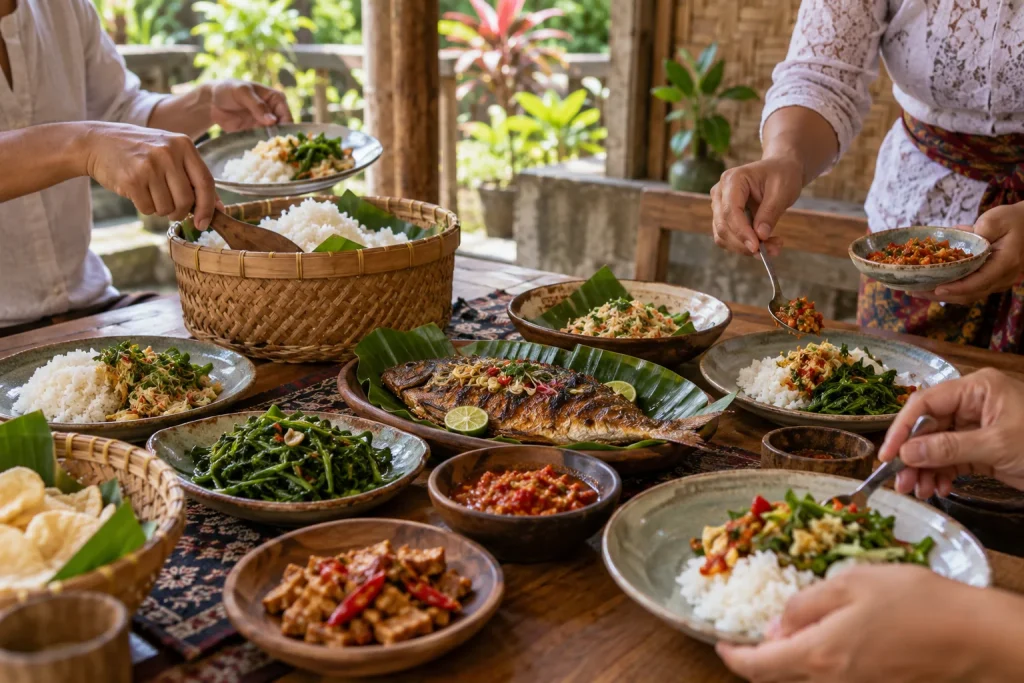

What is Balinese street food? It is easiest to answer with a few examples and a little care about the label. It can include ready-to-eat local dishes sold at markets, from a compact rice parcel to grilled satay or a plate assembled to order. The setting matters, but the dish still has its own history and ingredients. When examining what is balinese street food in the context of everyday kitchen work and guest planning in Gianyar and Ubud, separating specific ingredient names, preparation timing, and household customs prevents common misunderstandings before you shop or cook.
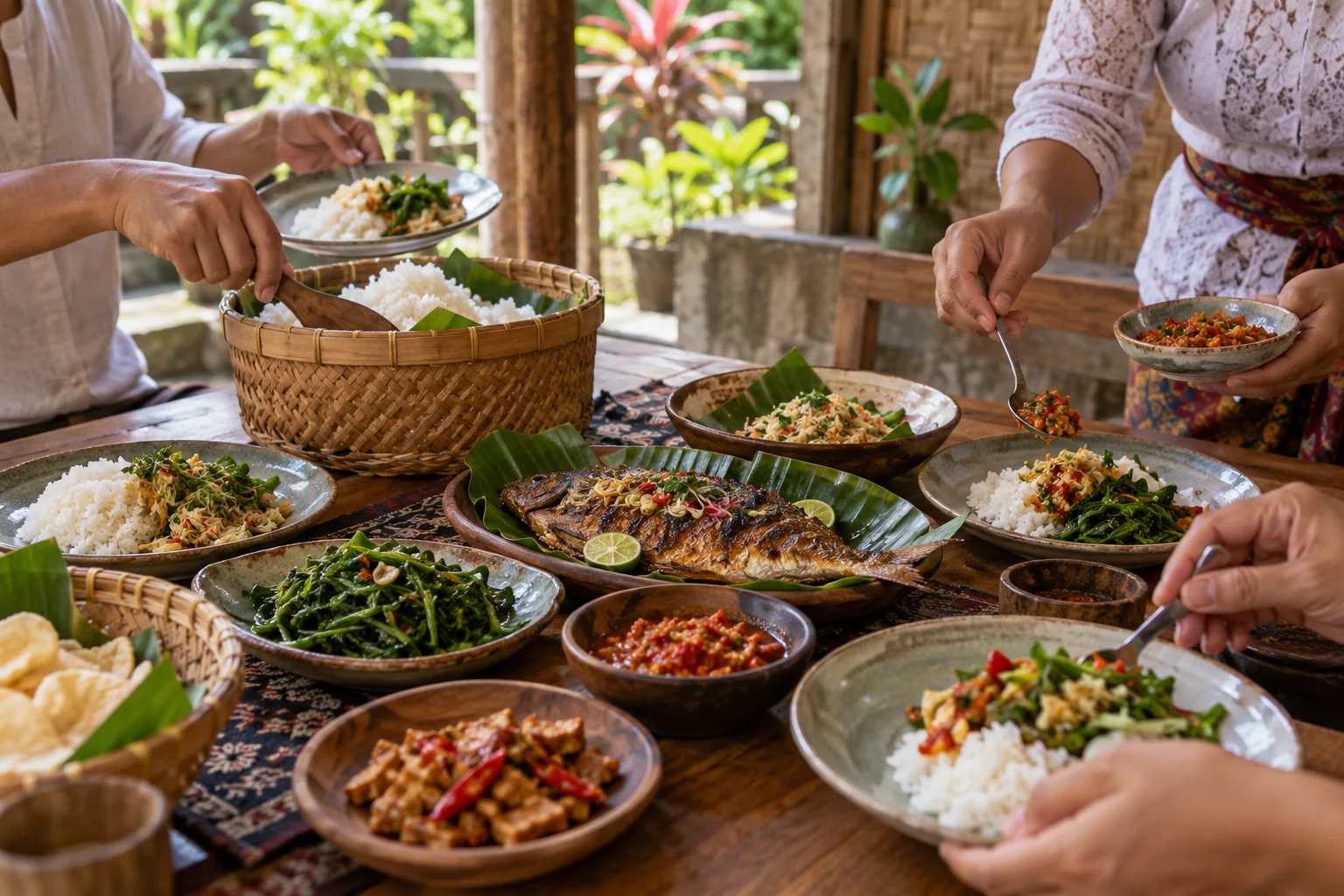
The phrase describes a way of serving
Street food is often cooked or assembled for people who want to eat without planning a full restaurant meal. In Bali, that might mean buying one wrapped portion, ordering from a counter or sharing a few bites while walking through a market. The phrase does not mean every dish is sold on a street, and it does not make all market food specifically Balinese.
Use dishes as examples, not as a complete list
Indonesia is made up of many regional cuisines. A stall in Bali may serve Balinese dishes alongside food from elsewhere in Indonesia. A clear guide names the dish and its ingredients instead of treating every plate as interchangeable.
Keep the description specific
Nasi Jinggo is known as a small rice parcel wrapped in banana leaf, with accompaniments that vary. Tipat Cantok brings rice cake and vegetables together with freshly ground peanut sauce. Sate Lilit uses seasoned minced ingredients shaped around a skewer before grilling. These foods show different formats: a portable meal, a sauced plate and a grilled bite.
Other snacks and cooked foods may be part of the same food scene, but a short list should not pretend to cover every village, seller or household version.
When you see the phrase Balinese street food on a menu or in a guide, look for a useful explanation: what is in the dish, how it is served and whether the item is a snack or a meal. If the description only says authentic or famous, ask one more question. A practical overview should help you recognise the range without turning every stall into a destination claim.
For a hands-on way to learn how local dishes are prepared, see current information for Cooking Class Ubud.
How What Counts as Balinese Street Food? Connects Market Observation, Kitchen Technique, and Practical Planning in Ubud
For travellers and home cooks researching what is balinese street food, the biggest gap in general travel guides is that they treat Balinese food and daily life as a single uniform checklist rather than a living household system. In a traditional Balinese compound around Ubud, decisions about ingredients, prep sequence, and table pairing depend on whether a meal is prepared for a quiet family lunch, a morning market run, or a shared gathering. When you join an Ubud Cooking Class at Wayan’s Paon, every question around what is balinese street food is answered through direct hands-on observation rather than abstract theory.
A second practical principle when evaluating what is balinese street food is recognizing the boundary between what happens at the morning produce stalls, what happens at the stone mortar (ulekan), and how the final dishes are balanced on the plate. In our private sessions such as Private Paon Table, your group works only with your own booking party and selects up to five dishes from the 53-dish menu (plus the foundational Base Genep spice paste), allowing you to test how each choice affects flavour, texture, and timing.
Comparative Reference Matrix: 10 Core Dimensions of What Is Balinese Street Food
Before diving into each specialized subtopic in this family of guides, the table below summarizes how the ten focused questions around what is balinese street food differ in scope, practical kitchen impact, and what you should verify before buying ingredients or confirming a menu in Ubud:
| Focus Topic / Keyword Owner | Specific Question Addressed | Key Practical Distinction in Ubud |
|---|---|---|
| 1. street food in ubud | A First Look at Street Food in Ubud | Street food in Ubud is easier to explore when you separate the food from the map. A market, a warung and a seller preparing one dish each of… |
| 2. balinese street food menu guide | How to Read a Balinese Food Stall Menu | A Balinese street food menu guide should help you ask better questions, not pretend that every handwritten board follows one translation. A … |
| 3. ubud street food practical tips | Cash, Queues and Timing at Local Food Stalls | Useful Ubud street food practical tips are mostly about timing and expectations. A market can be lively at one hour and quiet at another, an… |
| 4. trying balinese street food first time | Trying a New Dish at a Bali Market without Guesswork | Trying Balinese street food for the first time can feel easier when you begin with a dish you can describe. You do not need to order everyth… |
| 5. balinese street food vs cooking class | Street Food Guide or Cooking Class: Two Ways into Balinese Food | Balinese street food vs cooking class is a choice between two different ways of meeting local food. A street-food stop lets you sample a dis… |
| 6. balinese street food | Balinese Street Food: Small Meals, Snacks and Market Stalls | Balinese street food is not one fixed menu or one kind of stall. A small parcel of rice, a skewer cooked over coals, a plate of rice cakes w… |
| 7. nasi jinggo street food | Nasi Jinggo and the Idea of a Small Rice Parcel | Nasi Jinggo street food makes sense as a small meal built for carrying. Rice and savoury accompaniments are folded into a banana-leaf parcel… |
| 8. tipat cantok street food | Tipat Cantok: A Rice-Cake Meal with Vegetables and Peanut Sauce | Tipat Cantok street food is a satisfying example of how a few parts can make a complete plate. Sliced rice cake and vegetables are coated wi… |
| 9. sate lilit street food bali | Sate Lilit at a Street Stall and at the Family Table | Sate Lilit street food in Bali is recognised by its shape: seasoned minced ingredients are pressed around a skewer and grilled. A street-sta… |
| 10. balinese street food snacks and meals | Street Snacks or a Full Meal? What to Look For | Balinese street food snacks and meals do not always divide neatly into sweet and savoury. A small parcel of rice can be a compact meal, whil… |
Deep-Dive Guide to the 10 Specialized Subtopics Within What Is Balinese Street Food
Each of the ten companion articles in this topic family isolates one specific decision or ingredient question related to what is balinese street food so that you never confuse a broad category label with a concrete culinary rule. Below is how each specialized guide fits into the wider picture:
1. A First Look at Street Food in Ubud
When narrowing your focus from what is balinese street food to the specific question of street food in ubud, the primary distinction is context and practical application. Street food in Ubud is easier to explore when you separate the food from the map. A market, a warung and a seller preparing one dish each offer a different way to eat. Rather than treating the town as one night-market strip, begin with the dish you are curious about and check which setting is active when you plan to visit. By keeping this specific scope distinct from neighbouring topics, you avoid applying a general rule where a precise ingredient check or timing adjustment is required.
In practice at the market or in the paon, If you want a small meal to carry, look for wrapped rice parcels such as Nasi Jinggo. If you want a freshly dressed plate, Tipat Cantok is rice cake and vegetables served with peanut sauce. If grilled food appeals, ask what protein is used in the satay and whether the sambal comes on the side. These are starting points, not promises that every seller will have them. Whether you are comparing options before booking your private session or taking notes to cook at home after your trip, treating street food in ubud as its own step ensures your preparation remains accurate and stress-free.
2. How to Read a Balinese Food Stall Menu
When narrowing your focus from what is balinese street food to the specific question of balinese street food menu guide, the primary distinction is context and practical application. A Balinese street food menu guide should help you ask better questions, not pretend that every handwritten board follows one translation. A short name may identify the dish while leaving out its protein, sauce or chilli level. If a menu is brief, a polite question can be more useful than guessing from the spelling. By keeping this specific scope distinct from neighbouring topics, you avoid applying a general rule where a precise ingredient check or timing adjustment is required.
In practice at the market or in the paon, Look for the dish name, then ask what it contains if the description is unfamiliar. For satay, ask whether the protein is fish, chicken or pork. For a rice parcel, ask what sides are packed inside. For a plate with sauce, ask what the sauce is made from. The answer can vary by seller even when the dish name is the same. Whether you are comparing options before booking your private session or taking notes to cook at home after your trip, treating balinese street food menu guide as its own step ensures your preparation remains accurate and stress-free.
3. Cash, Queues and Timing at Local Food Stalls
When narrowing your focus from what is balinese street food to the specific question of ubud street food practical tips, the primary distinction is context and practical application. Useful Ubud street food practical tips are mostly about timing and expectations. A market can be lively at one hour and quiet at another, and a stall’s selection may depend on what has already sold. Treat old opening hours and prices as clues to recheck, not guarantees for the day you arrive. By keeping this specific scope distinct from neighbouring topics, you avoid applying a general rule where a precise ingredient check or timing adjustment is required.
In practice at the market or in the paon, Markets and food stalls can move, change hours or take breaks. If you are travelling across town for a specific setting, check its current location and schedule before leaving. A morning produce market and an evening food market can serve different purposes, even when a guide uses the same word for both. Whether you are comparing options before booking your private session or taking notes to cook at home after your trip, treating ubud street food practical tips as its own step ensures your preparation remains accurate and stress-free.
4. Trying a New Dish at a Bali Market without Guesswork
When narrowing your focus from what is balinese street food to the specific question of trying balinese street food first time, the primary distinction is context and practical application. Trying Balinese street food for the first time can feel easier when you begin with a dish you can describe. You do not need to order everything that looks unfamiliar. Pick one item, ask what goes into it and decide whether the portion and spice suit you. By keeping this specific scope distinct from neighbouring topics, you avoid applying a general rule where a precise ingredient check or timing adjustment is required.
In practice at the market or in the paon, A small rice parcel, a peanut-sauce plate or one grilled skewer gives you a clear first taste. If you order several unfamiliar dishes at once, it can be harder to tell which ingredients or seasoning you enjoyed. Start with one item and add another only if you are still hungry. Whether you are comparing options before booking your private session or taking notes to cook at home after your trip, treating trying balinese street food first time as its own step ensures your preparation remains accurate and stress-free.
5. Street Food Guide or Cooking Class: Two Ways into Balinese Food
When narrowing your focus from what is balinese street food to the specific question of balinese street food vs cooking class, the primary distinction is context and practical application. Balinese street food vs cooking class is a choice between two different ways of meeting local food. A street-food stop lets you sample a dish that someone has prepared. A cooking class puts you into the preparation, from handling ingredients to cooking and eating the menu. Neither replaces the other. By keeping this specific scope distinct from neighbouring topics, you avoid applying a general rule where a precise ingredient check or timing adjustment is required.
In practice at the market or in the paon, A market or small food stall can be a good fit when you have a short window and want to try a particular snack or meal. You can focus on the dish, the serving style and how its seasoning tastes. What is available depends on the seller and the time of day, so keep the plan flexible. Whether you are comparing options before booking your private session or taking notes to cook at home after your trip, treating balinese street food vs cooking class as its own step ensures your preparation remains accurate and stress-free.
6. Balinese Street Food: Small Meals, Snacks and Market Stalls
When narrowing your focus from what is balinese street food to the specific question of balinese street food, the primary distinction is context and practical application. Balinese street food is not one fixed menu or one kind of stall. A small parcel of rice, a skewer cooked over coals, a plate of rice cakes with vegetables and a sweet market snack can all belong to the same everyday food landscape. What they share is a practical way of eating: food is prepared for a quick meal, a walk through a market or a pause between errands. By keeping this specific scope distinct from neighbouring topics, you avoid applying a general rule where a precise ingredient check or timing adjustment is required.
In practice at the market or in the paon, Some foods are closely associated with Bali, while others are Indonesian dishes sold across the islands. Both may appear beside one another at a market. The word street food describes a setting and a way of serving as much as it describes a recipe, so a guide should explain what a dish is without claiming every seller makes it the same way. Whether you are comparing options before booking your private session or taking notes to cook at home after your trip, treating balinese street food as its own step ensures your preparation remains accurate and stress-free.
7. Nasi Jinggo and the Idea of a Small Rice Parcel
When narrowing your focus from what is balinese street food to the specific question of nasi jinggo street food, the primary distinction is context and practical application. Nasi Jinggo street food makes sense as a small meal built for carrying. Rice and savoury accompaniments are folded into a banana-leaf parcel, giving the dish a practical shape as well as a familiar aroma. The parcel can be modest in size, but the details inside it depend on the seller and the version being served. By keeping this specific scope distinct from neighbouring topics, you avoid applying a general rule where a precise ingredient check or timing adjustment is required.
In practice at the market or in the paon, There is no single universal filling list. Rice may be paired with a small amount of shredded or seasoned protein, sambal and other savoury sides. The balance changes from seller to seller. The leaf holds the food together for a quick meal and contributes an aroma, but the wrapper alone does not tell you everything about the ingredients. Whether you are comparing options before booking your private session or taking notes to cook at home after your trip, treating nasi jinggo street food as its own step ensures your preparation remains accurate and stress-free.
8. Tipat Cantok: A Rice-Cake Meal with Vegetables and Peanut Sauce
When narrowing your focus from what is balinese street food to the specific question of tipat cantok street food, the primary distinction is context and practical application. Tipat Cantok street food is a satisfying example of how a few parts can make a complete plate. Sliced rice cake and vegetables are coated with peanut sauce, often ground fresh for the serving. The sauce can be adjusted for heat and texture, so the same dish name may arrive a little differently from one cook to another. By keeping this specific scope distinct from neighbouring topics, you avoid applying a general rule where a precise ingredient check or timing adjustment is required.
In practice at the market or in the paon, The rice cake gives the plate its substance. Vegetables bring freshness and texture, while the peanut sauce carries salt, sweetness, acidity and chilli. The sauce is not just a garnish: it is what ties the ingredients together. A freshly ground version may feel coarser than a smooth bottled dressing. Whether you are comparing options before booking your private session or taking notes to cook at home after your trip, treating tipat cantok street food as its own step ensures your preparation remains accurate and stress-free.
9. Sate Lilit at a Street Stall and at the Family Table
When narrowing your focus from what is balinese street food to the specific question of sate lilit street food bali, the primary distinction is context and practical application. Sate Lilit street food in Bali is recognised by its shape: seasoned minced ingredients are pressed around a skewer and grilled. A street-stall serving may be eaten as a snack or alongside rice and other dishes. At a family table, the same broad style can be part of a larger meal. Neither setting guarantees one exact recipe. When examining sate lilit street food bali in the context of everyday kitchen work and guest planning in Gianyar and Ubud, separating specific ingredient names, preparation timing, and household customs prevents common misunderstandings before you shop or cook. By keeping this specific scope distinct from neighbouring topics, you avoid applying a general rule where a precise ingredient check or timing adjustment is required.
In practice at the market or in the paon, Lilit refers to the way the mixture is wrapped or pressed around its support. The mixture may use fish, chicken or pork with coconut and Balinese seasoning. Some cooks use lemongrass as a handle; others use a different skewer. The meat or fish, coconut and spice balance changes with the cook and the recipe. Whether you are comparing options before booking your private session or taking notes to cook at home after your trip, treating sate lilit street food bali as its own step ensures your preparation remains accurate and stress-free.
10. Street Snacks or a Full Meal? What to Look For
When narrowing your focus from what is balinese street food to the specific question of balinese street food snacks and meals, the primary distinction is context and practical application. Balinese street food snacks and meals do not always divide neatly into sweet and savoury. A small parcel of rice can be a compact meal, while a skewer or a piece of jaja may be a bite between stops. If you decide by portion and ingredients rather than the word snack, it is easier to choose what will satisfy you. By keeping this specific scope distinct from neighbouring topics, you avoid applying a general rule where a precise ingredient check or timing adjustment is required.
In practice at the market or in the paon, A snack can be savoury, grilled, wrapped or fried. Nasi Jinggo is small by design but includes rice and accompaniments. A satay skewer can be one bite within a larger meal or a quick stop by itself. Sweet market cakes are another category, often made with rice or coconut, but they are only part of the snack picture. Whether you are comparing options before booking your private session or taking notes to cook at home after your trip, treating balinese street food snacks and meals as its own step ensures your preparation remains accurate and stress-free.
How to Apply These Notes When Planning Your Private Cooking Day at Wayan’s Paon
Bringing all ten facets of what is balinese street food together reveals a consistent lesson about Balinese culinary culture: clarity comes from asking specific questions before the cooking begins. In a private household setting in Ubud, your host does not rely on factory-made pastes or rigid group schedules. Instead, fresh roots (galangal, turmeric, ginger, and aromatic kencur), shallots, garlic, lemongrass, salam leaves, and kaffir lime are proportioned for the exact five dishes your group chooses to cook.
If you have dietary requirements—such as vegetarian or vegan preparation without fermented shrimp paste (terasi), gluten-free substitutions using pure rice flour and palm sugar (Gula Aren), dairy-free coconut milk infusions, or nut-free spice pastes omitting candlenut (kemiri)—discussing them when you select your menu allows the kitchen to prepare dedicated mortars, cutting boards, and filtered drinking-water washing stations in advance.
Finally, use this pillar overview on what is balinese street food alongside the ten focused cluster guides linked above whenever you want to verify a local Balinese term, compare morning market timing against afternoon kitchen sessions, or adapt a traditional Ubud technique for your own stove at home.