
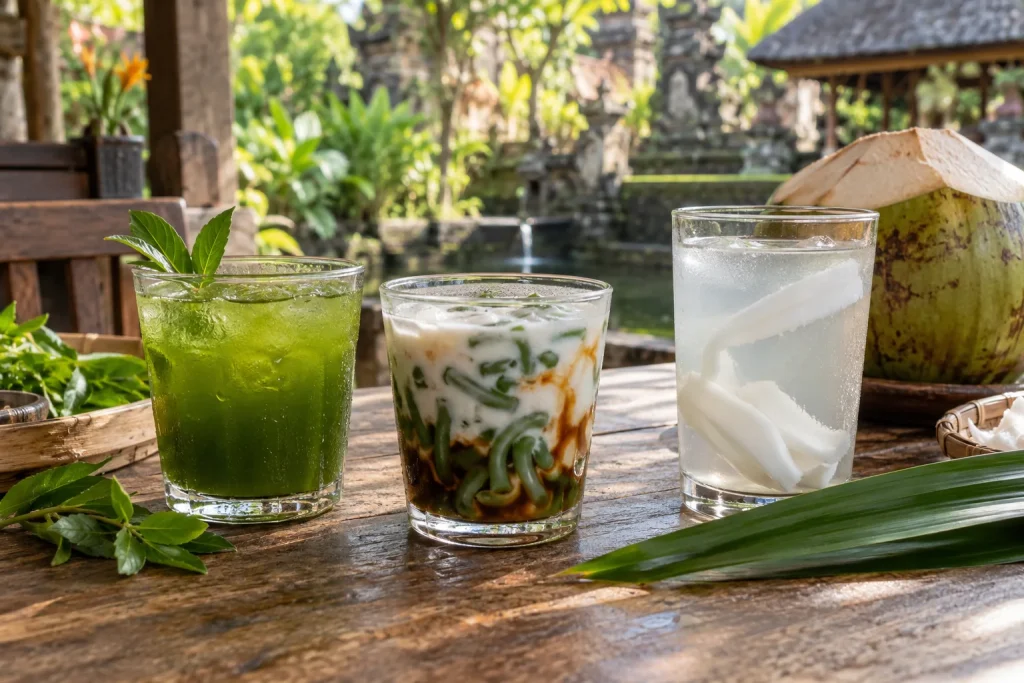

Balinese drinks move between herbal, tart, sweet and icy. A village-made loloh, a glass of Es Daluman and a freshly opened coconut can all belong to the same food conversation, even though they use different ingredients and serve different moments. There is no single island-wide drinks menu: recipes and names shift between households, villages and stalls. When examining balinese drinks in the context of everyday kitchen work and guest planning in Gianyar and Ubud, separating specific ingredient names, preparation timing, and household customs prevents common misunderstandings before you shop or cook.
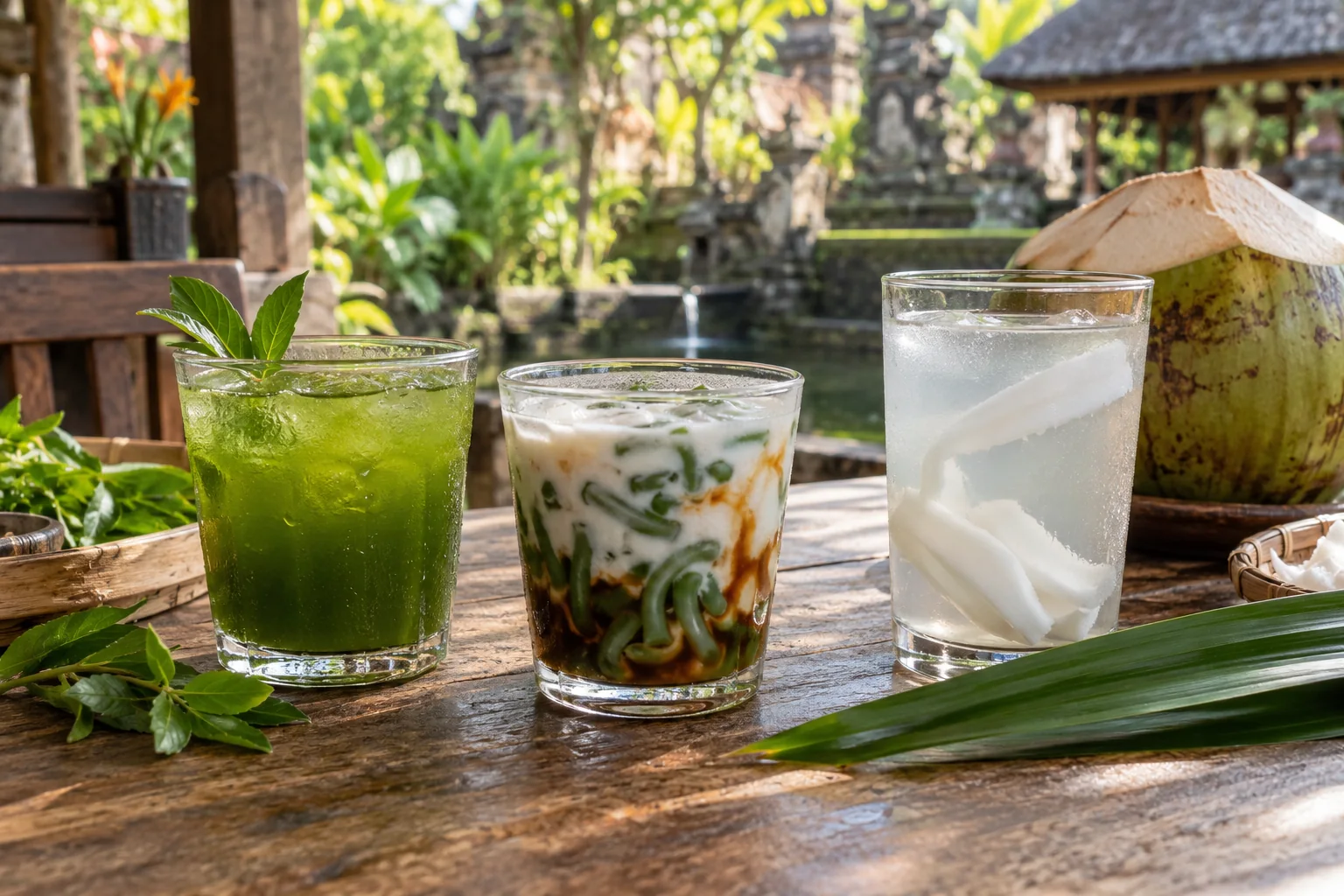
Start with loloh and jamu
Jamu is a broad Indonesian term for traditional herbal preparations. In Bali, many local herbal drinks are called loloh. The two words are often used loosely by visitors, but neither describes one standard recipe. A 2015 ethnobotanical study documented dozens of plants used in different Balinese loloh preparations; some are juiced, some simmered, and others added in simpler ways. The practical point for a traveller is to ask what is in the glass and how that particular maker prepares it.
Look for cold drinks built around texture
Loloh Cemcem is one well-known example associated with Penglipuran in Bangli. Its green colour and sour-sweet profile make it easy to recognise, while the details vary from producer to producer. Loloh kunyit is another local turmeric drink; one documented version from Pejeng combines fresh turmeric with tamarind and other seasonings. These drinks are enjoyed for their flavour and tradition. This guide does not treat them as medical remedies.
Choose by the meal and the moment
Es Daluman is made with soft green leaf jelly, usually served with coconut milk, palm-sugar syrup and ice. The jelly gives it a spoonable, dessert-like quality. Es Kuwut is lighter and more citrusy: young coconut water is often combined with lime, and some versions include melon or basil seeds. Es Tambring also pairs coconut with tamarind and sweetener, although recipes may differ. Ask before ordering if you have an allergy or need to avoid a particular ingredient.
Explore the individual drink guides
Fresh coconut water is the simplest option. In north Bali, Rujak Yeh Kuwud is a more specific household drink from the Suwug area: coconut water with galangal and salt, traditionally connected with preparing lawar nyuh. It is not the same as a generic coconut drink sold at every beach stall, and it may be made for a community cooking occasion rather than offered on a menu.
Read the individual guides
With a spicy or richly seasoned meal, a plain coconut drink or a lightly tart option can offer a clean contrast. After lunch, Es Daluman may feel more like dessert. There is no fixed pairing rule; sweetness, acidity, ice and texture are personal choices. If a drink is unfamiliar, ask whether it is herbal, milky, very sweet or made fresh before choosing.
Balinese drinks also include alcoholic traditions such as arak, tuak and brem. They are different from the non-alcoholic drinks covered in most of this series, and each has its own production and serving context. Check the drink name and ingredients instead of assuming that every local beverage is a soft drink.
Use the links below for a closer look at one drink, ingredient or serving question. Together they cover the broader phrase balinese drinks without turning each recipe variation into a separate, interchangeable page.
A cooking lesson can make local ingredients easier to recognise at the table. See the current details for our Cooking Class Ubud experience before booking.
How Balinese Drinks to Try, from Loloh to Coconut Water Connects Market Observation, Kitchen Technique, and Practical Planning in Ubud
For travellers and home cooks researching balinese drinks, the biggest gap in general travel guides is that they treat Balinese food and daily life as a single uniform checklist rather than a living household system. In a traditional Balinese compound around Ubud, decisions about ingredients, prep sequence, and table pairing depend on whether a meal is prepared for a quiet family lunch, a morning market run, or a shared gathering. When you join an Ubud Cooking Class at Wayan’s Paon, every question around balinese drinks is answered through direct hands-on observation rather than abstract theory.
A second practical principle when evaluating balinese drinks is recognizing the boundary between what happens at the morning produce stalls, what happens at the stone mortar (ulekan), and how the final dishes are balanced on the plate. In our private sessions such as Private Paon Table, your group works only with your own booking party and selects up to five dishes from the 53-dish menu (plus the foundational Base Genep spice paste), allowing you to test how each choice affects flavour, texture, and timing.
Comparative Reference Matrix: 10 Core Dimensions of Balinese Drinks
Before diving into each specialized subtopic in this family of guides, the table below summarizes how the ten focused questions around balinese drinks differ in scope, practical kitchen impact, and what you should verify before buying ingredients or confirming a menu in Ubud:
| Focus Topic / Keyword Owner | Specific Question Addressed | Key Practical Distinction in Ubud |
|---|---|---|
| 1. jamu bali | Jamu Bali: What’s in the Glass, and How Is It Served? | The phrase jamu Bali can mean different things depending on who is using it. Jamu is a familiar Indonesian name for traditional herbal drink… |
| 2. rujak tibah | Rujak Tibah: Bali’s Tangy Noni and Lime Drink | Rujak Tibah is a local Balinese drink made from the juice of tibah, the name used in Bali for noni fruit, combined with rujak-style seasonin… |
| 3. loloh cemcem vs loloh kunyit | Loloh Cemcem vs Loloh Kunyit: Two Different Bali Drinks | Loloh Cemcem vs Loloh Kunyit is a useful comparison when you want to try a Balinese herbal drink but would like to know what each glass may … |
| 4. es daluman vs es kuwut | Es Daluman vs Es Kuwut: Which Bali Drink Fits Your Taste? | Es Daluman vs Es Kuwut is a choice between two very different cold drinks. Es Daluman is soft, creamy and spoonable because green leaf jelly… |
| 5. es kuwut | Es Kuwut Bali: Coconut, Melon and a Little Lime | Es Kuwut is a bright, cold drink often associated with Bali. Young coconut gives it a clean base, while lime adds acidity. Many versions inc… |
| 6. es tambring | What Makes Es Tambring So Distinctively Tart? | Es Tambring pairs young coconut with tamarind for a drink that lands between sweet and tart. Coconut water keeps it light; tender flesh give… |
| 7. rujak yeh kuwud | Rujak Yeh Kuwud: A Savoury Coconut Drink from Buleleng | Rujak Yeh Kuwud is a coconut-water drink associated with Suwug village in Sawan, Buleleng. It is more specific than ordering an ordinary you… |
| 8. loloh kunyit | Loloh Kunyit: A Golden Balinese Drink with Tamarind | Loloh kunyit is a Balinese herbal drink centred on fresh turmeric. Its colour is vivid, but the flavour is more than earthy: tamarind can ad… |
| 9. coconut water in Bali | Coconut Water in Bali: What to Ask Before You Choose | Ordering coconut water in Bali is simple, but the coconut itself makes a difference. A young coconut tends to have tender flesh and a light,… |
| 10. drinks with balinese food | Drinks with Balinese Food: Pairing by Sweetness, Spice and Texture | The best drinks with Balinese food depend on the meal and on what you enjoy. A richly seasoned plate can work well with something plain and … |
Deep-Dive Guide to the 10 Specialized Subtopics Within Balinese Drinks
Each of the ten companion articles in this topic family isolates one specific decision or ingredient question related to balinese drinks so that you never confuse a broad category label with a concrete culinary rule. Below is how each specialized guide fits into the wider picture:
1. Jamu Bali: What’s in the Glass, and How Is It Served?
When narrowing your focus from balinese drinks to the specific question of jamu bali, the primary distinction is context and practical application. The phrase jamu Bali can mean different things depending on who is using it. Jamu is a familiar Indonesian name for traditional herbal drinks, while many Balinese makers call their local preparations loloh. A visitor may hear both words for a green, golden or brown drink, but the label alone will not tell you the recipe. By keeping this specific scope distinct from neighbouring topics, you avoid applying a general rule where a precise ingredient check or timing adjustment is required.
In practice at the market or in the paon, Across Indonesia, jamu is made in many ways and from many plants. Bali has its own ingredients and local practices, but it is more accurate to ask about the particular drink than to assume every glass follows one island-wide formula. A drink sold as jamu might be based on turmeric, ginger, tamarind or other herbs; a local loloh can use leaves and seasonings that are not part of a familiar Java-style recipe. Whether you are comparing options before booking your private session or taking notes to cook at home after your trip, treating jamu bali as its own step ensures your preparation remains accurate and stress-free.
2. Rujak Tibah: Bali’s Tangy Noni and Lime Drink
When narrowing your focus from balinese drinks to the specific question of rujak tibah, the primary distinction is context and practical application. Rujak Tibah is a local Balinese drink made from the juice of tibah, the name used in Bali for noni fruit, combined with rujak-style seasonings. It is associated with Tabanan, including Desa Tista and Perean, and has a sharper, more distinctive fruit aroma than a plain juice. Lime and palm sugar help create a sour-sweet balance. By keeping this specific scope distinct from neighbouring topics, you avoid applying a general rule where a precise ingredient check or timing adjustment is required.
In practice at the market or in the paon, Tibah, also known as mengkudu or noni, is the central ingredient. The drink is not simply noni juice poured over ice: traditional seasonings give it a more layered taste. One documented local preparation combines the fruit juice with palm sugar, salt and lime. That is a useful example, not a universal formula; a household or market seller may use a different balance. Whether you are comparing options before booking your private session or taking notes to cook at home after your trip, treating rujak tibah as its own step ensures your preparation remains accurate and stress-free.
3. Loloh Cemcem vs Loloh Kunyit: Two Different Bali Drinks
When narrowing your focus from balinese drinks to the specific question of loloh cemcem vs loloh kunyit, the primary distinction is context and practical application. Loloh Cemcem vs Loloh Kunyit is a useful comparison when you want to try a Balinese herbal drink but would like to know what each glass may taste like. Both are called loloh, yet they start with different plants and can look very different: one is associated with cemcem leaves and Penglipuran, while the other puts fresh turmeric, tamarind and seasoning in the foreground. By keeping this specific scope distinct from neighbouring topics, you avoid applying a general rule where a precise ingredient check or timing adjustment is required.
In practice at the market or in the paon, Loloh Cemcem is associated with Penglipuran in Bangli and is often described as a green, tangy drink made with cemcem leaves. Local recipes can include tamarind, palm sugar, salt, chilli and other ingredients; no single list covers every producer. The green colour and leaf-based flavour are useful first cues, but one bottle may be sweeter, sharper or spicier than another maker’s version. Whether you are comparing options before booking your private session or taking notes to cook at home after your trip, treating loloh cemcem vs loloh kunyit as its own step ensures your preparation remains accurate and stress-free.
4. Es Daluman vs Es Kuwut: Which Bali Drink Fits Your Taste?
When narrowing your focus from balinese drinks to the specific question of es daluman vs es kuwut, the primary distinction is context and practical application. Es Daluman vs Es Kuwut is a choice between two very different cold drinks. Es Daluman is soft, creamy and spoonable because green leaf jelly is served with coconut milk and palm-sugar syrup. Es Kuwut is usually lighter: young coconut water, lime and tender coconut flesh may be joined by melon or basil seeds. A menu can call both refreshing, but the texture is what sets them apart. By keeping this specific scope distinct from neighbouring topics, you avoid applying a general rule where a precise ingredient check or timing adjustment is required.
In practice at the market or in the paon, Daluman jelly is commonly made from green leaves, worked with water and strained so it can set into a delicate gel. In the glass, the pieces are paired with coconut milk, palm-sugar syrup and ice. The result is richer than clear juice and can feel closer to a light dessert. Ask whether the jelly was prepared from leaves or bought ready-made, and whether pandan or other flavourings have been added. Whether you are comparing options before booking your private session or taking notes to cook at home after your trip, treating es daluman vs es kuwut as its own step ensures your preparation remains accurate and stress-free.
5. Es Kuwut Bali: Coconut, Melon and a Little Lime
When narrowing your focus from balinese drinks to the specific question of es kuwut, the primary distinction is context and practical application. Es Kuwut is a bright, cold drink often associated with Bali. Young coconut gives it a clean base, while lime adds acidity. Many versions include melon and basil seeds, though the mix is not fixed. On a hot afternoon it is easy to see the appeal: the glass is light, fragrant and full of different textures. By keeping this specific scope distinct from neighbouring topics, you avoid applying a general rule where a precise ingredient check or timing adjustment is required.
In practice at the market or in the paon, A simple version begins with coconut water and tender coconut flesh. Lime or another citrus brings a sharper note. Melon shavings add a mild sweetness, and basil seeds provide small, soft beads through the glass. Some sellers use a different fruit, syrup or amount of ice. The drink can therefore taste crisp and tart at one stall, sweeter and more fruit-forward at another. Whether you are comparing options before booking your private session or taking notes to cook at home after your trip, treating es kuwut as its own step ensures your preparation remains accurate and stress-free.
6. What Makes Es Tambring So Distinctively Tart?
When narrowing your focus from balinese drinks to the specific question of es tambring, the primary distinction is context and practical application. Es Tambring pairs young coconut with tamarind for a drink that lands between sweet and tart. Coconut water keeps it light; tender flesh gives it a little chew; and a tamarind syrup brings a deeper sourness than lime. Sugar balances the edge, while ice makes it a refreshing choice in warm weather. By keeping this specific scope distinct from neighbouring topics, you avoid applying a general rule where a precise ingredient check or timing adjustment is required.
In practice at the market or in the paon, Most descriptions of Es Tambring start with young coconut water and flesh, tamarind and a sweetener. Some recipes cook tamarind with sugar and pandan to make a syrup. Others differ in how they handle the souring ingredient or how sweet the finished glass should be. A few published versions include cooked egg white, while many omit it. Ask the seller about ingredients if you have an allergy or dietary restriction. Whether you are comparing options before booking your private session or taking notes to cook at home after your trip, treating es tambring as its own step ensures your preparation remains accurate and stress-free.
7. Rujak Yeh Kuwud: A Savoury Coconut Drink from Buleleng
When narrowing your focus from balinese drinks to the specific question of rujak yeh kuwud, the primary distinction is context and practical application. Rujak Yeh Kuwud is a coconut-water drink associated with Suwug village in Sawan, Buleleng. It is more specific than ordering an ordinary young coconut: the water is seasoned with galangal and salt, creating a flavour that can be sweet, savoury and faintly sharp at once. Local descriptions also note that a slightly mature coconut may be used. By keeping this specific scope distinct from neighbouring topics, you avoid applying a general rule where a precise ingredient check or timing adjustment is required.
In practice at the market or in the paon, The drink is linked with preparing lawar nyuh, a coconut-based Balinese dish. Coconut water left from the cooking can be seasoned and served rather than discarded. That makes Rujak Yeh Kuwud a useful example of how a local kitchen uses more of an ingredient and how a drink can belong to a particular meal occasion. Whether you are comparing options before booking your private session or taking notes to cook at home after your trip, treating rujak yeh kuwud as its own step ensures your preparation remains accurate and stress-free.
8. Loloh Kunyit: A Golden Balinese Drink with Tamarind
When narrowing your focus from balinese drinks to the specific question of loloh kunyit, the primary distinction is context and practical application. Loloh kunyit is a Balinese herbal drink centred on fresh turmeric. Its colour is vivid, but the flavour is more than earthy: tamarind can add a sour note, sweetener can round it out, and each maker may season it differently. It is one of several loloh recorded in Bali, not a single recipe followed across the island. By keeping this specific scope distinct from neighbouring topics, you avoid applying a general rule where a precise ingredient check or timing adjustment is required.
In practice at the market or in the paon, A study of a local producer in Pejeng, Gianyar, describes a version made with freshly harvested turmeric, betel leaf, tamarind, palm sugar and salt. The recorded preparation also includes chilli and a small amount of roasted shrimp paste. That last ingredient is easy to miss if someone assumes every turmeric drink is plant-only, so ask before tasting if you are vegetarian, vegan or avoiding seafood. Whether you are comparing options before booking your private session or taking notes to cook at home after your trip, treating loloh kunyit as its own step ensures your preparation remains accurate and stress-free.
9. Coconut Water in Bali: What to Ask Before You Choose
When narrowing your focus from balinese drinks to the specific question of coconut water in Bali, the primary distinction is context and practical application. Ordering coconut water in Bali is simple, but the coconut itself makes a difference. A young coconut tends to have tender flesh and a light, fresh-tasting liquid; a more mature one may have firmer flesh and a different sweetness. Sellers know what is ready, so the most useful question is often whether the fruit is young, half-mature or better for eating than drinking. When examining coconut water in Bali in the context of everyday kitchen work and guest planning in Gianyar and Ubud, separating specific ingredient names, preparation timing, and household customs prevents common misunderstandings before you shop or cook. By keeping this specific scope distinct from neighbouring topics, you avoid applying a general rule where a precise ingredient check or timing adjustment is required.
In practice at the market or in the paon, At a stall, you can ask the seller to open the coconut when you order. That lets you see the fruit and drink it soon after opening. Check that the shell looks sound and that the serving glass or straw is clean. If coconut is already poured into a container, ask how it has been stored and when it was prepared. Whether you are comparing options before booking your private session or taking notes to cook at home after your trip, treating coconut water in Bali as its own step ensures your preparation remains accurate and stress-free.
10. Drinks with Balinese Food: Pairing by Sweetness, Spice and Texture
When narrowing your focus from balinese drinks to the specific question of drinks with balinese food, the primary distinction is context and practical application. The best drinks with Balinese food depend on the meal and on what you enjoy. A richly seasoned plate can work well with something plain and clean, while a tart or lightly sweet drink can add contrast. There is no mandatory pairing list, but thinking about acidity, sweetness and texture makes the choice easier. By keeping this specific scope distinct from neighbouring topics, you avoid applying a general rule where a precise ingredient check or timing adjustment is required.
In practice at the market or in the paon, If the meal already has several strong flavours, start with water or fresh coconut water. Both leave room for the food and can be sipped between bites. Coconut water has its own gentle sweetness, so ask for it without syrup if you prefer a more neutral drink. Whether you are comparing options before booking your private session or taking notes to cook at home after your trip, treating drinks with balinese food as its own step ensures your preparation remains accurate and stress-free.
How to Apply These Notes When Planning Your Private Cooking Day at Wayan’s Paon
Bringing all ten facets of balinese drinks together reveals a consistent lesson about Balinese culinary culture: clarity comes from asking specific questions before the cooking begins. In a private household setting in Ubud, your host does not rely on factory-made pastes or rigid group schedules. Instead, fresh roots (galangal, turmeric, ginger, and aromatic kencur), shallots, garlic, lemongrass, salam leaves, and kaffir lime are proportioned for the exact five dishes your group chooses to cook.
If you have dietary requirements—such as vegetarian or vegan preparation without fermented shrimp paste (terasi), gluten-free substitutions using pure rice flour and palm sugar (Gula Aren), dairy-free coconut milk infusions, or nut-free spice pastes omitting candlenut (kemiri)—discussing them when you select your menu allows the kitchen to prepare dedicated mortars, cutting boards, and filtered drinking-water washing stations in advance.
Finally, use this pillar overview on balinese drinks alongside the ten focused cluster guides linked above whenever you want to verify a local Balinese term, compare morning market timing against afternoon kitchen sessions, or adapt a traditional Ubud technique for your own stove at home.