
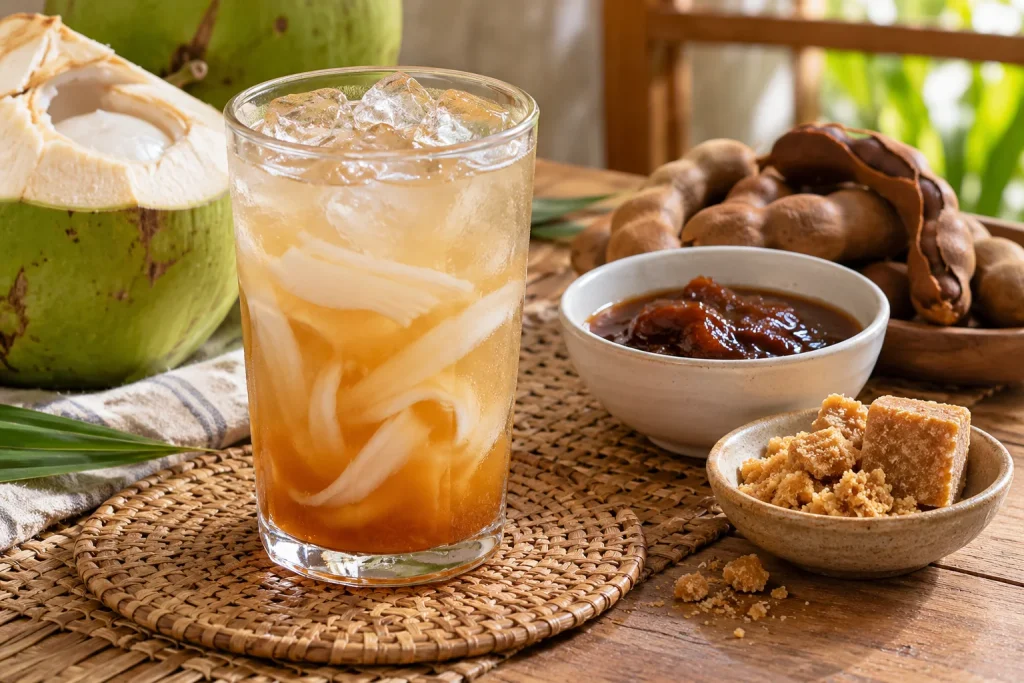

Es Tambring pairs young coconut with tamarind for a drink that lands between sweet and tart. Coconut water keeps it light; tender flesh gives it a little chew; and a tamarind syrup brings a deeper sourness than lime. Sugar balances the edge, while ice makes it a refreshing choice in warm weather.
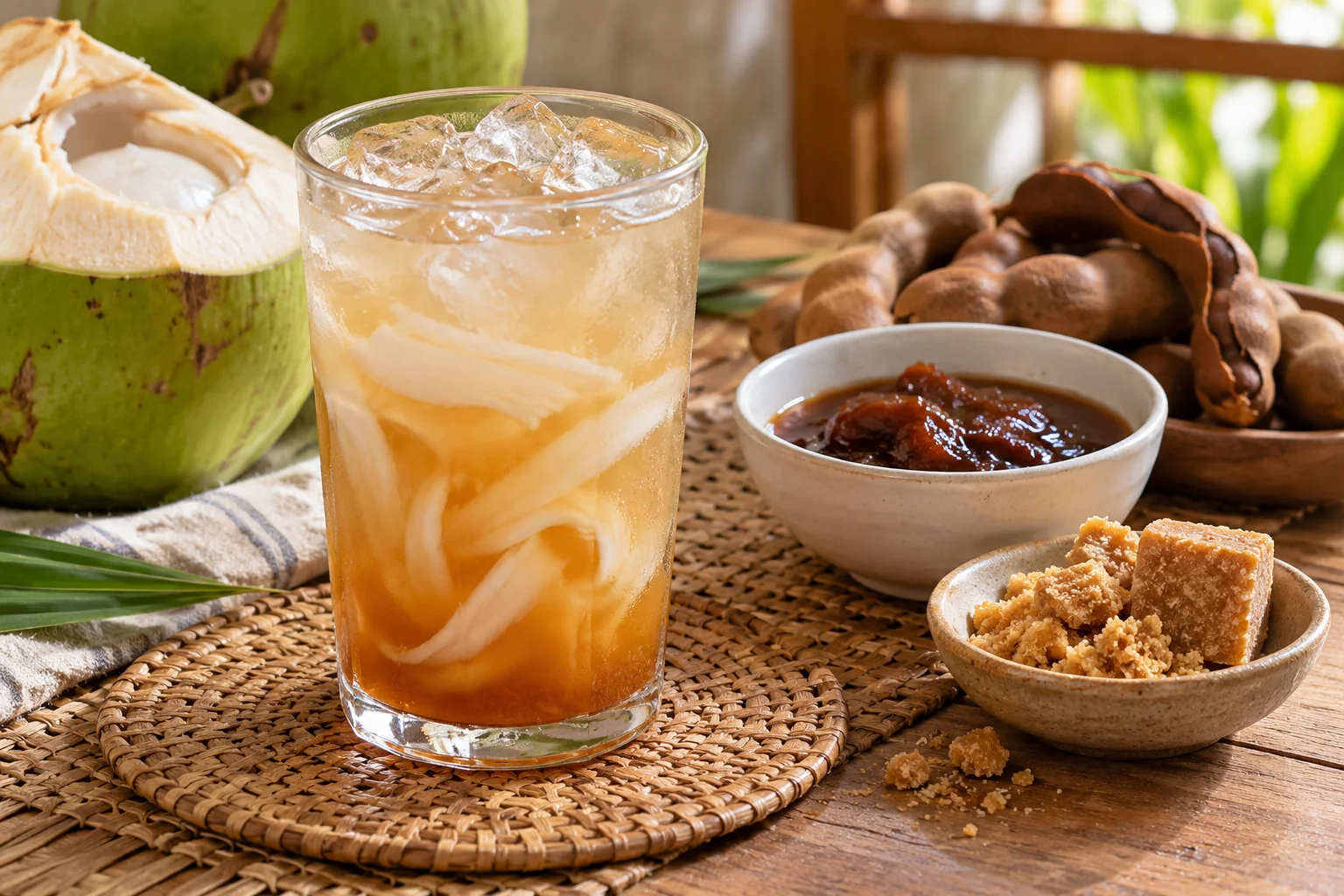
A short ingredient list, with room to vary
Most descriptions of Es Tambring start with young coconut water and flesh, tamarind and a sweetener. Some recipes cook tamarind with sugar and pandan to make a syrup. Others differ in how they handle the souring ingredient or how sweet the finished glass should be. A few published versions include cooked egg white, while many omit it. Ask the seller about ingredients if you have an allergy or dietary restriction.
How it tastes beside other Bali drinks
The tamarind should be prepared so the drink is smooth rather than full of fibrous pieces. Its concentration matters: a little makes the coconut taste brighter, while too much can dominate. Sweetness is best added gradually. The coconut itself changes from fruit to fruit, so a fixed ratio will not guarantee the same result every time.
Try it as a local flavour
Es Tambring is not the same as plain iced coconut water or Es Kuwut. It has a more pronounced tamarind flavour and often fewer mixed toppings. The sour-sweet combination can sit comfortably beside savoury food, especially if the meal is rich, but there is no universal pairing rule. Let your preference guide the level of syrup and ice.
Ask about the recipe before ordering
When ordering, ask whether the drink is made fresh, how sweet it is and whether it contains any ingredient you need to avoid. If only a menu name is given, a quick question can prevent an unwanted surprise. That is especially useful when comparing versions from a market, warung or restaurant.
Es Tambring offers a neat example of how coconut and sour fruit can share a glass. Its recipe is approachable, but a local stall’s version will tell you more than a standardised list of measurements. Notice whether the coconut or tamarind leads, and whether the sweetness is subtle or pronounced.
Some recipes cook the tamarind with sugar and pandan, then strain it into a clear syrup. Others use a simpler tamarind-water mixture. There are also published versions that cook egg white into the syrup; that detail is not universal, but it matters to people avoiding eggs. A quick question about the ingredients is more reliable than judging from the drink’s colour.
At home, let the tamarind mixture cool before combining it with coconut water so the drink stays pleasant and cold. Add the coconut flesh at the end, then pour over ice just before serving. If the glass tastes too sharp, add a little more sweetener; if it is too sweet, dilute with more coconut water. That flexible balance is more useful than assuming every coconut or tamarind tastes the same.
For more drinks built around local ingredients, continue to our balinese drinks guide. If you want to explore how flavour is built in Balinese cooking, see the current details for our Cooking Class Ubud experience.
How Es Tambring Fits Into the Wider Balinese Drinks Framework
When travellers and home cooks look closely at es tambring, the most helpful starting point is seeing where this specific topic sits inside our broader pillar guide on balinese drinks. While the parent overview maps out the full family of concepts, what makes es tambring so distinctively tart? focuses specifically on the practical criteria, kitchen boundaries, and real-world observations that apply only to this narrower question.
Keeping es tambring distinct from general assumptions matters because small details—such as how an ingredient is named at a Gianyar morning market, how heat or moisture affects texture, or how timing is coordinated for a private group—change the outcome on the plate. Rather than relying on generic rules of thumb, evaluating the concrete factors behind es tambring gives you a reliable checklist you can use both in Bali and in your own kitchen at home.
Practical Kitchen Verification and Guest Planning for Es Tambring in Ubud
In a traditional household compound in Ubud, questions surrounding es tambring are resolved through direct sensory checks and clear communication before cooking begins. During a private Cooking Class Ubud session with Wayan’s family, guests work exclusively with their own booking party, which means you can inspect every ingredient on the prep table, ask how local cooks judge ripeness, texture, or seasoning balance, and adjust the workflow to match your pace.
Choosing the right class format also helps you experience es tambring in the way that best matches your travel day. For instance, booking Private Paon Table allows your group to pair up to five confirmed Balinese dishes (alongside freshly pounded Base Genep spice paste) while discussing any dietary adaptations, spice-level preferences, or ingredient questions directly with Wayan before the wok or steamer is heated.
Decision & Observation Checklist for Es Tambring
To help you apply the lessons of es tambring without guesswork, the reference table below breaks down the four practical checkpoints to verify at the market, at the prep table, during cooking, and when adapting the method at home:
| Stage of Preparation | What to Check for Es Tambring | Why It Matters in a Balinese Paon |
|---|---|---|
| 1. Identification & Selection | Confirm the exact local name, variety, or session scope associated with es tambring rather than assuming a generic substitute works identically. | Prevents mixing up look-alike ingredients or mismatched schedule expectations before prep starts. |
| 2. Prep & Mortar Sequence | Separate components that require fine knife slicing (rajang), stone-mortar bruising (ulekan), or advance soaking/steaming. | Controls moisture release and aromatic oil extraction so textures stay crisp or tender as intended. |
| 3. Heat, Timing & Balance | Monitor visual and aromatic cues—colour change, steam aroma, and reduction thickness—while adjusting chili heat separately for your group. | Ensures every guest enjoys the full complexity of Balinese roots and herbs without overwhelming heat. |
| 4. Home Kitchen Adaptation | Record the functional role of each element in es tambring (acidity, starch structure, aromatic oil, or wrapping) before choosing a local equivalent at home. | Allows you to reproduce authentic Ubud flavours in Europe, North America, Australia, or East Asia. |
Comparing Es Tambring with Related Questions in the Same Culinary Series
A frequent point of confusion when researching es tambring is where its boundary meets adjacent questions in the same topic family. If your next question shifts toward rujak yeh kuwud: a savoury coconut drink from buleleng, our companion guide on rujak yeh kuwud addresses that specific angle directly so you can compare both side by side without conflating their rules.
Similarly, readers who want to connect es tambring with broader preparation choices often benefit from reviewing drinks with balinese food, which explores how complementary ingredients, equipment, or scheduling choices interact across a full five-dish Balinese menu.
Frequently Asked Questions About Es Tambring
How do we confirm details about es tambring before our private cooking class in Ubud?
When you send your booking inquiry to Wayan’s Paon via WhatsApp or the booking page, simply mention your interest in es tambring along with your preferred date, session time (morning market class at 08:00, morning kitchen-only class at 10:00, or afternoon/dinner class at 17:00), group size, and Ubud pickup location. Wayan personally reviews every request so that ingredient availability, menu balance, and dietary preferences are confirmed clearly before you arrive.
Can es tambring be adapted for vegetarian, vegan, gluten-free, or allergy-conscious guests?
Yes. Because every session at Wayan’s Paon is 100% private for your group and all spice pastes are ground fresh from whole roots and herbs using filtered potable water, we easily adapt recipes related to es tambring to omit shrimp paste (terasi), candlenuts, peanuts, gluten, or animal products while keeping the authentic Balinese flavour profile intact.
What is the most important takeaway to write in your kitchen notes for es tambring?
Focus on function rather than memorising a rigid formula: note how es tambring contributes to aroma, texture, or timing in the dish, observe the visual cues Wayan demonstrates during prep, and keep the ingredient’s specific role separate from look-alike varieties when you shop at home.